
Uber Is Back in the Fast Lane
Related content
Investors are worried – what lies ahead for Brazil?
In a major surprise, Lula won the second round of Brazil’s presidential election, even though markets had previously expected Flávio Bolsonaro to prevail. Lula’s victory triggered a sharp repricing of Brazilian assets, while sentiment deteriorated further shortly afterwards following an unorthodox proposal calling for a substantial reduction in the central bank’s policy rate. For now, it appears that no such plan is under consideration in Brazil, and the president has reaffirmed his commitment to fiscal discipline. Investors, however, remain largely sceptical. Market participants are waiting for concrete measures, and in the near term the key question for Brazil will be whether the anticipated fiscal measures can stabilise the country’s debt trajectory and how the president will reconcile them with his campaign promises.
Hungary: Headline inflation accelerated in line with expectations, while underlying inflation pressures remained elevated
Hungary's headline inflation rose by 0.4 ppts to 2.0% year-on-year in October, up from 1.6% in September. The data was in line with the market consensus (2.0%) and marginally above our forecast (1.9%). The main reason for the acceleration of headline inflation was the further increase of fuel inflation while processed food prices decreased less than expected mainly due to sugar and confectionaries. However, food prices still significantly contributed to the low inflation in Hungary, so the fact that prices of several agricultural commodities have started to rise in recent months, reinforces our view that food prices will no longer contribute to disinflation in 2027.
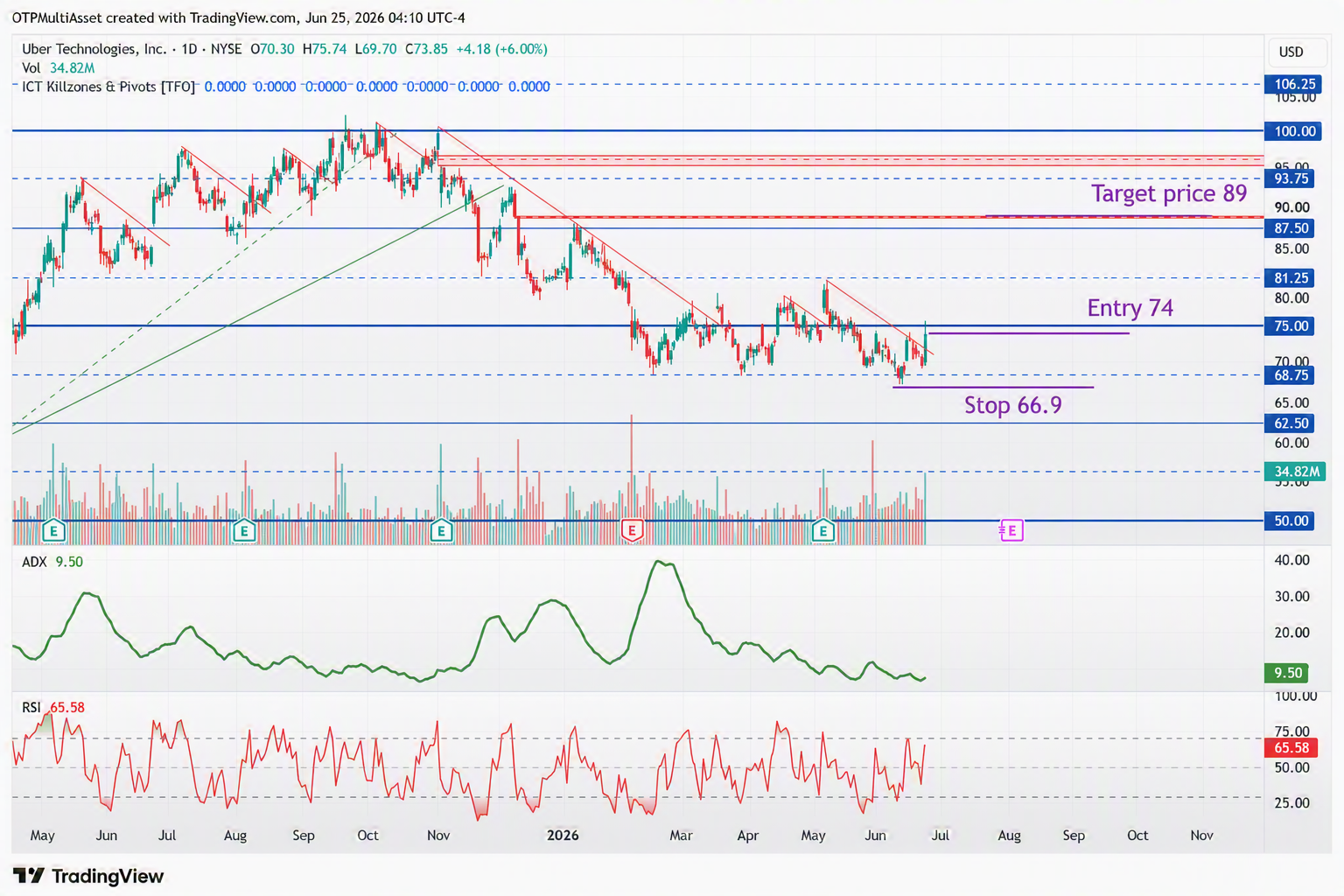
Uber is showing a nice breakout from a technical perspective, which is the basis for our trading idea on the stock. We would like to capitalize on favorable short-term momentum, but we are also positive about the company’s fundamentals. Revenue and profits could rise significantly for the company in the coming years, as both the mobility and delivery sectors are structurally growing markets where Uber is a leading player. In addition, the company could be one of the big winners as autonomous taxis become more widespread.

Positive technical outlook
There was strong buying activity in Uber stock yesterday, which could set the price on a long-term upward trajectory. Accumulation days have appeared regularly in recent months and have become increasingly frequent in the last few weeks. Yesterday’s move also broke a minor downtrend line, opening up room for an upward move. The formation of a higher low also reinforces the likelihood of a reversal.
Based on the nearest previous breakout level, the initial upside potential is around the $89–$90 target price. This offers a favorable risk-reward ratio of approximately 2:1. Accordingly, we are opening a long position today at around $74. Risk management is ensured by a stop-loss order placed below the previous low ($66.9), while we set the target price at $89.
It could be a story of structural growth
We added Uber to our Equity Top Pick List back in January, as the company is the world’s leading mobility platform and an increasingly significant player in the delivery market. It recently attracted attention in connection with the potential acquisition of Delivery Hero. Over the next four years, revenue is expected to grow at ~13% CAGR, while net profit could rise at a much higher rate - nearly 25 percent (CAGR). Moreover, the stock is not overvalued, its 12-month forward P/E ratio is currently below 20.
The first-quarter report was strong: the number of trips increased by 20%, gross orders in the delivery business jumped by 28%, and group-level EBITDA rose by 33%. Yesterday (June 24), newsflow laid the groundwork for the stock price increase: Uber partnered with five new U.S. brands, which will become available on the company’s delivery platform, thereby expanding its offerings. As the range of offerings becomes more extensive, this could attract even more new companies to the app in a self-reinforcing cycle, which could provide further growth momentum in the long term.
The Uber One subscription program has reached 50 million members, and these members now account for half of all gross bookings and orders. This is particularly important for delivery services, as the subscription model increases order frequency, improves customer retention, and can reduce customer acquisition costs in the long run.
Advertising revenue could also become an increasingly important source of income. The company launched this business line around 2022, and by 2025 it could reach an annual level of $1.5 billion, representing approximately 60% growth. The large user base, combined with data-driven and targeted advertising, could offer even greater growth potential.
Another key pillar of the investment story is self-driving mobility services. Uber does not develop self-driving technology or manufacture cars; rather, it provides the platform - that is, a global base of more than 200 million active monthly users - and as a result, it needs to invest much less money in this area. Recently, Uber has formed numerous partnerships with various companies and is launching its self-driving service in an increasing number of markets.
The company’s robotaxis are available in several cities in the U.S., but they are also expanding into Europe. According to the latest reports, the technology is being tested in Zurich and Madrid. In addition, it is already possible to ride in a robotaxi in Dubai and Abu Dhabi. In any case, competition will be fierce, as Waymo and Tesla are serious rivals at present, and it’s not inconceivable that new entrants will emerge. However, we believe that Uber has a significant advantage as the world’s largest mobility platform, allowing it to scale up its service more quickly.
Get more out of your investments!
Global Markets Services
OTP Global Markets offers a broad range of services in the field of local and international money and capital markets.
Read morePrivate Banking Services
Personal care and expertise with OTP Private Banking, along with the knowledge, security, and innovations of a multinational banking group.
Read more