
Uber: Still in the Fast Lane
Related content
US bank shares fell
The third-quarter earnings season in the US has picked up pace following the release of the latest figures from US banks. Based on preliminary expectations, the third quarter is likely to have closed with strong earnings growth for S&P 500 companies, led by the energy and technology sectors. The major US banks have still achieved solid growth on an annual basis, indicating that their operations remain strong, but the pace has clearly slowed in many cases, which has tended to result in negative share price reactions.
Commodities - Technical Analysis
Gold and silver continued their downward trend, bouncing off key levels. Until their downward trends are broken, they will not be able to produce a significant rise. The fall in oil prices reversed from the $87.5 level and began a slight upward movement. Natural gas remained in an uptrend; a significant rise could even occur if it breaks out upwards. The price of copper has become stuck in a wider range, so the oversold and overbought zones may offer more favourable trading opportunities. The falling prices of wheat and corn have reached key support levels; a buying reaction from these levels could present favourable long opportunities with limited risk.
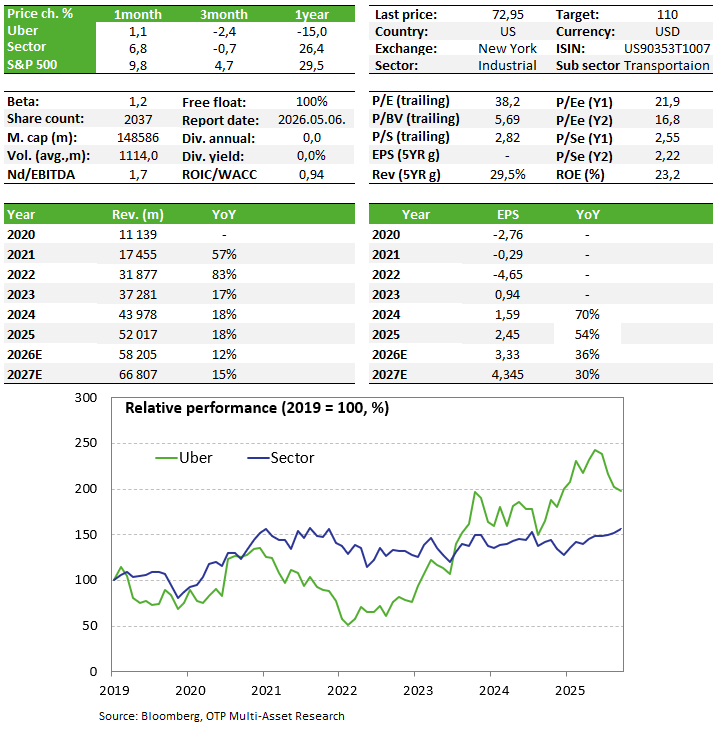
Uber’s quarterly results reinforced the view that the company’s growth and profitability story remains firmly intact. Investors focused primarily on stronger-than-expected gross bookings, robust trip growth, continued adjusted EBITDA expansion, and favorable guidance for the second quarter. The key message from the report is that Uber is no longer merely a mobility platform: the delivery business is increasingly emerging as a second meaningful profit pillar, while autonomous vehicles may represent a longer-term growth opportunity.
Uber shares remain on our Equity Top pick List.
Earnings Report
Uber’s Q1 report carried an overall positive message for equity investors. Although revenue came in slightly below consensus, gross bookings exceeded forecasts, trips increased by 20%, and adjusted EBITDA rose by 33%. Management also raised its gross bookings guidance for the current quarter. The share price reacted positively to the news.
In the Mobility segment, gross bookings increased by 25% to USD 26.4 billion. Revenue, however, rose by only 5% to USD 6.8 billion, falling short of the USD 7.1 billion consensus. That said, the company indicated that much of the divergence between gross bookings and revenue was attributable to a business model changes and possible adjustments in the take-rate structure. This interpretation is supported by the fact that segment operating profit increased by 28% to USD 2 billion, indicating that profitability remains very strong. If the company were facing genuine pricing pressure or a demand issue, operating profit would likely have been materially weaker as well.
In the Delivery segment, gross bookings increased by 28% to USD 26 billion, while revenue grew even faster, rising 34% to USD 5.07 billion. Operating profit expanded by 43% to USD 961 million. This is strategically important, as the Uber investment case was previously predominantly centered on Mobility, whereas Delivery now represents a demand pillar of almost comparable scale. Margins are admittedly lower in this business, but at the group level there is no evidence of profitability deterioration — quite the opposite. Delivery growth was particularly strong in Australia, Japan, and the United Kingdom, suggesting that the growth story is not solely dependent on the U.S. consumer, but is increasingly geographically diversified.
Another important driver has been Uber One. The membership program reached 50 million members, and members now account for roughly half of gross bookings and orders. This is especially important for Delivery, as the subscription model increases order frequency, improves customer retention, and may reduce customer acquisition costs over the longer term. There was limited new information regarding autonomous driving. The company had previously confirmed that it aims to launch in 15 new cities with various partners by the end of this year. Target markets include London, Zurich, Madrid, Munich, Los Angeles, and Hong Kong.
Investment story
- Uber is the world’s largest mobility platform, with 200 million monthly active users, and has already demonstrated that it can generate sustainable free cash flow while continuing to grow. Both Mobility and Delivery operate in structurally growing markets, where Uber holds a leading global position.
- The Uber One program increases user engagement and helps stabilize revenue. Advertising revenue is already at a multi-billion-dollar run-rate, generates high margins, and still offers meaningful additional growth potential.
- Uber is not developing autonomous-driving technology in-house; rather, it provides the demand layer and the platform. As a result, it assumes less capital intensity and technological risk than many competitors. If robotaxis become economically viable, Uber could be one of the most scalable beneficiaries.
- Main risks: The core business could be affected by weaker demand in the event of a slowing economy and softer consumer spending. The adoption of autonomous taxis may take longer than expected, while intense competition could also pressure profitability. Regulatory or safety-related issues could hinder the broader rollout of autonomous vehicles.
Get more out of your investments!
Global Markets Services
OTP Global Markets offers a broad range of services in the field of local and international money and capital markets.
Read morePrivate Banking Services
Personal care and expertise with OTP Private Banking, along with the knowledge, security, and innovations of a multinational banking group.
Read more