
Disney: Execution Risks and Fading Catalysts
Related content
US bank shares fell
The third-quarter earnings season in the US has picked up pace following the release of the latest figures from US banks. Based on preliminary expectations, the third quarter is likely to have closed with strong earnings growth for S&P 500 companies, led by the energy and technology sectors. The major US banks have still achieved solid growth on an annual basis, indicating that their operations remain strong, but the pace has clearly slowed in many cases, which has tended to result in negative share price reactions.
Commodities - Technical Analysis
Gold and silver continued their downward trend, bouncing off key levels. Until their downward trends are broken, they will not be able to produce a significant rise. The fall in oil prices reversed from the $87.5 level and began a slight upward movement. Natural gas remained in an uptrend; a significant rise could even occur if it breaks out upwards. The price of copper has become stuck in a wider range, so the oversold and overbought zones may offer more favourable trading opportunities. The falling prices of wheat and corn have reached key support levels; a buying reaction from these levels could present favourable long opportunities with limited risk.
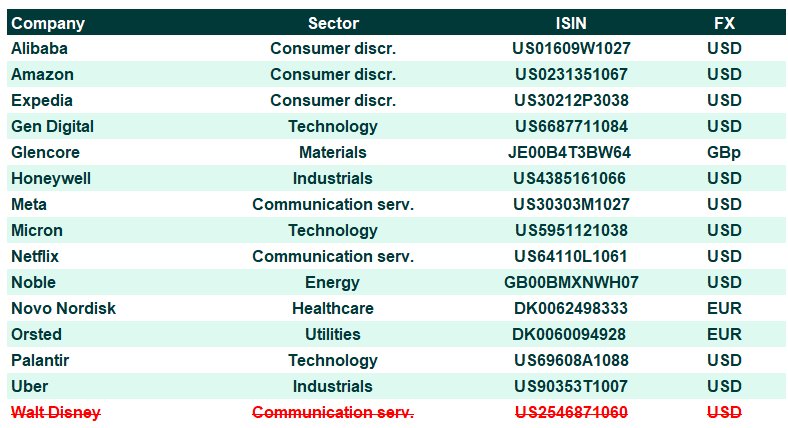
After two and a half years, Disney is being removed from our Equity Top Pick List. While the company remains one of the strongest global brands in the media sector, it has not managed in recent years to establish a growth and profitability trajectory that would meaningfully support a sustained share price appreciation. In streaming, Disney has fallen behind Netflix; the structural decline of linear television continues to be a drag on results; and the competitive landscape facing ESPN presents additional risks. We currently see no short time catalyst that would justify keeping the stock on our list.
We have been covering Disney for two and a half years and included the stock in our Equity Top Pick List throughout this period. However, during this time the share price has failed to generate any meaningful upside, instead trading within a broad range. As we do not currently see a catalyst that could change this picture over the longer term, we have decided to remove the stock from our list, ahead of next week’s quarterly earnings release. Within the sector, our preference currently lies with Netflix, which we added to our list in mid-April.
Disney has yet to achieve several of the targets that previously underpinned our more optimistic outlook. Although the company’s streaming business has recently turned profitable after years of heavy losses, it still lags well behind Netflix in terms of subscriber scale and remains significantly less profitable.
At Disney, the entertainment segment includes streaming alongside linear television and the film studio, and this is the area that is most directly comparable to Netflix. For fiscal year 2026, analysts expect Disney to generate an operating margin of around 11–12% in this segment, versus 31.5% at Netflix. Even the profitability of Disney’s sports segment (18%) and experiences segment (28%) falls well short of that of its largest competitor.
In addition, the company is facing a CEO transition, with Josh D’Amaro set to take over from Bob Iger. The last time Disney went through a CEO change, the outcome was far from successful, ultimately forcing the company to bring Iger back in to restore order. As a result, there is an execution risk around how effectively D’Amaro will be able to lead the company.
Linear television is in structural decline, and while it remains a significant profit contributor for Disney today, it is increasingly becoming a burden over time. It would have been favorable if Disney had been able to divest this division in recent years; however, despite having opportunities to do so, the company was ultimately unable to complete a sale.
In sports, the shift toward streaming offers some potential, but the coming years are likely to bring intensified competition for broadcasting rights in the U.S., particularly from large technology companies. This is expected to push costs higher and poses additional profitability challenges for players such as Disney via ESPN. While Netflix is also increasingly active in sports content, its spending in this area remains far below that of ESPN.
We are not suggesting that Disney is a bad company. It owns one of the strongest brands in the media sector, operates a traditional film studio and world-class theme parks, and clearly has the assets needed to operate successfully. However, recent experience does not suggest that management has been able to create meaningful shareholder value—the share price is currently at roughly the same level as in 2015—and the competitive challenges posed by rivals appear, in our view, to be too significant at this time.
Get more out of your investments!
Global Markets Services
OTP Global Markets offers a broad range of services in the field of local and international money and capital markets.
Read morePrivate Banking Services
Personal care and expertise with OTP Private Banking, along with the knowledge, security, and innovations of a multinational banking group.
Read more