
Despite the drop in its stock price, Uber's story remains intact
Related content
Commodities - Technical Analysis
Gold and silver continued their downward trend, bouncing off key levels. Until their downward trends are broken, they will not be able to produce a significant rise. The fall in oil prices reversed from the $87.5 level and began a slight upward movement. Natural gas remained in an uptrend; a significant rise could even occur if it breaks out upwards. The price of copper has become stuck in a wider range, so the oversold and overbought zones may offer more favourable trading opportunities. The falling prices of wheat and corn have reached key support levels; a buying reaction from these levels could present favourable long opportunities with limited risk.
Our Fixed Income Top Picks
The rise in yields seen over recent months has created a new environment across global fixed-income markets. With U.S. 10-year Treasury yields above 5%, increasing fiscal concerns in France, and corporate credit spreads remaining historically tight, the importance of selection has increased. In our latest top pick list, we highlight bonds that may offer attractive risk-adjusted return potential as part of a suitably diversified portfolio.
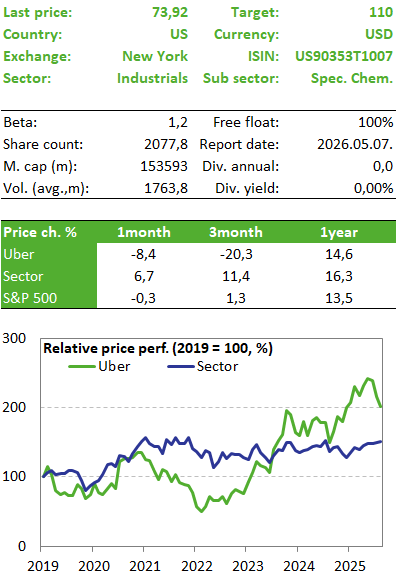
Uber’s quarterly earnings report painted a mixed picture, prompting a drop in its stock price. Although revenue and gross bookings exceeded expectations, earnings fell short of consensus, and management issued a more cautious forecast for the current quarter. We believe the long-term investment story remains intact, so we are keeping the stock on our Equity Top Pick List.
Quarterly Report
Uber’s stock price fell in response to its quarterly report after the company missed profit expectations and forecast slightly weaker-than-expected profits for the current quarter. Uber reported EPS of $0.71 in the fourth quarter, falling short of the $0.78 consensus, but revenue ($14.4 billion) exceeded expectations ($14.32 billion). Gross bookings rose 22% year-over-year to $54.1 billion, driven by an 18% increase in monthly active users and a 3% rise in trips per user.
Management forecasts earnings per share of $0.65–$0.72 for Q1 2026, which falls short of the $0.75 consensus. It expects a 17–21% increase in gross bookings. In the fourth quarter of last year, the delivery business was the catalyst, generating 30% growth, while the mobility segment also saw 19% expansion. Deliveries performed exceptionally well thanks to new partnerships, and we can even speak of global expansion here, as new agreements were signed not only in the U.S. but also in Canada, Japan, Poland, and Australia.
Profits were negatively impacted by the company recording a one-time $1.6 billion write-down on its equity investments, as well as paying higher taxes during the quarter and spending more on acquiring new users. In Q4 2025, Uber registered 202 million active users, an 18 percent increase year-over-year. The company’s relatively small transportation segment remained stagnant, but at least it is no longer generating a loss at the EBITDA level. Overall, the company’s core operations appear strong; while there is some short-term pressure on profitability due to growth, no major issues are apparent.
Of course, the topic of self-driving cars also came up in connection with the earnings call, and the CEO once again reaffirmed his commitment to this direction. Uber positions itself not as a manufacturer of autonomous vehicles, but rather as a self-driving platform and fleet manager that has already formed partnerships with several companies, as we detailed in our previous analysis.
In Atlanta and Austin, where Uber launched self-driving vehicles in 2025, the total number of rides increased even for traditional services; therefore, the company expects that self-driving technology will expand the mobility market rather than completely replace existing taxi services. The CEO also mentioned that by the end of 2026, Uber could launch self-driving vehicles in up to 15 cities worldwide. By 2029, they aim to become the world’s largest self-driving service platform. The next target cities include Houston, Los Angeles, and San Francisco, as well as London, Munich, Hong Kong, Zurich, and Madrid.
Of course, the CEO did caution that self-driving vehicles will likely continue to account for only a very small portion of their services for many years to come, given the technological and regulatory barriers hindering their wider adoption. We view this conservative approach as a positive sign.
Investment thesis
- Uber is the world’s largest mobility platform, with 200 million monthly active users, and has already demonstrated its ability to generate sustainable free cash flow even while growing. Both mobility and delivery are structurally growing markets in which Uber holds a leading global position.
- The Uber One subscription boosts user engagement and stabilizes revenue. Revenue from advertising is already in the billions of dollars and generates high margins, and there is still further growth potential.
- Uber isn’t developing self-driving technology; instead, it provides the demand side and the platform, so it takes on less capital and risk than its rivals. If robotaxis become economically viable, Uber could be one of the fastest-scaling winners.
Risks
- Core operations may be affected by declining demand due to the slowing economy and falling consumption.
- The adaptation of self-driving taxis could take a long time, and intense competition could also undermine profitability.
- Regulatory or safety issues may hinder the widespread adoption of self-driving vehicles.
Get more out of your investments!
Global Markets Services
OTP Global Markets offers a broad range of services in the field of local and international money and capital markets.
Read morePrivate Banking Services
Personal care and expertise with OTP Private Banking, along with the knowledge, security, and innovations of a multinational banking group.
Read more