
Could the momentum return in the semiconductors?
Related content
Our Fixed Income Top Picks
The rise in yields seen over recent months has created a new environment across global fixed-income markets. With U.S. 10-year Treasury yields above 5%, increasing fiscal concerns in France, and corporate credit spreads remaining historically tight, the importance of selection has increased. In our latest top pick list, we highlight bonds that may offer attractive risk-adjusted return potential as part of a suitably diversified portfolio.
Cybersecurity is essential in the age of AI
Anthropic’s Mythos model marked a turning point for the cybersecurity sector after companies realized they were ill-prepared, from a cybersecurity perspective, to face the new challenges posed by AI. The AI security concerns that have surfaced in recent months may further reinforce this trend, as the precautions needed to monitor and control these models could also contribute to an increase in security spending. These positive developments are reflected not only in improved investor sentiment but also in rising revenue and profit expectations, which attracted significant capital inflows into the sector in the third quarter. These trends are likely to persist in the coming quarters.
The semiconductor sector has had a challenging quarter, with its performance in recent months lagging behind improvements in underlying fundamentals, even as AI-driven demand remained exceptionally strong. The accelerating adoption of AI by enterprises and the proliferation of AI agents are significantly increasing the demand for computing capacity, which points to a further surge in cloud services and data center investments. Given current supply constraints, record-high backlogs, and higher-than-expected investment needs, we expect further upward revisions to earnings forecasts in the semiconductor industry. Nevertheless, the sector’s valuation appears favorable from a historical perspective, which, in our view, could result in a more attractive risk-return profile in the coming months.
According to the Ramp AI index, the percentage of companies using subscription-based AI services has now exceeded 56%, up from 7.5% at the beginning of 2023, indicating the rapid adoption of artificial intelligence in the corporate sector. Not only is the number of companies adopting AI growing rapidly, but so is the intensity with which they use these solutions. With the emergence of AI agents, an increasing number of business processes can be automated, as these systems are capable of independently performing even more complex tasks. According to Anthropic, an AI agent can use up to 15 times more tokens than a traditional chatbot, which could lead to exponential growth in token usage. This, in turn, generates strong demand for computing capacity, which ultimately translates into growth in cloud service revenues for major technology companies.
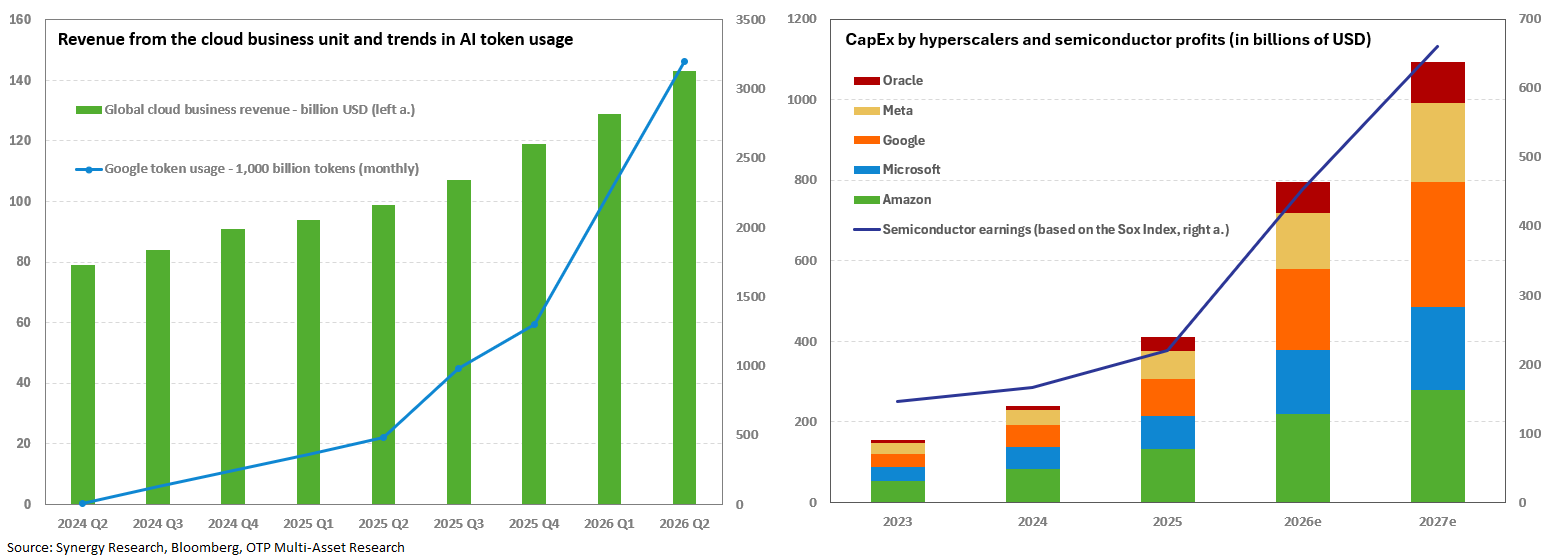
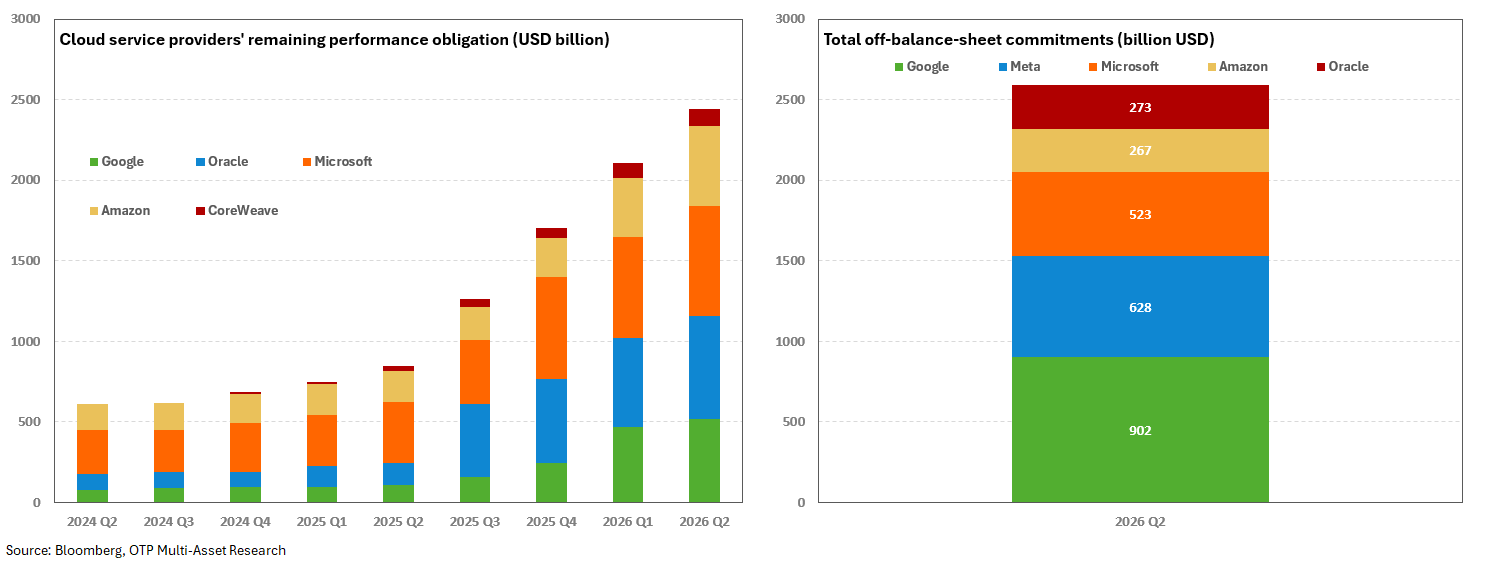
To meet growing demand, hyperscalers continue to ramp up their data center investments at a remarkable pace, which supports demand for chips and, overall, translates into revenue and profit growth for semiconductor companies. Strong demand is evident across all segments of the AI value chain, and based on current trends, no significant slowdown is expected in the next 1 to 1.5 years. Major U.S. technology companies have a backlog of approximately $2,500 billion in remaining performance obligation for their cloud services, the fulfillment of which may require significant additional investment. In addition, they have more than $2,600 billion in off-balance-sheet commitments, which are primarily related to future chip purchases from semiconductor companies.
Growth in the cloud sector is currently constrained by supply , and we expect this to persist through 2027 despite the acceleration of data center investments. Consensus analyst estimates for hyperscalers’ 2027 capex currently stand at around $1,100 billion; however, in our view, there could be as much as an additional ~15% upside potential due to strong demand for computing capacity, a growing backlog, and rising prices for infrastructure components. Based on all this, we expect further upward revisions to earnings expectations for the semiconductor sector in the coming months.
Nevertheless, stock prices have not fully reflected the improvement in fundamentals in recent months, which could result in a more attractive entry point for chip manufacturers from a valuation perspective. Based on current analyst estimates, the nearly 100% profit growth rate could be sustained over the next 1 to 1.5 years, while margins may continue to improve next year. In this context, the 12-month forward P/E ratio of less than 20 appears favorable, especially given that the average forward P/E ratio over the past three years has been around 24.
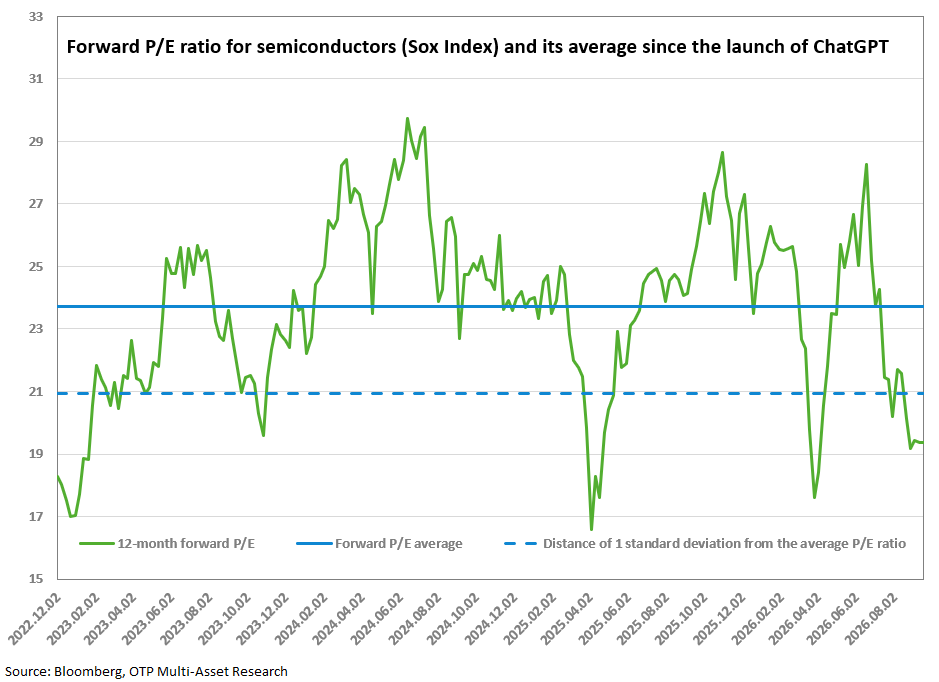
Although a certain degree of discount is justified due to higher risks compared to previous years, the current valuation discount of over 20% appears excessive. In our view, this is primarily the result of the more negative newsflow in recent months and the unfavorable market environment. An improvement in investor sentiment could lead to a positive revaluation in the sector, which, combined with positive EPS revisions, could support a rise in stock prices for the remainder of the year.
Risks
In our view, the greatest risk may come from the financing side, as large technology companies are already allocating nearly all of their free cash flow to investments this year. As a result, further growth in investment activity may increasingly rely on external capital raising, while transactions raising concerns about cross-financing have also become more frequent in recent months. For this reason, the AI investment cycle may become more sensitive to changes in market liquidity conditions and the yield environment, which — due to rising risks — could justify a slight discount compared to valuation levels seen in previous years. At the same time, we believe that, given current pricing, there may still be room for appreciation.
Pressure to slow the pace of AI development could also come from regulators, although we currently consider this unlikely. However, such a turn of events could have a significant negative impact on semiconductor stocks, as we noted in our previous analysis. In our view, this would require a security incident causing significant damage to occur in the coming quarters, which would push policymakers toward stricter regulation. At present, however, the likelihood of this is limited, as the U.S. leadership has no interest in substantially slowing down development in the AI race with China.
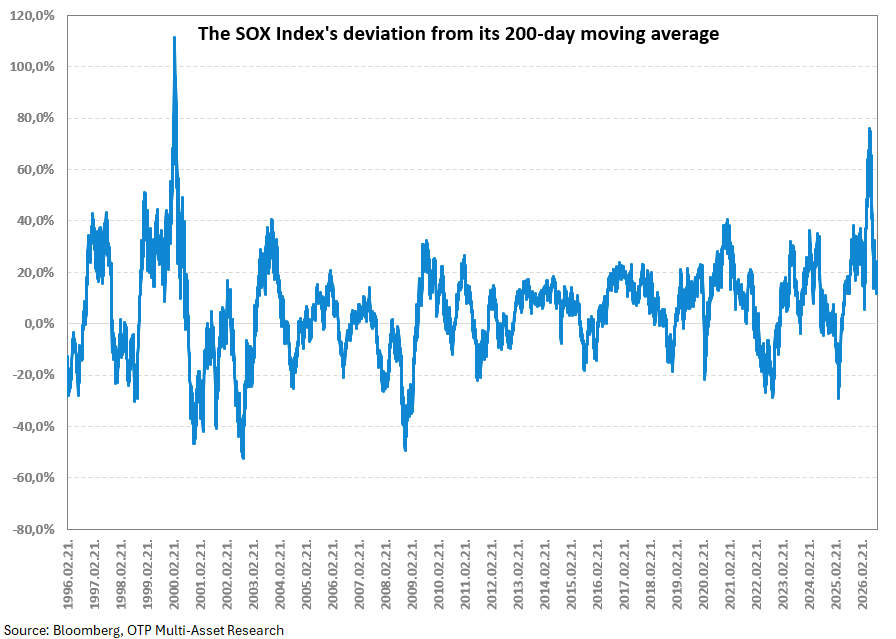
In addition, growing public opposition to data center construction, as well as the resulting delays in permitting and construction, could also slow growth. Another risk stems from the shortage of certain components of data center infrastructure, which could create bottlenecks in capacity expansion and, in turn, dampen demand for semiconductor products. Despite these risks, the reduction in positioning observed since the end of the second quarter, combined with the continued strength of the fundamental backdrop, suggests a more favorable risk-return profile for the remainder of the year, in our view.
Get more out of your investments!
Global Markets Services
OTP Global Markets offers a broad range of services in the field of local and international money and capital markets.
Read morePrivate Banking Services
Personal care and expertise with OTP Private Banking, along with the knowledge, security, and innovations of a multinational banking group.
Read more