
Is a new era dawning in the development of artificial intelligence?
Related content
Hungary: Despite the lower-than-expected headline inflation data the picture is not as rosy as it first appears
Hungary's headline inflation increased to 1.6% year-on-year in September from 1.3% in August. The published data was lower than the consensus and our forecast (both 1.8%). The lower-than-expected inflation was due to above expectation core inflation but a bigger than expected decline in food prices and a decrease in administered prices.
Commodities - Technical Analysis
Gold and silver continued their correction and even dropped below key support levels, so it’s best to postpone buying for now. The price of oil has narrowed significantly between the $87.50 level and the trend line, so any significant movement will likely require a breakout from this zone. Natural gas has retested its uptrend line, but buyers continue to show strength.Copper appears to be developing a broader trading range, making oversold and overbought zones potentially more attractive for trading opportunities. Wheat and corn continue to trade in a correction phase, while moving closer and closer to their key support levels.
In recent weeks, concerns about the security risks of AI developments have once again taken center stage. Several leading industry players have come out in favor of a more unified security framework and a slower pace of development. Although U.S. policymakers have so far rejected unilateral restrictions due to the technological competition with China, the debate may already be affecting players in the AI ecosystem. These developments are creating uncertainty regarding future growth rates, which could put pressure on the semiconductor industry in the short term, while providing temporary relief for the software sector. At the same time, in our view, the impact on long-term fundamentals is likely to be limited for now. Meanwhile, cybersecurity companies stand to benefit most from the increased focus on security.
In recent weeks, concerns about the security risks posed by AI have intensified after Jacob Coxon, a former researcher at Anthropic, wrote about the dangers the technology poses to humans following his departure from the company. These fears are shared by several researchers currently working at leading AI development companies. Although researchers have previously urged that the pace of development be curtailed, this past summer more than 1,100 AI researchers submitted a joint open letter to the U.S. government on the subject; however, there has never before been such a high degree of consensus among leading figures in the field as there is now.
Last weekend, Anthropic CEO Dario Amodei published a post calling for a slowdown in the pace of development and urging the creation of a unified safety regulatory framework. The initiative has also received support from leading AI developers, including Sam Altman (OpenAI), Elon Musk (xAI), and Demis Hassabis (Google DeepMind). In addition, Sam Altman indicated that his company does not plan to go public this year, as ensuring safe development is currently the top priority.
Although the announcement sounds positive from a corporate social responsibility perspective, there are likely other factors at play behind the scenes. The unfavorable market environment, negative investor sentiment toward AI and related investments, and Anthropic’s more favorable growth momentum may all have contributed to the decision. In fact, Anthropic has already surpassed OpenAI this year in both revenue and enterprise adoption.
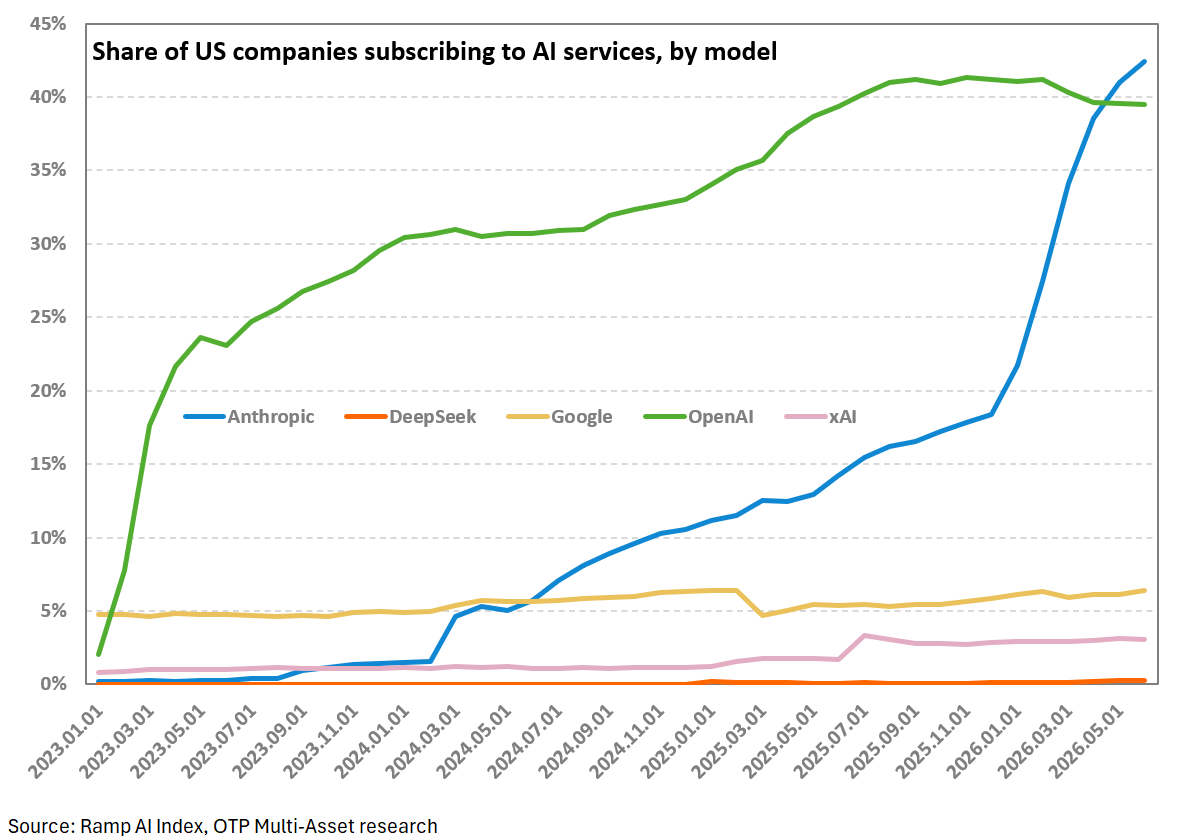
It is an interesting question, however, why — despite previous statements calling for regulation — Anthropic’s leadership has come forward now to emphasize the need for stricter regulation, just as the company prepares to go public in a few weeks. At first glance, calling for a slowdown in growth does not seem like a message investors would want to hear ahead of an IPO; however, it is possible that the real goal of regulation is to limit competition within the industry.
Leading AI development companies have the influence to significantly shape such regulations, which could even be designed to align with their own interests. Safety standards may also be introduced that require significant resources to comply with, thereby making it more difficult for smaller AI labs and Chinese players. In the longer term, the structure of the AI models market—which currently resembles a competitive market—may shift toward an oligopolistic model, which could strengthen the pricing power of dominant players and, in turn, improve their profitability.
The strictest restriction
At the same time, the most important question is exactly what such regulations would look like. There are several possible scenarios, the strictest of which would be a temporary halt to development until a comprehensive safety framework is established. In this case, a significant portion of the computing capacity currently used to train AI models would be freed up, which could then be reallocated to the inference phase — that is, the actual use of the models. This sudden surge in excess capacity could even lead to an oversupply in the market, even if the adoption of current AI models by businesses remains unabated. This could put pressure on data center providers’ margins and might even lead them to scale back their investment plans.
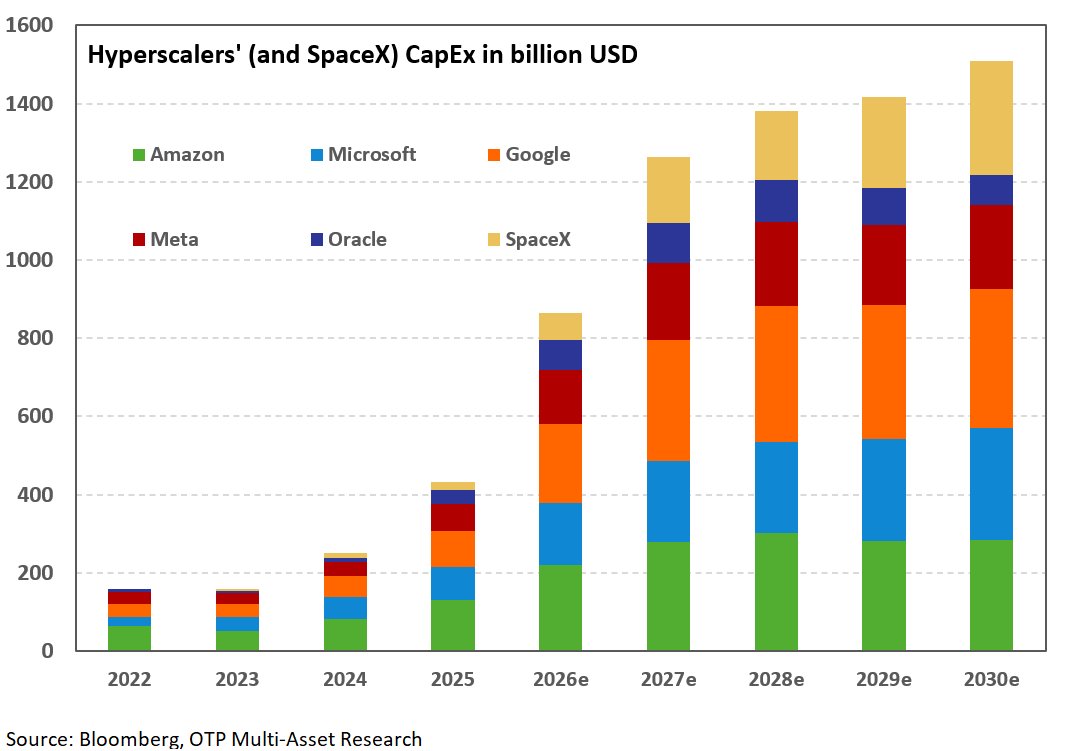
The biggest losers in this scenario could be neo-cloud service providers and memory chip manufacturers, whose margins are particularly sensitive to changes in supply-and-demand conditions due to the lack of wide economic moats. At the same time, the entire semiconductor sector would likely come under significant pressure as a result of the repricing of growth prospects. In contrast, software companies could be the biggest winners, as they would be less likely to face the risk of their services being replaced in the near future in the absence of more advanced AI models. At the same time, this scenario is currently unlikely, as there appears to be no actor — neither among AI developers nor among policymakers — who would have an interest in completely halting.
What AI developers are calling for
In his post, Dario Amodei argues that development should continue, provided that appropriate safeguards are in place. For example, independent evaluators with employee-level access should verify that the models have the necessary safety guardrails. In this case, the impact on short-term growth prospects — that is, those for the next year and a half — is expected to be limited, as most players have already secured a significant portion of the necessary computing capacity. Regulation could instead lead to a repricing of growth expectations beyond 2028. At the same time, long lead times (for delivery and deployment) are expected to discourage customers from giving up their demand for scarce computing capacity, especially since competitors would likely quickly snap up any capacity that becomes available.
In some cases, security constraints may even increase the demand for computing capacity if evaluation, monitoring, and other security processes increase the computational requirements of individual workloads. For example, it is conceivable that, when solving a task, the model would first be run in an isolated environment to verify its safety before being granted access to production systems. However, this would result in higher processor, memory, and infrastructure requirements. Currently, due to the lack of detail regarding the specific security mechanisms, it is difficult to assess exactly what impact this scenario would have on semiconductor companies, but overall, it can be considered largely neutral.
What politicians want
Following the events over the weekend, Donald Trump indicated that he does not support central restrictions on AI development, saying that the United States currently has an advantage over China in this area and that it is crucial to maintain that advantage. Scott Bessent made a similar point last week, stating that nothing else matters if China wins the AI race. In light of this, we can hardly expect unilateral restrictions; at most, a coordinated slowdown in development with China is conceivable. It remains to be seen, however, whether the parties would abide by such an agreement or trust that the other party would do the same.
In our view, the introduction of comprehensive regulations in the future would require a security incident resulting in significant damage, which would force decision-makers to move in that direction; however, until then, we see little chance of such a scenario unfolding. Thus, this outcome would entail relatively little change compared to the current situation. Since, as we have shown, there are several possible scenarios, this in itself creates uncertainty, which the market fundamentally views as a risk. For this reason, the stocks of AI hardware manufacturers may remain under pressure in the short term, as market reactions at the beginning of last week have shown.
The potential winners
It is difficult to assess exactly what direction the slowdown in the pace of AI development might take, but the potential winners are already beginning to emerge. In the short term, the software sector can breathe a sigh of relief, as the slowdown in the development of model capabilities may push back the date when AI could substantially replace certain software services. This could give companies time to adapt. In the longer term, however, the introduction and use of AI tools will likely continue to take priority in the allocation of IT budgets, while spending on traditional software may remain more subdued in the coming quarters.
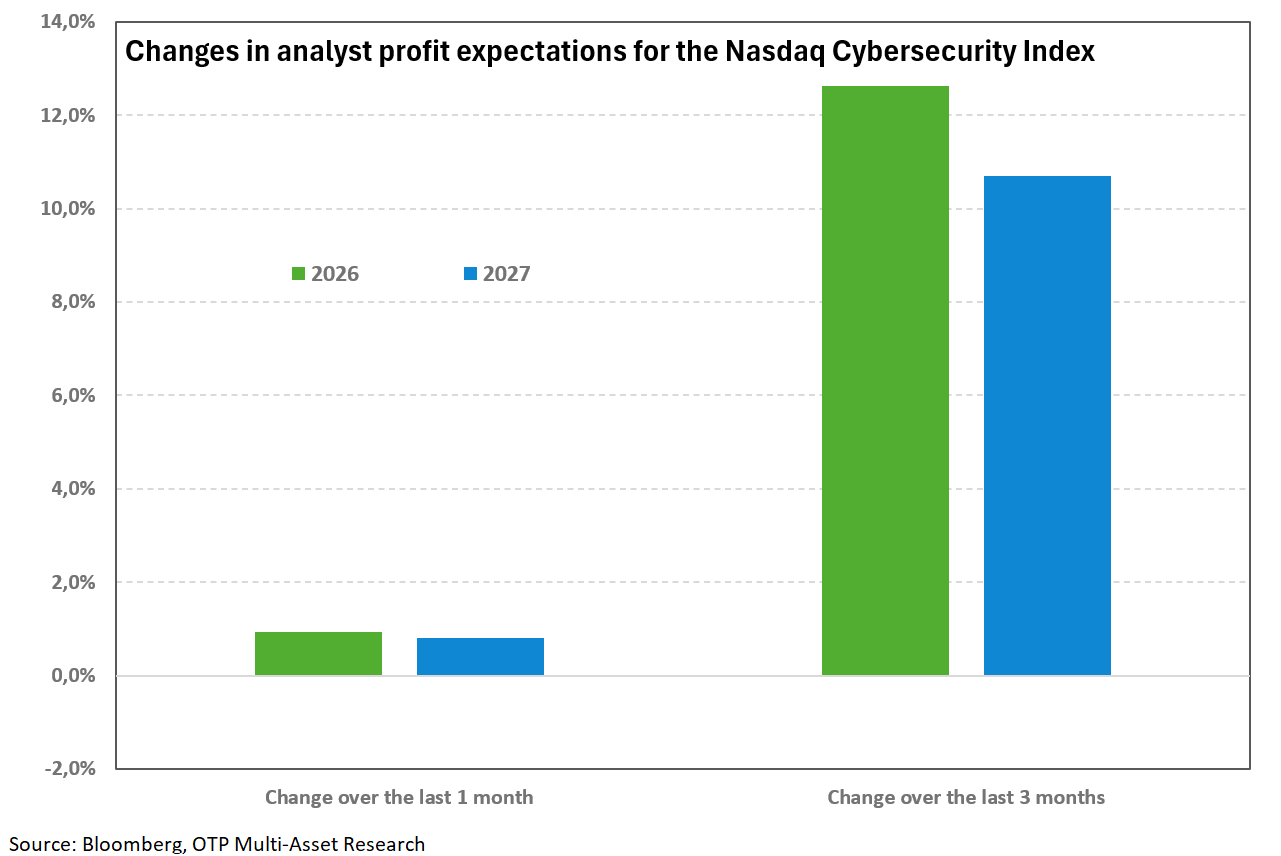
At the same time, within the software sector, the growing significance of security risks related to artificial intelligence could boost demand for cybersecurity companies, meaning the industry could emerge as one of the biggest winners from last weekend’s events, as reflected in market reactions earlier last week. Monitoring AI agents may become an increasingly important corporate priority, as the proliferation of autonomous systems increases the attack surface and the risk of unauthorized operations. To mitigate these risks, demand may grow for solutions that provide transparency, real-time monitoring, and independent auditing, which could drive upward revisions to cybersecurity companies’ revenue and profit expectations in the short and medium term.
Get more out of your investments!
Global Markets Services
OTP Global Markets offers a broad range of services in the field of local and international money and capital markets.
Read morePrivate Banking Services
Personal care and expertise with OTP Private Banking, along with the knowledge, security, and innovations of a multinational banking group.
Read more