
The Decade of Robotics May Be Ahead
Related content
US bank shares fell
The third-quarter earnings season in the US has picked up pace following the release of the latest figures from US banks. Based on preliminary expectations, the third quarter is likely to have closed with strong earnings growth for S&P 500 companies, led by the energy and technology sectors. The major US banks have still achieved solid growth on an annual basis, indicating that their operations remain strong, but the pace has clearly slowed in many cases, which has tended to result in negative share price reactions.
Commodities - Technical Analysis
Gold and silver continued their downward trend, bouncing off key levels. Until their downward trends are broken, they will not be able to produce a significant rise. The fall in oil prices reversed from the $87.5 level and began a slight upward movement. Natural gas remained in an uptrend; a significant rise could even occur if it breaks out upwards. The price of copper has become stuck in a wider range, so the oversold and overbought zones may offer more favourable trading opportunities. The falling prices of wheat and corn have reached key support levels; a buying reaction from these levels could present favourable long opportunities with limited risk.
AI is not only transforming the world of software, but is also increasingly making its way into the physical economy. One of the biggest beneficiaries of this trend could be robotics, where industrial automation, collaborative robots, autonomous mobile systems and humanoid developments are all creating new growth opportunities at the same time. Labour shortages, wage inflation, demographic pressure and the race for efficiency are already accelerating the adoption of robots, while AI is equipping these systems with new capabilities. Although the sector remains sensitive to economic cycles, the long-term investment case is becoming increasingly compelling: robotisation could become one of the defining megatrends of the coming years.
Over the next few years, robotisation is likely to reshape the economy to a significant extent, driven by advances in artificial intelligence. These changes could create an environment in which the sector becomes one of the key investment stories of the years ahead. Various types of industrial robots have already been present for decades in factories and logistics centres. Their manufacturers have performed particularly well on the stock market in recent years, as the number of industrial robots being put into operation continues to rise year after year.
Globally, the number of robots installed has exceeded 500,000 units annually in each of the past four years, according to the International Federation of Robotics. The industrial robotics market may have been worth close to USD 50 billion in 2025, with further expansion still expected from here. Several research houses believe the market could reach the USD 100 billion mark by 2030. This figure includes not only hardware, but also the software solutions used to control robots.
As we also noted in our previous analysis, the most important structural driver behind rising demand for robots is labour shortages and increasing wage costs. It is no coincidence that robot adoption is expanding most rapidly in Japan, South Korea, Germany and China, where demographic challenges are already significant.
Based on installations, China is the largest industrial robotics market, accounting for roughly 54% of the global market, followed by Japan and the United States. Despite the supportive long-term trends, risks remain. The sector is sensitive to macroeconomic cycles, as most robots are used in manufacturing and logistics. As a result, there may be downturns in the short and medium term.
The key players
At present, five major companies operate in the industry and together control around 30% of the total market. These are Switzerland’s ABB — which, however, sold its robotics division to SoftBank at the end of last year, while continuing to be active in automation systems — Japan’s Fanuc and Yaskawa, US-based Teradyne, and Germany’s Kuka, an unlisted company under Chinese ownership.
In addition to these players, of course, many smaller companies are also active in the sector, although we will not discuss them in detail here. Amazon is also worth mentioning, even though it is not a conventional market participant, as it uses its internally developed robots only within its own operations — albeit in very significant numbers. Since 2012, Amazon has deployed more than 1 million robots, making its logistics operations more efficient and thereby becoming one of the world’s largest robot operators.
Types of industrial robots
- In industrial robotics, six-axis robotic arms are the most widespread and versatile tools. The six axes refer to six rotary joints, which allow the robotic arm to reach virtually any point in space and position the end effector — such as a gripper or welding torch — at the desired angle. These are high-payload systems suitable for welding, assembly, painting, machine tending and many other tasks. All of the companies listed above offer solutions in this segment, with varying payload capacities. Six-axis robots are present in almost every industry where automated manufacturing, material handling or precision operations are required. The automotive industry is the most classic example, but today they are also widely used across sectors ranging from food processing and pharmaceuticals to logistics.
- A special variant of robotic arms, known as SCARA robots, enables high-speed and high-precision operations, for example in electronics assembly. Typical applications include handling printed circuit boards, inserting connectors and performing micro-soldering tasks.
- Delta robots are typically mounted from above. They are fast and lightweight, which is why they are frequently used for packaging and assembly tasks in the food industry, pharmaceuticals and logistics.
- Gantry robots are robotic systems typically made up of linear axes. They are capable of transporting loads over long distances and positioning them with high precision. In the automotive industry, they are used to move body panels and engine blocks, while in aerospace they are also used, for example, to position wing panels.
- Collaborative robots, or cobots, are one of the fastest-growing areas of industrial robotics. These robots are designed for human–robot collaboration: rather than operating in isolated cells, they work alongside people. This category also includes automated guided vehicles and autonomous mobile robots — AGVs and AMRs — which can transport components, raw materials and goods in logistics centres or factories without human intervention.
Forecasts for the size of the robotics market vary significantly depending on whether research houses include hardware revenue, complete systems, software, integration, installed units or only robotic arms in their calculations. Among these categories, cobots appear to offer the strongest structural growth story. According to MarketsandMarkets, the global cobot market could grow from USD 1.4 billion in 2025 to USD 3.4 billion by 2030, implying a CAGR of 18.9%.
The SCARA robot market is currently much larger. According to Mordor Intelligence, this segment could reach USD 12.5 billion in 2026 and expand to around USD 19 billion by 2030, implying a CAGR of 9.6%. The Delta robot market could grow to USD 7.5 billion by 2030, corresponding to a CAGR of 7.9%, while the gantry robot market could expand to USD 4 billion, with a CAGR of 8.3%.
Artificial intelligence is also transforming the way industrial robots operate, moving them increasingly from simple automation towards autonomy. AI enables advanced actuation systems to support workflows that are less pre-programmed and more adaptive. This is particularly important in logistics, warehousing and manufacturing, where perception, navigation and emerging reinforcement-learning techniques related to grasping and motion are becoming essential. From here, the path naturally leads towards the development of humanoid robots. Although this field is still in its infancy and today mostly consists of promising prototypes, its development could be extremely rapid. In the not-too-distant future, humanoid robots may revolutionise entire industries.
Nvidia: The Unavoidable Heavyweight
Nvidia is already one of the key players in robotics. It is not simply a chipmaker, but a provider of a platform and a complete ecosystem: data collection › simulation › training › validation › real-time deployment on the robot › fleet-level industrial integration. Nvidia often frames this as “physical AI” — in other words, AI systems that do not merely understand text or images, but can perceive, plan and act in the physical world.
Jetson is one of the most important building blocks of Nvidia’s robotics hardware offering. It is a family of computer modules that can be embedded into robots, drones and autonomous machines. The key idea is that the robot should not have to send every decision to the cloud, but should be able to perceive and react locally, in real time. For example, an autonomous machine cannot wait several seconds for a cloud-based response when a human enters its workspace. Jetson is therefore not just a chip, but the robot’s onboard AI computer.
Isaac Sim is the robot’s virtual proving ground. Before a robot is released into the real world, it can first be tested in thousands or even millions of simulated scenarios, as this is cheaper, faster and safer than crashing real robots in a factory or laboratory. The goal of AI models such as GR00T is to enable humanoid robots not merely to execute pre-programmed movements, but to learn generalisable capabilities from visual information, language instructions and robot actions.
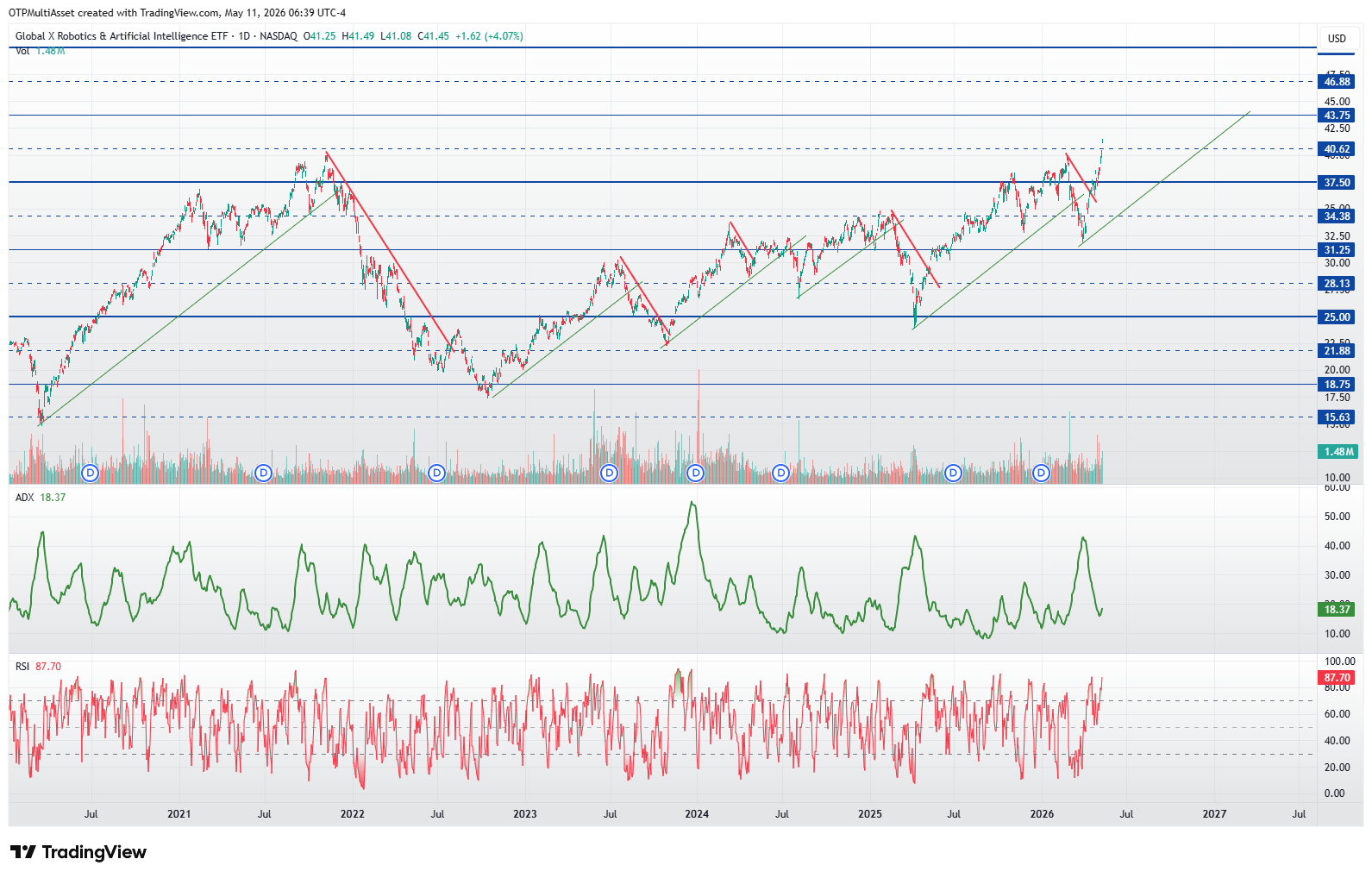
Nvidia has already entered into numerous partnerships with companies across robotics and automation. It is therefore no coincidence that the company is also one of the largest constituents of BOTZ, one of the key thematic ETFs in the space — the Robotics & Artificial Intelligence ETF.
BOTZ ETF chart
Other players
Another major constituent of the ETF is currently Switzerland’s ABB, which, as noted above, is in the process of selling its robotics division. Even so, it is not inconceivable that the company will remain in the ETF, as industrial automation remains an important segment for ABB. If robotics is interpreted broadly — including automated machinery, motion control, sensors, industrial control, mechatronics and digital manufacturing systems — ABB will remain a company with strong exposure to robotics-adjacent activities.
Japan’s Fanuc is also one of the leading companies in industrial robotics and automation, with several decades of experience. Its offering includes robotic arms, collaborative robots, CNC controls and other automation-enabling solutions. In March, the company entered into a partnership with Nvidia to further develop industrial robots with the help of AI. Over the next four years, Fanuc could achieve average annual revenue growth of close to 6%, while its net income could expand by 9% on a CAGR basis. During this period, the company’s EBITDA margin could rise from 26.5% to as much as 29%, based on analyst expectations. The stock, however, is not cheap, with its current P/E ratio above 35.
US-based Teradyne is also a significant player. The company develops equipment and software used to test, control and optimise chips, electronic modules, wireless devices and even industrial robots. Chips, for example, need to be tested before they are installed in cars or data centres, in order to verify whether they function properly, what level of performance they can deliver and what defect rates they exhibit. Teradyne’s products make this testing possible. In addition, Teradyne also manufactures collaborative robots and autonomous mobile robots. Over the next four years, the company could achieve average annual revenue growth of 20%, while its net profit may increase at an even faster pace, with a CAGR of 31%. Teradyne’s EBITDA margin could rise above 30% this year and, according to expectations, could reach 34% by 2028. This growth profile, however, comes with a high valuation, as the company’s 2026 forward P/E ratio is currently around 50.
The share price of Japan’s Keyence Corporation also surged after its excellent report at the end of April, making it a major constituent of the BOTZ ETF as well. Keyence is not a traditional robot manufacturer, but rather a supplier of factory automation technology. Its products help factories operate more accurately, faster and with fewer human errors. Its typical customers include companies in the automotive, electronics, semiconductor and pharmaceutical industries. Keyence reported quarterly operating profit of JPY 179.4 billion, compared with the JPY 163.8 billion consensus estimate. In other words, the market clearly priced in a positive earnings surprise. Investors also welcomed the company’s proposed amendment to its articles of incorporation, which could open the door to a potential share buyback programme. The company’s profitability is outstanding, with an operating margin of 51%, although this is accompanied by a high valuation, with a P/E ratio of 40.
We can see that robotisation is already a major business area today. However, the sector is likely still far from where it may develop over the next decade. Innovation is expected to take place in mobile robots — and perhaps even more so in humanoids.
Get more out of your investments!
Global Markets Services
OTP Global Markets offers a broad range of services in the field of local and international money and capital markets.
Read morePrivate Banking Services
Personal care and expertise with OTP Private Banking, along with the knowledge, security, and innovations of a multinational banking group.
Read more