
Robotics & AI: The Next Revolution
Related content
US bank shares fell
The third-quarter earnings season in the US has picked up pace following the release of the latest figures from US banks. Based on preliminary expectations, the third quarter is likely to have closed with strong earnings growth for S&P 500 companies, led by the energy and technology sectors. The major US banks have still achieved solid growth on an annual basis, indicating that their operations remain strong, but the pace has clearly slowed in many cases, which has tended to result in negative share price reactions.
Commodities - Technical Analysis
Gold and silver continued their downward trend, bouncing off key levels. Until their downward trends are broken, they will not be able to produce a significant rise. The fall in oil prices reversed from the $87.5 level and began a slight upward movement. Natural gas remained in an uptrend; a significant rise could even occur if it breaks out upwards. The price of copper has become stuck in a wider range, so the oversold and overbought zones may offer more favourable trading opportunities. The falling prices of wheat and corn have reached key support levels; a buying reaction from these levels could present favourable long opportunities with limited risk.
A profound structural transformation is emerging at the intersection of robotics and artificial intelligence — potentially one of the most significant economic shifts of the coming decades. While recent market narratives have been dominated by generative AI and software ecosystems, the next true productivity revolution is likely to take place in the physical world. Autonomous robots — rather than chatbots — may become the primary drivers of incremental economic value as demographic headwinds, supply-chain restructuring, and rapid technological advancement converge.
Robotization and automation collectively offer a long-duration structural growth story. Even though generative AI has been the central theme since its acceleration in 2022, the past several quarters have exposed the limitations and cost pressures of software-only approaches: narrowing margins, uncertain monetization, and the questioning of established business models across multiple sectors.
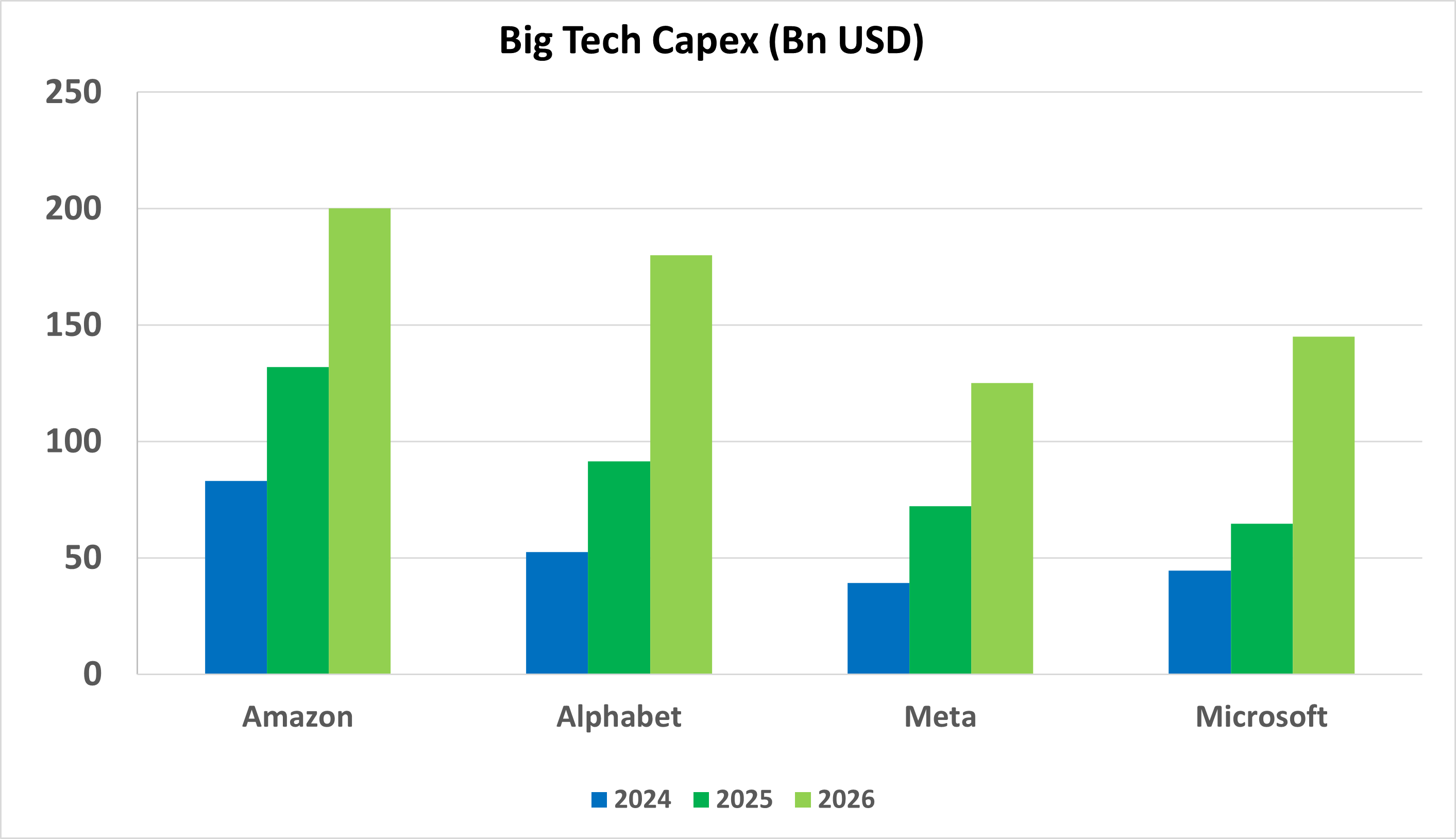
In 1Q2026, the four major U.S. technology platforms (Microsoft, Meta, Amazon, Google) guided to roughly USD 650bn of capex by 2026, equivalent to nearly three times Hungary’s annual GDP. However, investors have become increasingly skeptical that such unprecedented investments will deliver adequate returns. Mega-cap performance has recently lagged the broader market, and the software sector has come under pressure as increasingly capable AI models challenge the sustainability of existing operating models and valuation premiums.
AI’s True Potential Shifts Toward the Physical World
Despite the recent re-rating, AI’s underlying potential has not diminished—if anything, it is expanding. The narrative is shifting toward AI-enabled automation in the physical domain. Robotics may become the field where AI creates tangible economic value in the coming years, potentially at the expense of previously dominant software-centric themes.
Robotics is not a new concept: industrial robots and automated assembly lines have been transforming manufacturing since the 1960s. However, traditional robots were deterministic machines — executing only predefined, programmed actions.
AI fundamentally changes this paradigm. Models capable of simulating reasoning can now integrate structured and unstructured data, execute multi-step tasks, and match or exceed human-level performance in narrowly defined domains (e.g., autonomous driving). Continuous algorithmic and hardware innovation is reducing training and inference costs, improving energy efficiency, and enabling multimodal capabilities—processing and generating text, images, audio, and video — critical for advanced robotic systems, especially humanoids.
AI-driven robotic systems unify perception, reasoning, and action, enabling operation in unstructured environments, execution of novel tasks, and following human verbal instructions—capabilities far beyond traditional automation. Widespread humanoid deployment, however, will depend on rapid declines in manufacturing costs, scalable production capacity, and supportive policy frameworks. The replacement of human labor introduces social and political considerations as well, though these fall outside the scope of this analysis.
Powerful Megatrends Supporting Adoption
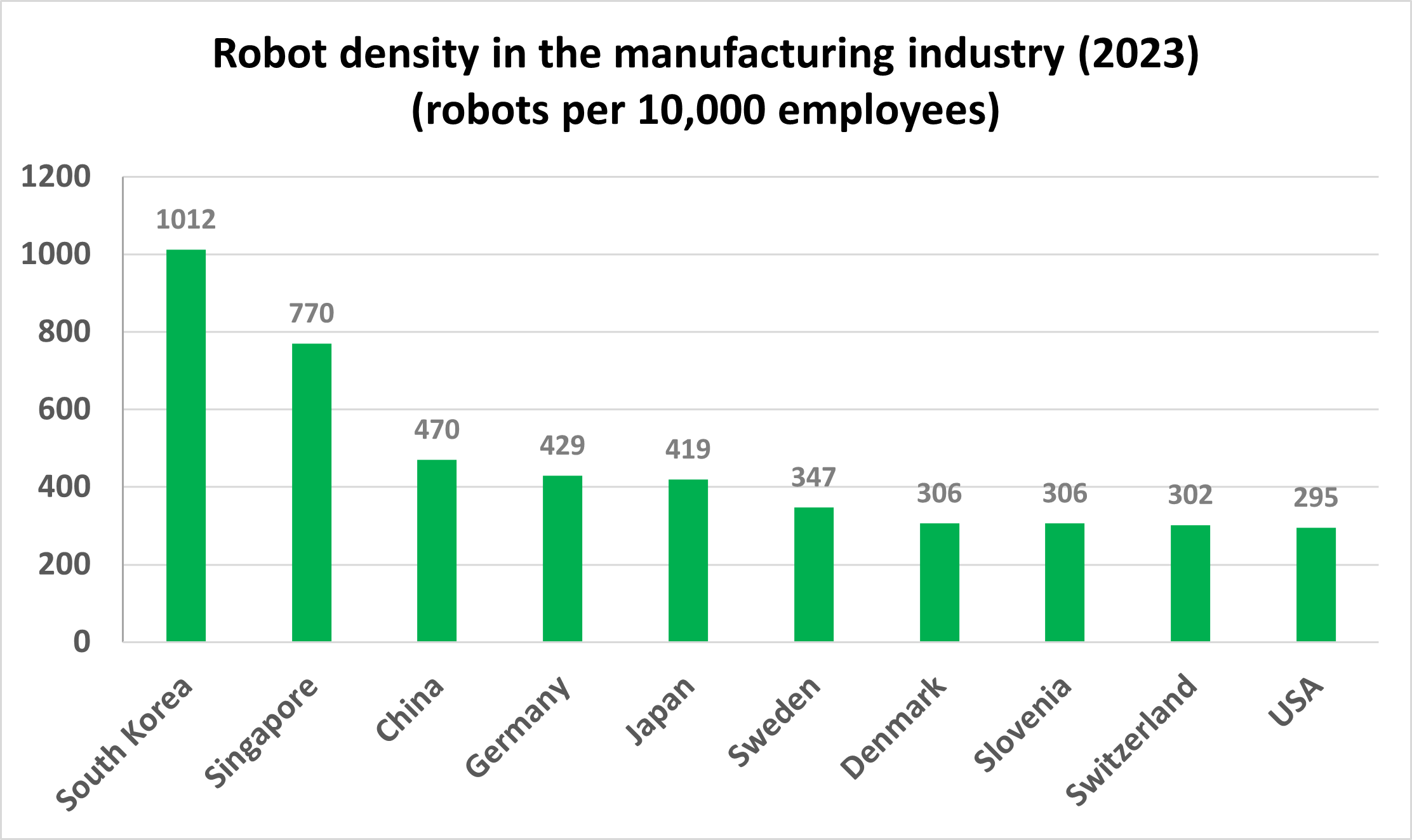
Demographic trends represent one of the most significant structural drivers. Most developed economies — and increasingly major emerging ones such as China — face declining birth rates and rapidly aging populations. Today, individuals aged 65+ comprise roughly 10% of the global population, by 2050 this share is expected to reach 16%, while the working-age population stagnates. Germany’s workforce, for example, may shrink by up to 10% by mid-century. The economic burden of eldercare will rise sharply. Unsurprisingly, South Korea, a country long challenged by demographic decline, already has the world’s highest industrial-robot density.
Urbanization will continue to concentrate populations in cities, exacerbating labor shortages in rural regions and associated industries. In parallel, workers are increasingly unwilling to perform dangerous, repetitive, or physically demanding jobs — roles well-suited for robotic substitution. Supply-chain reconfiguration also represents a major catalyst. Reshoring and near-shoring require the relocation of production to high-cost economies. Such moves are only viable with deep automation, as Western manufacturing cannot compete with East Asia on labor cost — but can regain competitiveness if robotics becomes the backbone of production.
Market Size and Growth Trajectory
Estimating the size of the robotics market is inherently difficult, given the uncertainty around the scope of included technologies (pure hardware vs. full automation ecosystems with software integration). Current estimates for 2026 range broadly between USD 50–100bn. Looking further out, most analysts forecast 15–20% CAGR through 2035.
Among the subsegments, humanoid robots may exhibit the fastest growth due to their currently small base. From roughly USD 1–3bn in 2023, the humanoid market could expand to USD 40bn by 2035 under Barclays’ base case, with a bullish scenario closer to USD 200bn. Morgan Stanley projects a potential USD 1tn humanoid market by 2050. While such long-range forecasts carry significant uncertainty, directionally the growth potential is substantial.
Importantly, this will not be a winner-takes-all market. Value creation will be distributed across the hardware supply chain, software platforms, system integrators, and component manufacturers. End-users across manufacturing, logistics, retail, healthcare, and infrastructure stand to benefit from meaningful productivity gains.
Robotization is emerging as a major multi-decade investment theme. We expect the coming years to be defined by accelerating adoption, expanding addressable markets, and an evolving competitive landscape across both hardware and software ecosystems.
Further robotics-focused analysis will follow in the coming weeks.
Get more out of your investments!
Global Markets Services
OTP Global Markets offers a broad range of services in the field of local and international money and capital markets.
Read morePrivate Banking Services
Personal care and expertise with OTP Private Banking, along with the knowledge, security, and innovations of a multinational banking group.
Read more