
Palantir: Another Outstanding Quarter
Related content
US bank shares fell
The third-quarter earnings season in the US has picked up pace following the release of the latest figures from US banks. Based on preliminary expectations, the third quarter is likely to have closed with strong earnings growth for S&P 500 companies, led by the energy and technology sectors. The major US banks have still achieved solid growth on an annual basis, indicating that their operations remain strong, but the pace has clearly slowed in many cases, which has tended to result in negative share price reactions.
Commodities - Technical Analysis
Gold and silver continued their downward trend, bouncing off key levels. Until their downward trends are broken, they will not be able to produce a significant rise. The fall in oil prices reversed from the $87.5 level and began a slight upward movement. Natural gas remained in an uptrend; a significant rise could even occur if it breaks out upwards. The price of copper has become stuck in a wider range, so the oversold and overbought zones may offer more favourable trading opportunities. The falling prices of wheat and corn have reached key support levels; a buying reaction from these levels could present favourable long opportunities with limited risk.
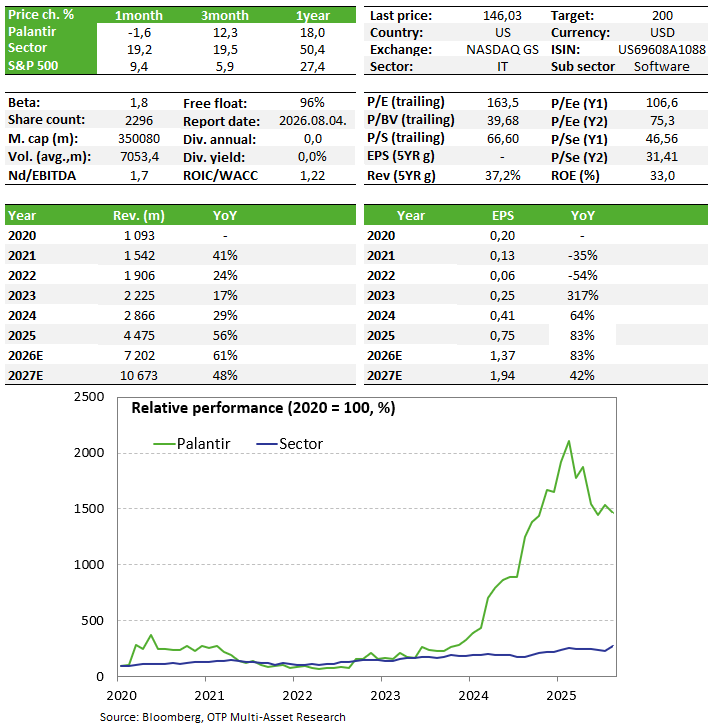
Palantir delivered yet another exceptionally strong quarter. The company not only posted robust revenue growth and outstanding profitability, but forward-looking contract metrics pointing to future revenues also improved materially. The results reaffirm that Palantir’s U.S. business — particularly enterprise AI adoption — remains on a very strong growth trajectory. While higher guidance inevitably raises market expectations, Palantir continues to offer a rare combination of rapid growth, high margins, and strong cash generation.
Palantir shares remain on our Equity Top pick List.
Quarterly Report
Palantir once again reported an outstanding quarterly performance. Revenue increased 85% year-on-year to USD 1.63 billion, the highest level since the company’s IPO, while adjusted operating margin reached 60%. Beyond headline revenue, forward-looking indicators also strengthened significantly. Remaining Deal Value (RDV) — the value of signed contracts not yet billed — rose to USD 11.8 billion, up 98% year-on-year. Remaining Performance Obligations (RPO) surged 134% year-on-year to USD 4.5 billion, further underscoring strong demand visibility.
The company generated USD 871 million in GAAP net income, implying a 53% net margin. In other words, Palantir is achieving extraordinary growth without sacrificing profitability: accelerating revenues are translating directly into net income and free cash flow.?
The U.S. segment continues to be the main driver of the investment thesis. U.S. revenue grew 104% year-on-year to USD 1.28 billion, accounting for approximately 79% of total revenue. U.S. commercial revenue surged 133% to USD 595 million, while U.S. government revenue increased 84% to USD 687 million. The commercial segment is particularly important, as a key historical question around Palantir was whether it could evolve beyond its government-centric roots into a scalable enterprise AI platform. The Q1 2026 results clearly suggest that it can.
Management raised full-year 2026 revenue guidance to USD 7.65–7.662 billion, well above the USD 7.245 billion consensus estimate. On the U.S. commercial front, management now expects more than USD 3.224 billion in revenue for 2026, implying at least 120% growth. This is a powerful signal, indicating that enterprise AI adoption in the U.S. is not slowing but accelerating further.
That said, higher guidance also brings higher expectations. From here, the market will demand sustained strength in U.S. enterprise growth alongside stable government demand. The negative post-market reaction suggests that some investors believe a meaningful portion of the good news may already be priced in.?
Palantir does not position itself as an AI model developer, but rather as an operating layer that enables AI to be deployed effectively in large-scale enterprise and government environments. According to CTO Shyam Sankar, declining inference costs are not a threat but a tailwind: as AI becomes cheaper, organizations will want to automate more workflows — but doing so requires control, auditability, and a trusted platform. Under Palantir’s narrative, cheaper AI does not undermine the business model; instead, it increases the value of platforms such as AIP that sit at the intersection of AI, operations, and governance.
Investment story
- Palantir offers a direct way to gain exposure to the AI momentum. Over the next four years, consensus expectations point to 30–40% average annual growth in both revenue and profits. The company operates with net margins above 40%, generates strong free cash flow, and holds a net cash position.
- If Palantir can retain its dominant position in the government sector while continuing to scale meaningfully in the commercial space — something it has demonstrated so far — elevated valuation multiples could persist for an extended period. In an optimistic scenario, rapid earnings growth could quickly compress valuation metrics even without a share price correction.
- Key risks: The primary risk remains valuation. The stock is priced at extremely high multiples, meaning that any shortfall versus growth expectations could trigger a sharp correction. In a broader risk-off environment, a 40–50% drawdown cannot be ruled out.
Get more out of your investments!
Global Markets Services
OTP Global Markets offers a broad range of services in the field of local and international money and capital markets.
Read morePrivate Banking Services
Personal care and expertise with OTP Private Banking, along with the knowledge, security, and innovations of a multinational banking group.
Read more