
Investors are worried – what lies ahead for Brazil?
Related content
Hungary: Headline inflation accelerated in line with expectations, while underlying inflation pressures remained elevated
Hungary's headline inflation rose by 0.4 ppts to 2.0% year-on-year in October, up from 1.6% in September. The data was in line with the market consensus (2.0%) and marginally above our forecast (1.9%). The main reason for the acceleration of headline inflation was the further increase of fuel inflation while processed food prices decreased less than expected mainly due to sugar and confectionaries. However, food prices still significantly contributed to the low inflation in Hungary, so the fact that prices of several agricultural commodities have started to rise in recent months, reinforces our view that food prices will no longer contribute to disinflation in 2027.
FX - Technical Analysis
The dollar has shown a slight correction over the past two weeks, which so far has signaled a pause in its strengthening rather than a meaningful trend reversal. There are still no signs pointing to a sustained weakening. The EUR/HUF cross is trading within a narrowing range. At the same time, the forint has remained in an uptrend against the dollar. The USD/JPY exchange rate broke out of its narrowing range, but has not yet moved far enough away from the breakout level to clearly confirm the move. In the case of EUR/CHF, the first signs of a reversal are already visible; however, to confirm a sustained trend reversal, a higher low would need to form and the dominant downtrend would need to be broken.
In a major surprise, Lula won the second round of Brazil’s presidential election, even though markets had previously expected Flávio Bolsonaro to prevail. Lula’s victory triggered a sharp repricing of Brazilian assets, while sentiment deteriorated further shortly afterwards following an unorthodox proposal calling for a substantial reduction in the central bank’s policy rate. For now, it appears that no such plan is under consideration in Brazil, and the president has reaffirmed his commitment to fiscal discipline. Investors, however, remain largely sceptical. Market participants are waiting for concrete measures, and in the near term the key question for Brazil will be whether the anticipated fiscal measures can stabilise the country’s debt trajectory and how the president will reconcile them with his campaign promises.
A historic presidential election in Brazil
Brazilian assets experienced considerable turmoil following the presidential election, after President Lula overturned the first-round result to win the runoff, a feat never previously achieved by a Brazilian presidential candidate. Investors, however, appeared to have priced in a victory for Flávio Bolsonaro. Lula’s unexpected win and the reassessment of the anticipated fiscal policy shift therefore triggered moves in Brazilian assets on a scale not seen for years.
Brazil’s benchmark Bovespa equity index plunged by nearly 14% following the second round of the presidential election, while the real weakened sharply against the US dollar and the yield on Brazil’s ten-year government bonds soared. After Lula’s re-election, investors clearly wanted greater clarity on the fiscal policy direction that his administration intended to pursue during the new presidential term. They also sought to understand how the president would reconcile his campaign promises with the fiscal adjustment that markets considered necessary.
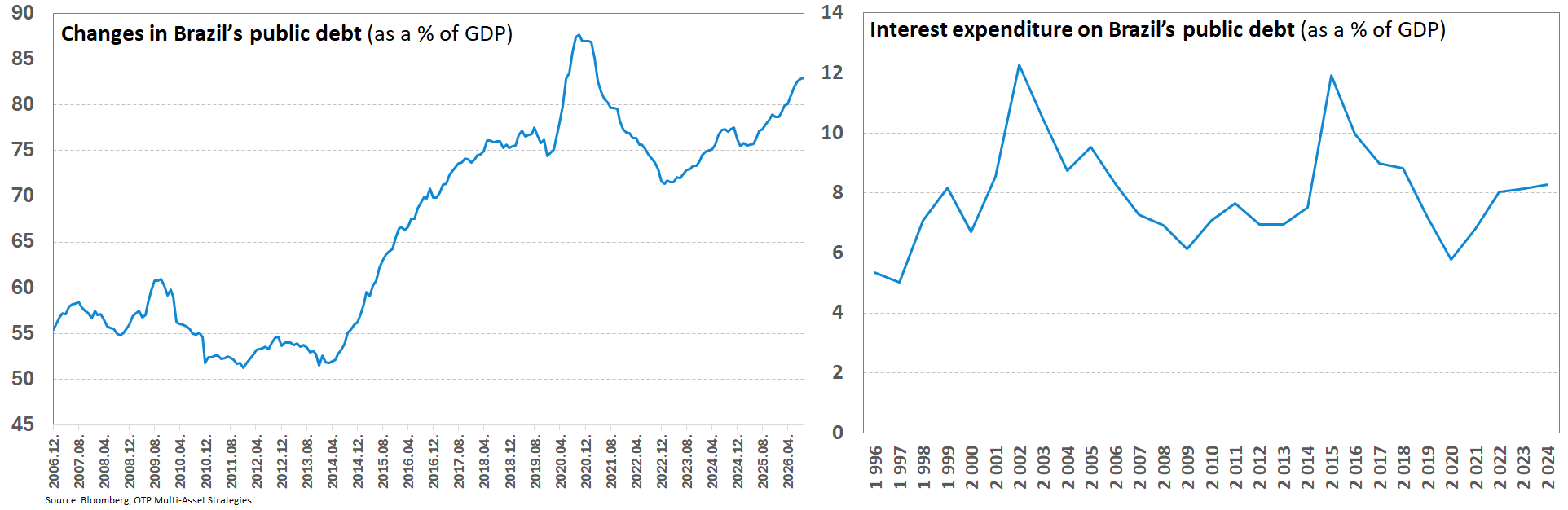
Brazil’s public debt has surpassed 80% of GDP this year, while interest expenditures on public debt exceed 8% of GDP. Although the central bank has cut rates this year, its benchmark rate remains high by global standards. With roughly half of domestic public debt carrying floating rates, changes in the policy rate pass through directly to the government’s borrowing costs.
A surprising plan has heightened concerns
Following the presidential election, investors were looking for concrete policy signals, including the appointment of the next finance minister. In the meantime, however, another narrative began to emerge, one that arguably weighed even more heavily on Brazilian asset prices. This narrative appears to have been driven largely by the unorthodox proposals put forward in September by Brazilian economist André Lara Resende.
It is important to note that Lara Resende’s work contributed to the Plano Real, the stabilization programme that helped Brazil bring hyperinflation under control in the 1990s. In a recently published article, he argued that Brazil’s debt problem is being aggravated not primarily by excessive government spending, but by extraordinarily high interest rates.
Lara Resende’s proposals, along with their apparently growing support on the left, attracted significant attention in Brazil. At the heart of his argument is the view that high interest rates are the main driver of the country’s rising public debt. He therefore proposed establishing a new body to coordinate fiscal and monetary policy over a four- to five-year horizon. The Central Bank of Brazil would retain operational independence, while jointly agreed guidelines would govern interest rates, inflation and debt sustainability.
Under the proposal, the policy rate would be restricted to a range of 3% to 5.5% over the longer term. The lower end of the range would correspond to the 3% inflation target, while the ceiling would be determined by the economy’s potential nominal growth rate, defined as the sum of the inflation target and potential real GDP growth. Assuming potential growth of 2.5%, the ceiling would be set at 5.5%, keeping the benchmark rate within the 3% to 5.5% range under normal economic conditions.
According to the proposal, the central bank would follow a pre-announced easing path, gradually lowering interest rates to 7.5% over 12 months. The target rate would comprise the previously discussed 5.5% ceiling and a temporary 2 percentage point safety buffer, which would be reviewed regularly and phased out over time. Lara Resende estimates that the plan could generate annual savings of around 4% of GDP. However, he also acknowledges the associated risks: a rapid reduction in interest rates could undermine the appeal of Brazilian assets, while a weaker real could push up the prices of imported goods and fuel, making it more difficult to bring inflation under control. To mitigate these risks, the proposal would draw on Brazil’s foreign exchange reserves of more than $300 billion.
The finance minister quickly denied this
Reports in the local media indicated that divisions may have emerged within the administration over the appropriate direction of economic policy. Some officials viewed continued fiscal consolidation as the safest course, while others opposed further budget tightening, arguing that it would amount to abandoning Lula’s campaign promises. Reports also emerged that Lula was considering nominees for upcoming vacancies on the central bank’s board who could push monetary policy towards a more accommodative stance. As the country moved further beyond the second round of the presidential election, uncertainty about the administration’s policy direction, coupled with concerns that Lara Resende’s proposals might gain influence, increasingly weighed on investor sentiment.
The unorthodox proposal also prompted some commentators to draw comparisons with Turkey, where the president had wrongly argued that high interest rates caused inflation rather than helped to contain it. The central bank’s subsequent rate cuts contributed to a sharp acceleration in Turkish inflation, which could be brought under control only through painful policy tightening. André Lara Resende later denied that he had met with Lula, and Brazil’s finance minister also dismissed reports that the government was considering drastic interest-rate cuts to mitigate the country’s debt situation.
The diagnosis behind the surprising proposal is sound: high interest costs are an important driver of Brazil’s public debt dynamics. However, lowering interest rates when such a move is not justified by the fiscal and inflation outlook would entail considerable risks, potentially reflected in currency depreciation and/or changing demand for different types of government securities. Lasting rate cuts would first require credible fiscal consolidation and a central bank firmly committed to its inflation target. Once these conditions are in place, the risk premium could decline, helping to lower the government’s borrowing costs.
What might happen next?
In a televised address on Sunday, November 8, Brazil’s president reaffirmed his commitment to fiscal responsibility and pledged to create the conditions necessary for lower interest rates. While Lula stopped short of announcing new measures to reassure investors, he reiterated one of his key objectives: increasing investment as a share of GDP. This would require an economic and fiscal framework that supports lower interest rates while preserving sustainable social policies and encouraging stronger investment activity.
At this stage, the unorthodox scenario outlined earlier appears unlikely to be on the government’s agenda. Even so, Lula will need to convince markets that he can deliver fiscal adjustments sufficient to slow the rise in public debt while fulfilling his campaign commitments. Implementing the pledges made ahead of the runoff will also require amendments to the next annual budget. These promises include higher Bolsa Família payments for low-income households, an expansion of the student incentive programme, the partial assumption of microentrepreneurs’ debts by the government and free public transport at weekends, among other measures. Which of these pledges are implemented, and how the government intends to finance them, will provide important signals about the future direction of economic policy.
More important still for financial markets will be Lula’s choice of finance minister. The appointee will play a central role in shaping the timing and sequencing of fiscal measures, negotiating them with Congress and communicating the government’s policy direction to investors. The president’s nominations for the vacant policymaking positions at the central bank will also be closely watched as an important signal of the administration’s intentions.
Recent market moves suggest that investors may have started pricing in a less market-friendly policy path. In his weekend address, however, Lula expressed concern about the trajectory of public debt and reiterated his commitment to fiscal responsibility. While this represents an encouraging first step, the absence of concrete policy measures has so far proved insufficient to reassure investors.
Brazilian government sources suggest that a set of measures targeting a fiscal adjustment equivalent to 0.5% of GDP in 2027 could be announced within days. The package would give the government greater scope to freeze spending if fiscal targets are at risk and could also include a reduction in certain tax benefits.
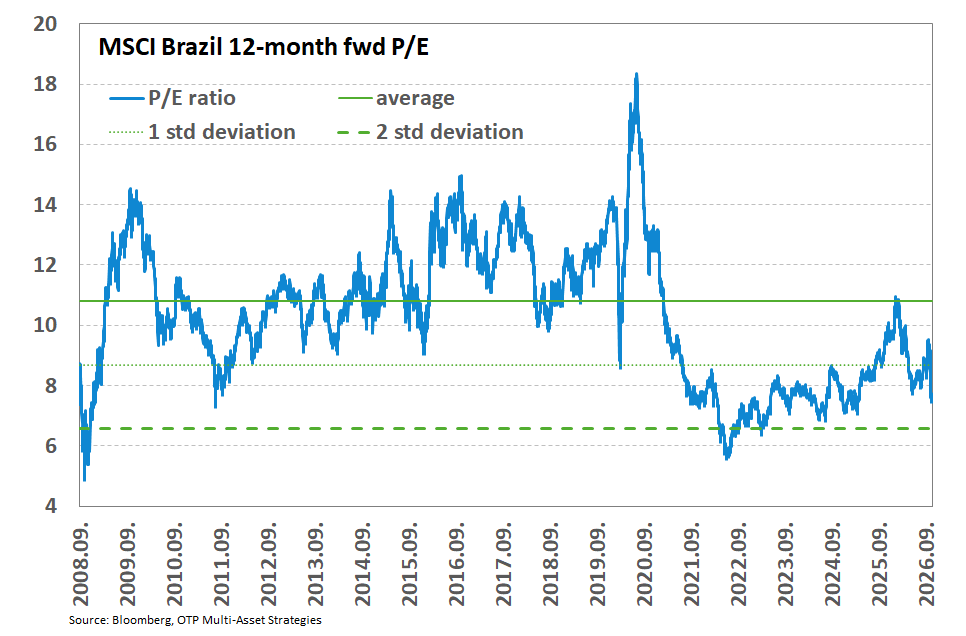
Brazilian equities remain attractively valued, but near-term risks have increased. The MSCI Brazil Index trades at a forward P/E ratio of 7.7, compared with 8.2 for the MSCI Emerging Markets Index. The key question now is what Lula will do next. Investors will be watching whether the expected measures are sufficient to stabilise the country’s debt trajectory and how the president intends to reconcile fiscal adjustment with his campaign promises.
Bovespa index technical picture
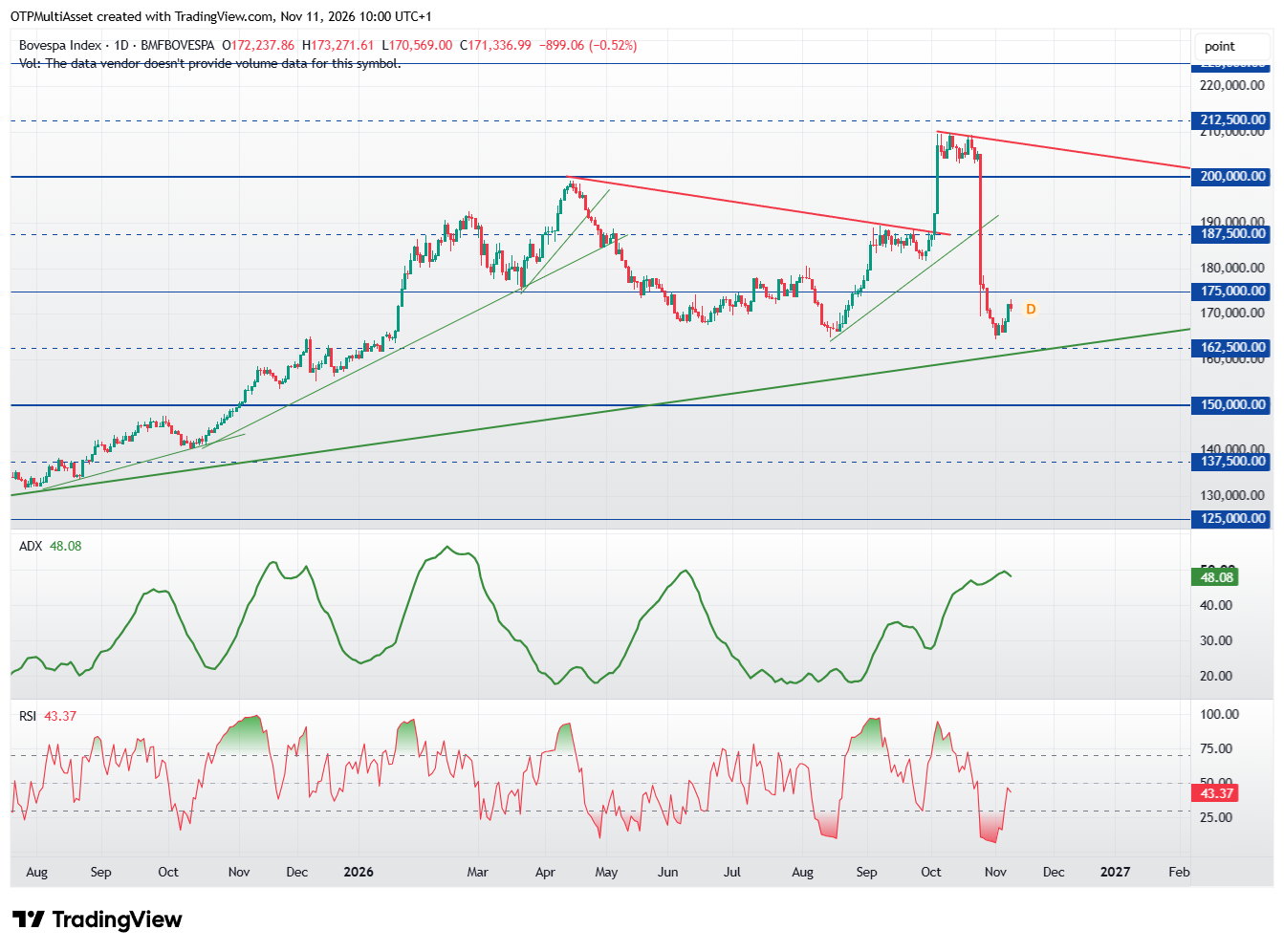
The sharp, high-volume sell-off after the presidential election rapidly reshaped the curve. The rising trend was broken at 187,500, while the long-term ascending trendline, located around 162,500, has provided support so far. A minor upward correction has since emerged, although it currently lacks both strength and momentum. The 187,500 level has turned into resistance and may be retested. This would represent an approximately 50% retracement of the final leg and could be considered an ideal technical correction. Nevertheless, the current pattern provides no indication of a sustained, trend-like advance.
Get more out of your investments!
Global Markets Services
OTP Global Markets offers a broad range of services in the field of local and international money and capital markets.
Read morePrivate Banking Services
Personal care and expertise with OTP Private Banking, along with the knowledge, security, and innovations of a multinational banking group.
Read more