
AI Could Be the New Profit Driver for Digital Platforms
Related content
US bank shares fell
The third-quarter earnings season in the US has picked up pace following the release of the latest figures from US banks. Based on preliminary expectations, the third quarter is likely to have closed with strong earnings growth for S&P 500 companies, led by the energy and technology sectors. The major US banks have still achieved solid growth on an annual basis, indicating that their operations remain strong, but the pace has clearly slowed in many cases, which has tended to result in negative share price reactions.
Commodities - Technical Analysis
Gold and silver continued their downward trend, bouncing off key levels. Until their downward trends are broken, they will not be able to produce a significant rise. The fall in oil prices reversed from the $87.5 level and began a slight upward movement. Natural gas remained in an uptrend; a significant rise could even occur if it breaks out upwards. The price of copper has become stuck in a wider range, so the oversold and overbought zones may offer more favourable trading opportunities. The falling prices of wheat and corn have reached key support levels; a buying reaction from these levels could present favourable long opportunities with limited risk.
In recent years, artificial intelligence has become one of the most important topics in the technology sector. While much of the attention is focused on model developers and companies providing infrastructure, the long-term winners in this technology may also emerge on the application side. The interactive media segment is particularly interesting from this perspective, as the business models of companies operating in this field rely heavily on monetizing user attention and producing digital content. In the second part of our industry analysis series, we review current trends and potential catalysts affecting search engines and social media platforms.
Our previous analysis, which provides an overview of the industry background, is available here.
Where do industry players get their income from?
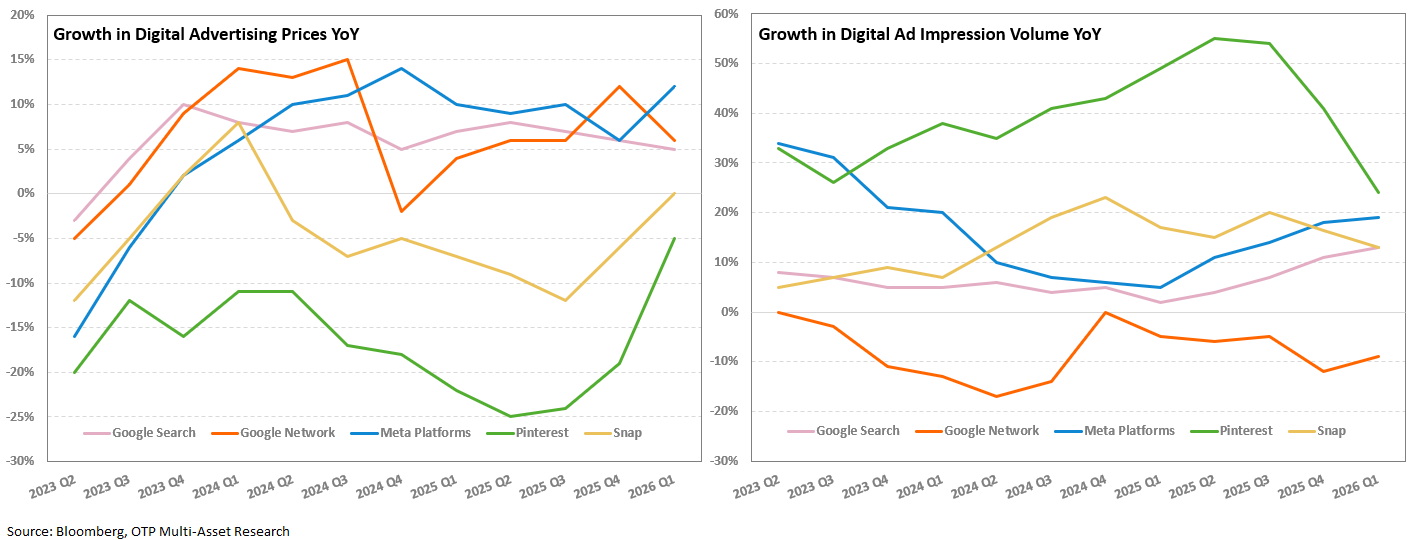
In the interactive media segment, the majority of revenue comes from online advertising, particularly on search engines and social media platforms. The most important factors in this model are: the number of active users, time spent on the platform, the number of ad impressions, and their average price. Pricing is essentially based on a real-time auction system, with advertisers competing against each other for impressions and clicks. For example, when you open Facebook or perform a Google search, the platform first analyzes the user (age, interests, location) and then selects the advertisers who want to reach that user. It then conducts an auction among them to determine which ad will be displayed and at what price.
There are several models for calculating revenue. One is Cost Per Click (CPC), in which advertisers pay per click. In this case, during the bidding process, advertisers specify how much they are willing to pay per click, and the advertiser who submits the highest bid wins the ad space. The platform’s revenue is then determined based on the actual number of clicks. Another approach is Cost Per Mille (CPM), where the number of ad impressions, rather than clicks, is the determining factor. Social media platforms also frequently use conversion-based (CPA) pricing, in which advertisers pay only when a user performs a predetermined action, such as signing up or downloading an app. In the latter model, not only the cost per conversion but also the expected probability of conversion plays a key role in the bidding process. As a result, it is not necessarily the highest bid that wins the auction, but rather the one that is expected to generate greater long-term revenue for the platform.
In addition to the factors mentioned above, there is another key factor affecting industry revenues: companies’ spending on advertising. If companies’ marketing budgets shrink, this can result in fewer ads or lower bids during auctions, which ultimately reduces the platforms’ revenues. Typically, in a more subdued economic environment, companies are among the first to cut their marketing expenditures, so a strong positive correlation can be observed between spending on online advertising and the economic cycle.
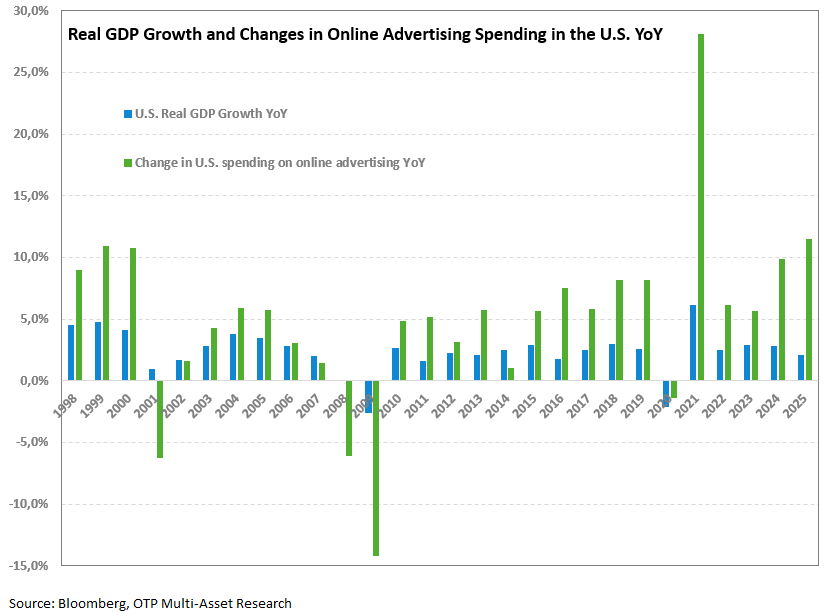
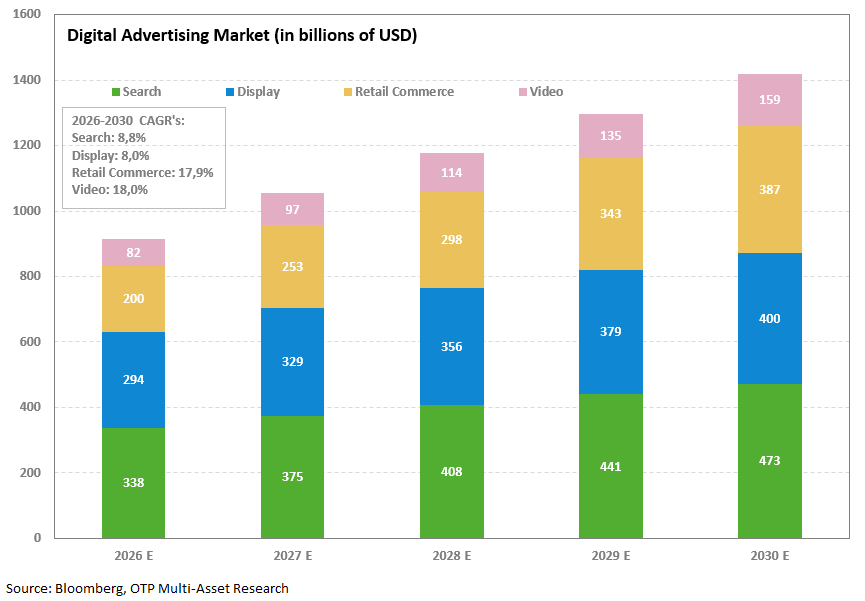
At present, the outlook for the industry appears to be largely positive, given that the U.S. economy continues to show resilience and is expected to achieve an average annual growth rate of approximately 2% over the next 2–3 years, with no significant disruptions to the growth trajectory in sight for the time being. Although consumer sentiment in the United States is decidedly unfavorable, this has not yet been reflected in retail sales trends. In light of all this, stable growth is expected in online advertising spending over the next few years (CAGR 2026–2030: 11.6%), although there may be significant variations among individual segments.
Spending on traditional search ads, which are in a more mature life cycle, is expected to grow at a rate below the industry average (<9%), while the market for ads appearing in video content — which consumers increasingly prefer — could grow by as much as 18% annually through 2030, according to eMarketer’s forecast. In addition to economic growth, the wider adoption of AI could be one of the most important drivers for the industry, which could also make the sector attractive from an investment perspective.
AI as a positive catalyst
For the industry, artificial intelligence may primarily serve as a monetization tool, as it can improve digital ad pricing through more personalized content and more precise targeting. In addition, the introduction of generative AI could increase user engagement on social media platforms thanks to more effective content recommendation systems. As a result, users may spend more time in the apps, which could lead to a higher number of ad impressions and, consequently, higher revenue. Meta reported last quarter that users are spending an average of 5–10 minutes more per day in its apps, a trend it attributed to improvements in the efficiency of its AI-based recommendation systems. This is particularly noteworthy given that, according to many investors, Meta is not yet among the clear frontrunners in the development of AI models.
A similar trend can be observed in search platforms, where the rise of AI-powered searches could increase the time users spend on the platform and the number of ad impressions. Google reported last quarter that the number of searches had reached an all-time high. The longer context windows of newer AI models — that is, the maximum amount of text and data they can process simultaneously — can further improve the effectiveness of ad targeting. This could result in higher click-through rates and more conversions per ad, which could ultimately support revenue growth for players in the interactive media industry.
What does AI development involve?
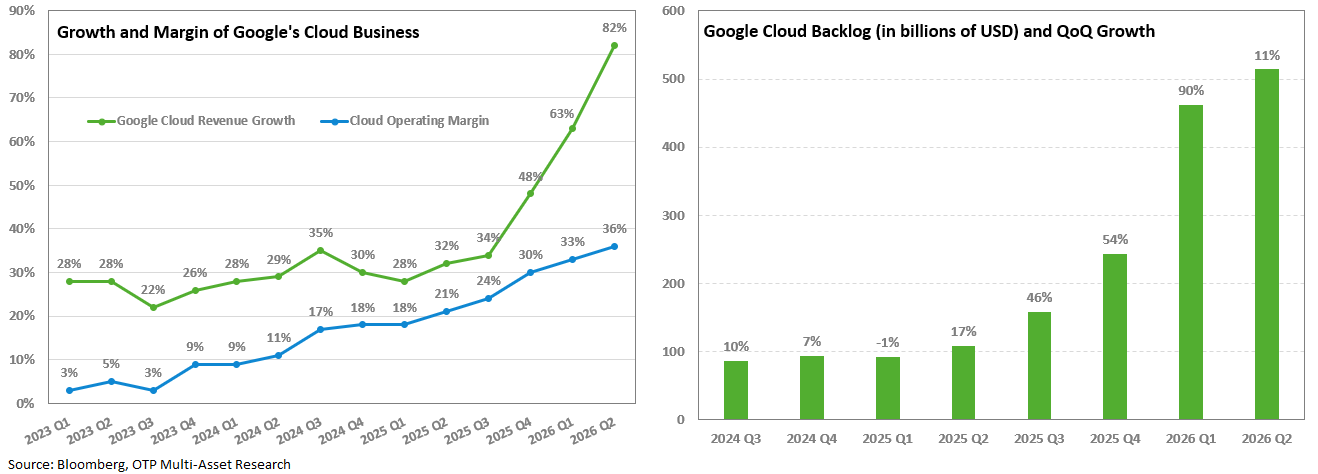
At the same time, the development of models and the deployment of the underlying infrastructure place significant pressure on large companies’ ability to generate cash flow. This may be partially offset by the increased pricing power provided by AI in the advertising sector, as well as the impact of workforce reductions; nevertheless, it will be critical to build the most cost-effective infrastructure possible and operate the models efficiently. In this area, Google leads the way thanks to its custom-designed AI chips, the TPUs (Tensor Processing Units), developed in collaboration with Broadcom. These solutions enable a more cost-effective infrastructure than that of many competitors, a fact reflected in the margins of Google’s cloud and search businesses. In addition, these advantages support the growth of the cloud business, which is expanding at a faster pace than that of many competitors. However, Google remains only the third-largest player in this market, behind AWS and Microsoft Azure.
Meta recently announced that it is selling a portion of its unused computing capacity, effectively entering the cloud services market. This is a particularly interesting move, as cloud services are currently considered one of the most important growth drivers for hyperscaler companies. In addition, it could help alleviate the pressure on cash flow caused by significant AI investments in the short term. This is particularly important for Meta, as its ability to generate operating cash flow continues to lag behind that of Microsoft, Amazon, and Google; as a result, the market has historically been less tolerant of its aggressive investment strategy, which has been reflected in the stock’s underperformance.
How did the smaller players position themselves?
Smaller companies that profit from online advertising (Reddit, Pinterest, Snap) will initially face pressure on their gross margins due to model costs as they roll out AI features. In the longer term, however, artificial intelligence can significantly improve the efficiency of their content recommendation systems, which could create additional monetization opportunities through increased user engagement. Although margins may remain under pressure during the technology’s scaling-up phase, in a scenario where AI models become increasingly commoditized and cheaper, these companies could even find themselves in a more favorable position than their larger competitors in the long run. This is because, as users, they can reap the benefits of the technology without having to devote significant resources to developing the underlying models.
Overall, as AI models become more capable and the context window expands, the effectiveness of content recommendation and personalization features is likely to improve further. This could lead to higher conversion rates, more ad impressions, and a greater number of clicks, which could ultimately support revenue growth for companies in the industry.
We believe we are still in the early stages of the widespread adoption of artificial intelligence. Currently, infrastructure development and model costs are putting pressure on cash flow for large corporations and on margins for smaller players; however, the technology holds significant value-creation potential in the long term. Moreover, some of the monetization benefits are already clearly visible among industry players. Nevertheless, most companies continue to trade at more conservative valuation multiples, which is partly attributable to uncertainties regarding the return on AI investments.
Get more out of your investments!
Global Markets Services
OTP Global Markets offers a broad range of services in the field of local and international money and capital markets.
Read morePrivate Banking Services
Personal care and expertise with OTP Private Banking, along with the knowledge, security, and innovations of a multinational banking group.
Read more