
Interactive media: the battle for users' attention
Related content
US bank shares fell
The third-quarter earnings season in the US has picked up pace following the release of the latest figures from US banks. Based on preliminary expectations, the third quarter is likely to have closed with strong earnings growth for S&P 500 companies, led by the energy and technology sectors. The major US banks have still achieved solid growth on an annual basis, indicating that their operations remain strong, but the pace has clearly slowed in many cases, which has tended to result in negative share price reactions.
Commodities - Technical Analysis
Gold and silver continued their downward trend, bouncing off key levels. Until their downward trends are broken, they will not be able to produce a significant rise. The fall in oil prices reversed from the $87.5 level and began a slight upward movement. Natural gas remained in an uptrend; a significant rise could even occur if it breaks out upwards. The price of copper has become stuck in a wider range, so the oversold and overbought zones may offer more favourable trading opportunities. The falling prices of wheat and corn have reached key support levels; a buying reaction from these levels could present favourable long opportunities with limited risk.
The interactive media industry has become one of the most important segments of the digital economy. The rise of AI, stricter regulations, and rapidly changing consumer preferences are creating both opportunities and risks for leading players. While the sector’s appeal lies in its high profitability and excellent scalability, understanding the differing competitive dynamics of each sub-sector is essential for identifying long-term winners. A deeper analysis of industry-specific characteristics is therefore one of the most important starting points for evaluating investment opportunities.
One of the defining consumer trends of the past two decades has been the gradual decline of passive media content and the rise of interactive experiences. Whereas television, radio, and print media previously provided one-way communication, in the interactive media segment, users themselves become active participants. Industry players primarily compete for users’ attention, while the effectiveness of their business models is determined by the monetizability of user engagement. Companies in this sector typically have strong network effects and high scalability, which can provide a lasting competitive advantage for leading players. This category includes diverse business models that operate according to a common economic logic, such as social media, online search, video games, and AI-based interactive services.
Search Platforms
The search engine market is highly concentrated, with a market share of around 90%, Google has long held a virtual monopoly in the market, while Microsoft’s Bing, Yahoo, and other players have only been able to establish marginal positions. Furthermore, the risks posed by new entrants are lower, since an effective, high-quality search engine requires a massive amount of data—which most new entrants are unlikely to possess — and building out huge server farms is also extremely capital-intensive. The company’s competitive advantage is supported not only by its search technology but also by its global distribution network. Through the Android operating system and the Chrome browser, Google appears as the default search engine on numerous devices, which provides a significant traffic advantage over its competitors.
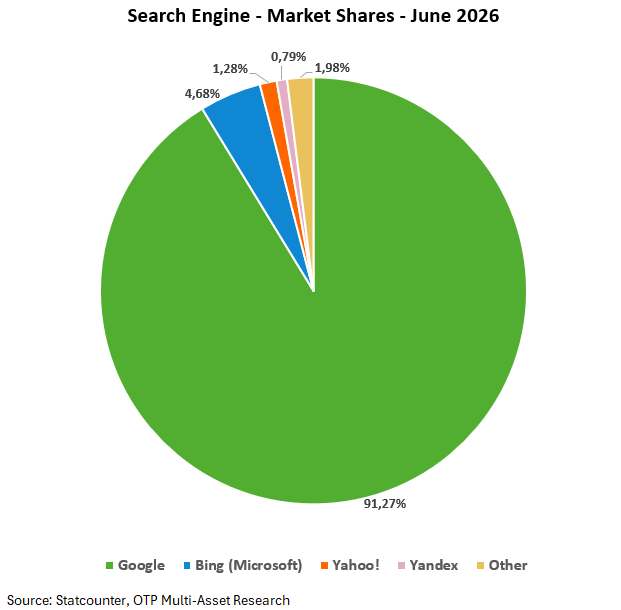
At the same time, new generative AI-based search solutions could pose a potential threat. OpenAI, Perplexity, and other players offer a new type of user experience that could reduce the share of traditional searches in the long run. At the same time, Google has also successfully integrated its own Gemini AI model into its search engine, which, based on data from recent quarters, has helped retain users.
Although switching costs are low for consumers, user retention remains extremely high. This is due to the habits formed through billions of daily searches, which also reinforce Google’s market-leading position. Aside from AI, one of the greatest threats to this position may come from regulators, in recent years, several investigations have been launched to examine the company’s dominance in the search engine market. Although the company has so far managed to avoid serious consequences, a potential breakup in the future would cause significant damage while creating a great opportunity for competitors, however, the likelihood of this happening is currently low.
The search engine industry is traditionally considered a mature market, there are few new users left to acquire, so the focus is on optimizing monetization rather than growth. Thanks to the good scalability of search platforms, leading players enjoy high margins, which may be sustainable in the long term due to high barriers to entry. Significant risks to margins may stem from the regulatory environment mentioned earlier, as well as from the impact of AI on the industry. Another risk is the cyclical nature of the industry, which arises from the fact that the majority of revenue comes from online advertising, and companies’ marketing expenditures are strongly correlated with economic cycles.
Overall, the search engine market is a mature industry that offers high returns and has significant barriers to entry, where the market leader’s competitive advantage appears to remain stable; however, AI-based search and increasing regulatory pressure may raise questions about the market’s long-term structure in the future.
Social media platforms
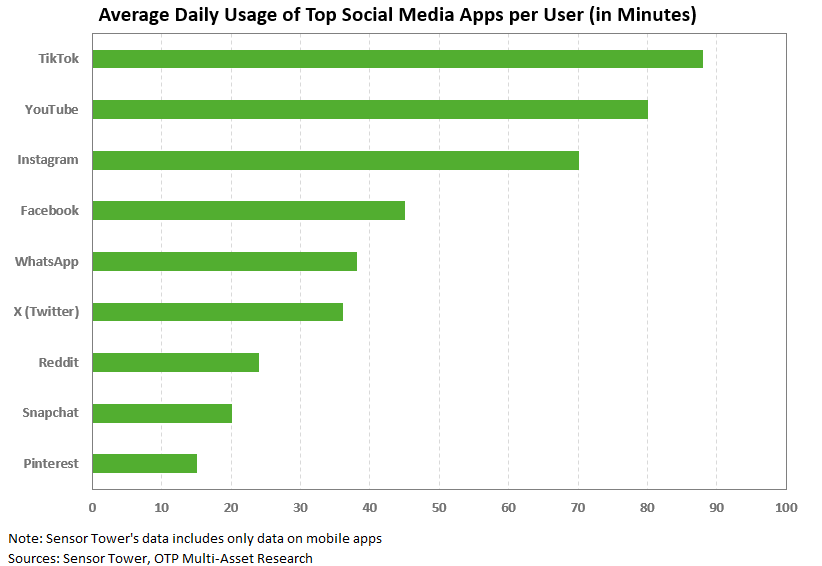
The social media market shares structural characteristics with the search engine industry in many respects, though it is characterized by oligopolistic competition rather than a monopoly. The largest market player is Meta, which plays a dominant role in the global social media ecosystem through its Facebook, Instagram, and WhatsApp platforms. The company is followed by major players such as YouTube, TikTok, X, Snapchat, Reddit, and Pinterest, which cater to different user needs. One of the industry’s most important characteristics is the presence of strong network effects, which create significant barriers to entry for new market participants. For a new platform to succeed, it is not enough to simply develop the technology or build the necessary infrastructure, acquiring a critical mass of users is typically an extremely time- and capital-intensive process. This is because the value of these platforms depends heavily on the number and activity level of their users.
Network effects result not only in barriers to entry but also in high switching costs. Although the direct financial cost of switching platforms is typically negligible, the risk of losing one’s established network of connections, personalized content feed, and content stored on the platform can significantly reduce users’ willingness to switch. As a result, leading platforms generally have high user retention rates, which can further strengthen their market position and monetization capabilities in the long term.
Unlike search platforms, in the social media market, users typically use multiple services simultaneously, therefore competition is primarily not about acquiring users, but about capturing as much of their attention as possible. Accordingly, one of the most important industry metrics is the time spent on platforms and the level of activity per user. In this regard, both TikTok and YouTube pose a serious challenge to Meta’s apps, which clearly reflects the shift in consumer preferences toward video content, particularly short-form video content.
The risks posed by AI are lower in the social media segment. Although AI startups capable of generating video content (such as OpenAI and Anthropic) may enter the market and increase competition, the core business model is not currently threatened by new technology trends. However, regulatory risks may pose an even greater challenge in this area, than for search platforms. Leading platforms are regularly subject to competition and antitrust investigations, while increasing attention is being directed toward social media’s impact on underage users and mental health. In many countries, initiatives to restrict minors’ access or impose stricter regulations on platform operations are on the agenda, if adopted, these could dampen user activity in the long term and negatively impact the fundamentals of industry players.
Social media penetration is already extremely high globally, with the number of users approaching 6 billion, which is why the industry’s growth profile is gradually shifting. In the coming years, acquiring new users is expected to play an increasingly smaller role, while the focus shifts toward more effective monetization of the existing user base, signaling the industry’s transition to a more mature phase. Thanks to its high scalability—similar to that of search engines—leading players in this sector also enjoy high margins that are sustainable over the long term. While a significant portion of the industry’s revenue still comes from digital advertising, the sector’s profitability is strongly linked to demand in the advertising market and, consequently, to the macroeconomic environment, resulting in moderate cyclicality.
Overall, the social media market is a mature industry that offers high returns, where the leading players’ positions are protected by strong network effects, however, changing consumer habits and increasing regulatory pressure may pose challenges for current market leaders in the future.
Video Games
The video game industry differs from the structure of the search engine and social media markets in several respects. Overall, the sector is less concentrated, and market shares tend to fluctuate more dynamically, as the release of a single highly successful game can lead to significant revenue and market share gains in a short period of time, though these gains are not necessarily sustainable. As a result, competitive advantages often stem less from market position and much more from strong intellectual property (IP), development capabilities, and successful franchises.
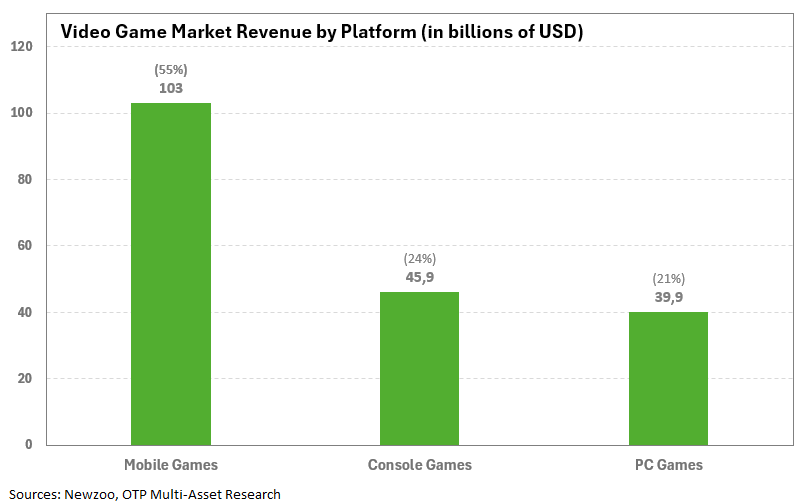
At the same time, however, there are significant differences between the various segments within the industry. The market for premium and AAA games is typically characterized by long development cycles — sometimes spanning several years — significant capital requirements, and high marketing costs, which create substantial barriers to entry for new players. In contrast, in the mobile gaming segment, development costs and the resources required to enter the market are significantly lower, resulting in more intense competition. Development tools powered by artificial intelligence may enable further cost reductions, which could further lower barriers to entry in the long term. As a result, players in the mobile gaming market may face stronger competition, which could negatively impact industry profitability.
Just as with search engines and social media platforms, switching costs for consumers do not appear to be high when it comes to games. However, in titles that require long playtimes, players invest significant time in developing their progress and characters, while in multiplayer games, established communities and social connections can further increase user retention. As a result, more complex games that elicit higher levels of engagement typically have better retention rates, which can provide them with a structural competitive advantage over simpler games.
One of the most important competitive advantages of leading developers and publishers (such as Electronic Arts or Take-Two) is their strong intellectual property and franchises. Well-known brands and a loyal player base enable greater pricing power, particularly for premium and AAA-category games. In the mobile gaming market, by contrast, pricing power stems primarily from monetization efficiency. Revenue comes predominantly from in-game purchases and ads, so the key to success is high user activity and maximizing revenue per player.
In the video game industry as well, increasing attention is being paid to the potential long-term effects of artificial intelligence. Advances in AI-based content-generation technologies could, over time, reduce game development costs and lower barriers to market entry, particularly for smaller and independent studios, which typically produce games with lower-quality graphics. Larger players, however, may be better protected in the short to medium term. Furthermore, a potential decline in the console market could adversely affect publishers whose revenues are heavily tied to traditional console ecosystems. As a result, platform diversification and the development of content available across multiple devices may become an increasingly important strategic consideration for industry players.
The growth profile of the video game industry is gradually shifting toward a more mature phase, particularly in developed markets and the console segment, where signs of user base saturation are becoming increasingly apparent. As a result, growth is increasingly dependent on monetizing existing players and capitalizing on successful franchises. In contrast, the mobile gaming market—particularly in emerging regions—continues to offer favorable growth opportunities thanks to the rise in smartphone usage and the development of digital infrastructure. The industry’s profitability has historically proven to be relatively resilient to economic downturns, as video games are typically considered an affordable form of entertainment. As a result, the sector’s performance is generally determined not by macroeconomic cycles, but rather by content cycles and the timing of major game releases.
Compared to the search engine and social media markets, the video game industry is less concentrated, and competitive advantages stem from different sources. While in the former segments, network effects, data advantages, and scalability are the primary drivers of a sustainable market position, in the video game industry, the most important value-creating factors are successful intellectual property, developer expertise, and loyal player communities. The sector is less predictable and more heavily dependent on the success of individual game releases. From an investor’s perspective, therefore, when evaluating the video game industry, the quality of the content portfolio, the strength of IPs, and monetization capabilities are at least as important as traditional financial metrics.
Get more out of your investments!
Global Markets Services
OTP Global Markets offers a broad range of services in the field of local and international money and capital markets.
Read morePrivate Banking Services
Personal care and expertise with OTP Private Banking, along with the knowledge, security, and innovations of a multinational banking group.
Read more