
The government plans a 4.9% deficit for next year
Related content
Investors are worried – what lies ahead for Brazil?
In a major surprise, Lula won the second round of Brazil’s presidential election, even though markets had previously expected Flávio Bolsonaro to prevail. Lula’s victory triggered a sharp repricing of Brazilian assets, while sentiment deteriorated further shortly afterwards following an unorthodox proposal calling for a substantial reduction in the central bank’s policy rate. For now, it appears that no such plan is under consideration in Brazil, and the president has reaffirmed his commitment to fiscal discipline. Investors, however, remain largely sceptical. Market participants are waiting for concrete measures, and in the near term the key question for Brazil will be whether the anticipated fiscal measures can stabilise the country’s debt trajectory and how the president will reconcile them with his campaign promises.
Hungary: Headline inflation accelerated in line with expectations, while underlying inflation pressures remained elevated
Hungary's headline inflation rose by 0.4 ppts to 2.0% year-on-year in October, up from 1.6% in September. The data was in line with the market consensus (2.0%) and marginally above our forecast (1.9%). The main reason for the acceleration of headline inflation was the further increase of fuel inflation while processed food prices decreased less than expected mainly due to sugar and confectionaries. However, food prices still significantly contributed to the low inflation in Hungary, so the fact that prices of several agricultural commodities have started to rise in recent months, reinforces our view that food prices will no longer contribute to disinflation in 2027.
The government plans a 4.9% deficit for next year and will gradually reach 2.8% by 2030, under the Maastricht criteria
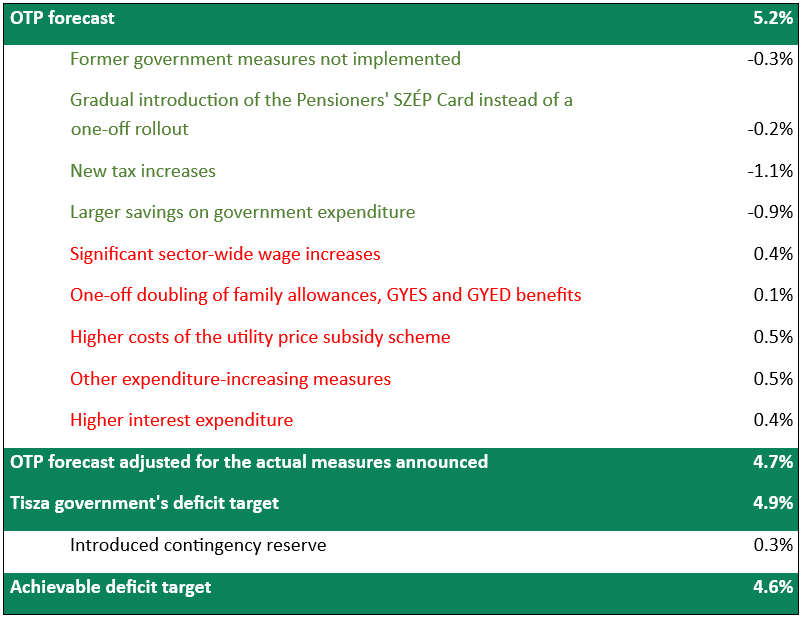
The 2027 fiscal deficit target of 4.9% of GDP is slightly lower than our previous forecast of 5.2%, and significantly below the 7.5% deficit currently expected for 2026. As discussed in our latest flash report, a substantial part of this one-year improvement reflects the fading of one-off factors. However, the government has also announced a number of expenditure-side consolidation measures, which primarily reduce public sector spending. While this implies lower government consumption, it does not directly depress household consumption, resulting in a more efficient way of reducing the deficit compared to traditional austerity measures.
In addition, the government has scaled back several previously announced measures that would have had a significant and lasting negative impact on the fiscal balance. These include limiting the 14th-month pension payment to one week and narrowing the scope of the personal income tax exemption for mothers.
Furthermore, the market is likely to welcome the removal of the retail margin cap, a measure that had been widely viewed as highly distortionary. The government has also set aside a contingency reserve equivalent to 0.3% of GDP to cover unforeseen expenditures; if these funds remain unused, the deficit could be even lower than the targeted 4.9%. In addition, the projected growth path appears relatively conservative (GDP growth: 2.4%), which enhances the credibility and feasibility of the 2027 budget.
However, the medium-term fiscal trajectory presented by the government nevertheless raises question marks regarding the timing of euro area accession. Under the published plan, the fiscal deficit is expected to fall below 3% of GDP only by 2030, implying that the country could exit the Excessive Deficit Procedure (EDP) no earlier than 2031. Given past experience, investors may view the projected additional 0.6% of GDP reduction in the deficit in the 2030 election year with a degree of reservation.
This is further complicated by the fact that, apart from the phase-out of the retail margin cap, other market-distorting measures remain in place, notably the sector-specific windfall taxes and the utility price subsidy scheme. Both issues were highlighted in the recommendations addressed to Hungary under the European Semester (see Table 2) and could become part of the discussions surrounding eventual participation in ERM II and euro adoption.
Following the announcement series that began on Monday, the forint weakened from around 362.5 to 365.4 against the euro, representing a depreciation of roughly 0.6%. In the bond market, the yield on the Hungarian 10-year bond has increased by 24 basis points since Tuesday, while yields on both the German Bund and the US 10-year Treasury declined by around 2-3 basis points in the same period. Investor reservation regarding the announced fiscal path could result in persistently higher domestic yields, slowing the process of interest-rate convergence. This would also limit the decline in government interest expenditures, making it more difficult to achieve the targeted 3% fiscal deficit threshold over the medium term.
At the press conference following the Hungarian National Bank’s policy meeting on Tuesday, Varga Mihály argued in favour of a swift entry into the ERM II exchange rate mechanism.
The latest developments point to several possible outcomes. In the baseline scenario, the government successfully implements its planned fiscal consolidation path. Under this scenario, fiscal adjustment proceeds broadly as planned, allowing the country to meet the Maastricht deficit criterion over time, with euro adoption taking place around 2032.
Under a downside scenario, fiscal consolidation could take a back seat to political priorities in the run-up to the elections. In such a case, the pace of deficit reduction would slow, pushing back compliance with the Maastricht fiscal criteria and, consequently, delaying euro adoption. Under this scenario, 2033 would represent the earliest feasible date for joining the euro area.
In a more optimistic scenario, economic growth could exceed the government's relatively conservative baseline projections, while global energy prices normalize more rapidly than expected. This combination would support fiscal consolidation through two channels: stronger growth would boost tax revenues, while lower energy prices could contribute to a decline in international bond yields, reducing government borrowing costs and the funding needs of the utility price subsidy scheme. Under such a scenario, the fiscal deficit could potentially fall below 3% of GDP as early as 2029, allowing the country to meet the Maastricht fiscal criterion sooner than currently envisaged.
Table 1- 2027 deficit compared to the prior OTP forecast (GDP %)
Get more out of your investments!
Global Markets Services
OTP Global Markets offers a broad range of services in the field of local and international money and capital markets.
Read morePrivate Banking Services
Personal care and expertise with OTP Private Banking, along with the knowledge, security, and innovations of a multinational banking group.
Read more