
7.5% deficit is projected for 2026, and 5.2% for next year
Related content
International Markets - Technical Analysis
The two leading U.S. indices have broken their upward trend that had lasted for months, so from a technical perspective, a downward trend remains visible. There is still room for prices to fall, so opening long positions seems early at this point. The Russell 2000 had already signaled significant weakness earlier. Although some buying pressure is currently observable, which could lead to a corrective rally, this appears to be more of a temporary rebound than the start of a sustained uptrend. Following their corrections, the DAX and Stoxx 600 indices also appear to be turning downward again, so the formation of new swing lows cannot be ruled out for them either. The index tracking emerging markets has not yet been able to demonstrate any significant buying momentum, so there is still some room here for further weakness.
Chemical Giant's Chart Signals a Potential Turnaround
Major U.S. indices have broken their longer-term uptrends, triggering a significant market correction. Despite this, there are always stocks that exhibit relative strength and may be able to move against the prevailing market direction. This week, one of the standout names was Dow Inc., which ranked among the strongest performers. The company is one of the world's leading players in the chemical industry.
7.5% deficit is projected for 2026, and 5.2% for next year, as the effect of previous tax cuts new spending measures build up, while one-off expenditures fall out in 2027.
Hungary's ESA-based fiscal deficit increased to 6.4% of GDP in Q2 2026, up from 5.5% in Q1 on a four-quarter (4Q) rolling basis, and from 4.7% in 2025 reflecting a 3.3% deficit in the second quarter compared to a 0.3% surplus in the same period of the previous year (Figure 2). The result was in line with the estimate published in the financial accounts on the same day. The 0.9 ppts deterioration in the deficit was driven primarily by a decline in the revenue-to-GDP ratio of 0.8 ppt, while the expenditure-to-GDP ratio remained broadly unchanged. The widening of the deficit was not unexpected, as the exceptionally strong fiscal position in Q2 2025, driven by one-off dividend payments and elevated EU revenues, dropped out of the four-quarter rolling balance.
Expenditures measured as a share of GDP on a 4Q basis, were mainly affected by lower investment spending (-0.2 ppts) and lower operating expenditures (-0.1 ppt), while financial transfers and public sector wages each increased by 0.1 ppt. The decline in investment was broadly in line with the trend observed in recent quarters, suggesting that the additional EU funds unlocked by the new government had not yet translated into higher public investment by Q2. The reduction in operating expenditures may reflect either expenditure-saving measures introduced by the new administration or the temporary slowdown in government spending typically associated with the transition period following a change in government. Other expenditure categories remained broadly unchanged (Figure 4).
On the revenue side, the deterioration was driven primarily by a 0.6 ppts decline in other revenues, reflecting unfavourable base effects as a substantial amount of current EU transfers was received in Q2 2025. In addition, interest and dividend revenues decreased by 0.3 ppts following the exceptionally large dividend payments recorded in the same period of the previous year. Changes in the remaining revenue categories were relatively small, ranging between -0.1 and 0.1 ppt (Figure 5).
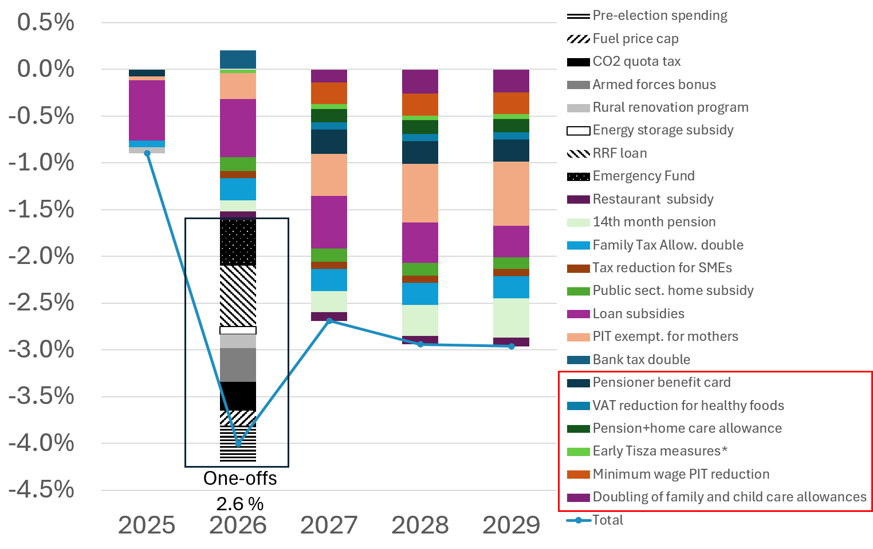
The fiscal deficit in 2026 could reach around 7.5% of GDP, considering both the measures already embedded in the budget and the financial transfers promised by the new government for this year. The previous administration introduced several significant measures last year (outlined in an earlier flash report) that had only a moderate impact on the 2025 deficit but are expected to weigh more heavily in subsequent years. Their effect will be particularly pronounced in 2026 due to several one-off expenditures (Figure 1).
These one-off measures inherited from the previous government have been complemented by policies introduced by the new administration, most notably the Emergency Fund, which amounts to 0.5% of GDP. The fund was established to create fiscal space for addressing the impact of short-term shocks, such as the summer drought and elevated energy prices, and could also finance measures such as the diesel support program, which provides HUF 5,000 per month to eligible households. Finally, the projects financed from RRF loan are expected to cost an additional 0.7% of GDP, which represents a temporary one-off expenditure in 2026 rather than a lasting source of fiscal pressure.
In addition to these one-off measures, the incoming government has introduced a range of permanent spending and revenue measures (Figure 1). Unlike the one-off expenditures discussed above, these measures will have a lasting impact on the budget and will continue to add pressure to an already strained fiscal position in the coming years. Moreover, the government has begun scaling back low-priority legacy investment projects and reviewing agreements that provided limited benefits to the state, such as motorway concession contracts and the financing arrangements of the previous government's space programme. The new administration continues its review of public expenditures to find opportunities to reduce budgetary spending.
The second-quarter cash-based fiscal data showed a surplus of HUF 38.2bn, markedly different from the HUF 758bn deficit recorded under ESA methodology. While the two accounting frameworks cannot be fully reconciled, our calculations suggest that the discrepancy may have been driven by factors such as a significant slowdown in spending under professional chapter-managed appropriations during May and June (and also in July). This was further supported by the postponement of several payments related to motorway development projects that had originally been scheduled for June. The sharp increase in these expenditures in August also points to a timing effect rather than a permanent improvement in the fiscal position. Additionally, the differences in the timing of interest expenditure recognition could also contribute to the discrepancy.
Based on the two months of data available for the third quarter, the strong fiscal performance seen in June continued into July, with the budget posting a surplus of HUF 524bn. August, however, brought a substantial deterioration, with the cumulative deficit widening to HUF 2,311bn. This was primarily attributable to the pre-financing of Recovery and Resilience Facility (RRF) projects, which alone worsened the August fiscal balance by HUF 1,645bn (Figure 7). Excluding these expenditures and the temporarily slower spending by the newly formed government, up to HUF 350 billion of the 950 billion surplus recorded over the previous two months could prove to be lasting.
Looking ahead, we expect the deficit to narrow to around 5.2% of GDP in 2027, as the expiry of one-off spending items more than offsets the deficit-increasing effects of gradually introduced tax exemptions and the partial phase-out of windfall taxes. One-off expenditures amounting to roughly 2.6% of GDP are set to drop out of the budget in 2027. Furthermore, a set of factors help the government reduce the budget deficit, while a number of new measures put additional strain on it. Both are outlined in Figure 1 and Tables 1 and 2. Even though, uncertainty remains high, as the government's detailed budget plans for 2027 are expected to be released in mid-October. These plans should provide a clearer picture of next year's fiscal outlook and the medium-term path towards meeting the Maastricht requirements.
As of yet, the government appears committed to pursuing fiscal consolidation primarily through expenditure restraint, which, based on historical experience, tends to be a more effective approach to reducing deficits. However, achieving genuine structural savings takes time, as does the impact of lower interest expenditures and the savings stemming from reduced national co-financing requirements associated with EU funds. Therefore, it seems unlikely that the deficit will decline very significantly as early as 2027.
Figure 1 – One-off outlays and medium-run effect of major government measures on the budget balance*
Get more out of your investments!
Global Markets Services
OTP Global Markets offers a broad range of services in the field of local and international money and capital markets.
Read morePrivate Banking Services
Personal care and expertise with OTP Private Banking, along with the knowledge, security, and innovations of a multinational banking group.
Read more