
After a sharp correction, the South Korean stock market hit new highs
Related content
US bank shares fell
The third-quarter earnings season in the US has picked up pace following the release of the latest figures from US banks. Based on preliminary expectations, the third quarter is likely to have closed with strong earnings growth for S&P 500 companies, led by the energy and technology sectors. The major US banks have still achieved solid growth on an annual basis, indicating that their operations remain strong, but the pace has clearly slowed in many cases, which has tended to result in negative share price reactions.
Commodities - Technical Analysis
Gold and silver continued their downward trend, bouncing off key levels. Until their downward trends are broken, they will not be able to produce a significant rise. The fall in oil prices reversed from the $87.5 level and began a slight upward movement. Natural gas remained in an uptrend; a significant rise could even occur if it breaks out upwards. The price of copper has become stuck in a wider range, so the oversold and overbought zones may offer more favourable trading opportunities. The falling prices of wheat and corn have reached key support levels; a buying reaction from these levels could present favourable long opportunities with limited risk.
Following a significant rally at the start of the year, the South Korean stock market broke through key levels; however, the conflict in Iran later intervened, leading to a massive correction in March. By the end of April, the KOSPI had fully recovered from the earlier decline, and the index set a series of new all-time highs. In addition to ongoing corporate governance reforms, the tailwind provided by artificial intelligence significantly supported the rise of the local stock market. Forward-looking earnings expectations are currently rising sharply, and valuations are favorable; however, the potential prolongation of the Middle East conflict and a slowdown in the artificial intelligence boom represent the most significant risks to further gains.
The South Korean stock market has hit a new high
The South Korean stock market got off to a very strong start this year, with the KOSPI rising by about 50% between early January and late February; however, the escalating conflict in Iran temporarily took the wind out of the market’s sails. Having weathered the ~20% correction in March, the index climbed higher again as market participants shifted their focus from the Middle East conflict news cycle to artificial intelligence-related companies and corporate earnings expectations.
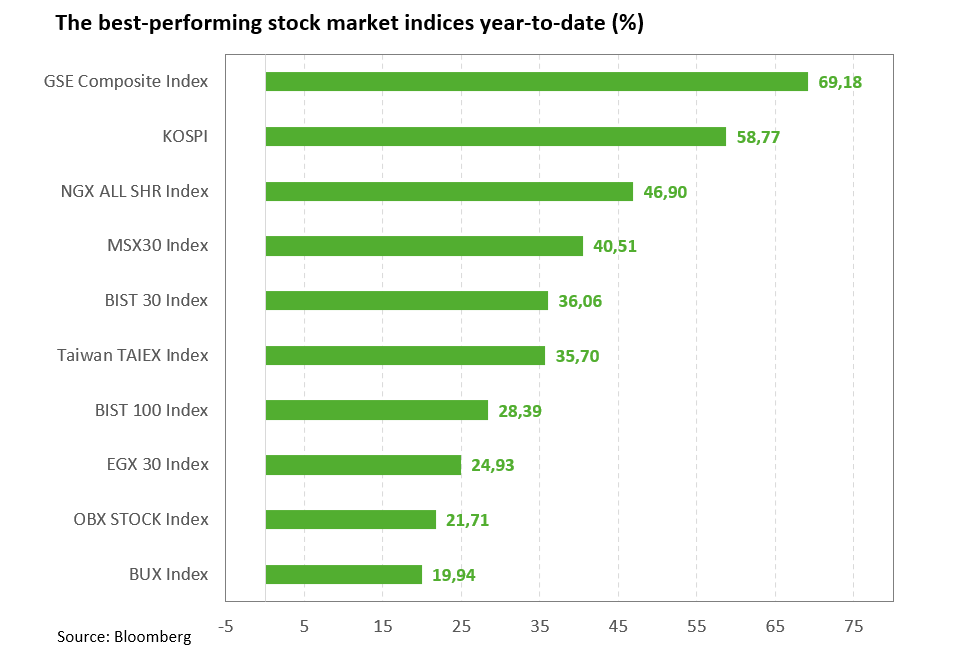
By the end of April, the South Korean stock market had fully recovered from its earlier losses, and the index subsequently rose to one historic high after another. With a year-to-date gain of approximately 58%, the KOSPI is currently the world’s second-best performing stock index, and South Korea has become the world’s eighth-largest stock market; with the total market capitalization of companies listed on the South Korean stock exchange exceeding $4 trillion this year, surpassing even the United Kingdom.
Artificial intelligence has provided a strong tailwind
Artificial intelligence-related technology companies played a key role in the index’s rise: Samsung and chipmaker SK Hynix—the two largest companies on the South Korean stock exchange by market capitalization—had fully recovered from the March correction and reached new highs by the end of April. Samsung released its preliminary first-quarter figures in early April (the detailed Q1 report is due on April 30), with both preliminary revenue and operating profit exceeding expectations, while the latter rose approximately eightfold amid strong demand for artificial intelligence-related memory chips.
SK Hynix has also released its first-quarter results, with both revenue and EPS exceeding expectations; the latter nearly quintupled compared to the same period last year. According to the company’s CFO, demand for high-bandwidth memory chips (HBM, which are essential for training and running artificial intelligence models) will exceed supply over the next three years; and the CFO sought to allay concerns about oversupply by indicating that the company’s investments will increase significantly this year. Samsung and SK Hynix’s 12-month forward earnings estimates have risen sharply so far this year, with analysts currently expecting triple-digit percentage EPS growth for both companies by 2026.
South Korea’s first-quarter GDP also came in as a positive surprise, with the South Korean economy growing by 1.7% (quarter-on-quarter, exceeding expectations). Growth was driven by strong demand for artificial intelligence-related chips, boosting exports and increasing investment. However, some analysts suggest that the growth rate in the first quarter of this year may slow down later on, as the war in Iran begins to take its toll. According to current forecasts, the South Korean economy is expected to grow by 2% this year (following 1% GDP growth in 2025).
Although the boom in semiconductor exports is giving a tailwind to South Korea’s economic growth, some observers believe that deeper structural weaknesses continue to weigh on the country’s long-term development trajectory. Some commentators argue that policy measures are needed to reduce dependence on semiconductors, and that longer-term growth-stimulating measures should also take into account the aging population and low birth rates.
What does this year hold for South Korea?
Meanwhile, some of the major brokerage firms have also become more optimistic: JP Morgan’s base-case scenario now projects a KOSPI level of 7,000 for this year, citing a decline in risk premiums related to Iran as well as more favorable earnings outlooks driven by the technology and memory manufacturing sectors. Meanwhile, Goldman Sachs has set a target price of 8,000 points for the South Korean index.
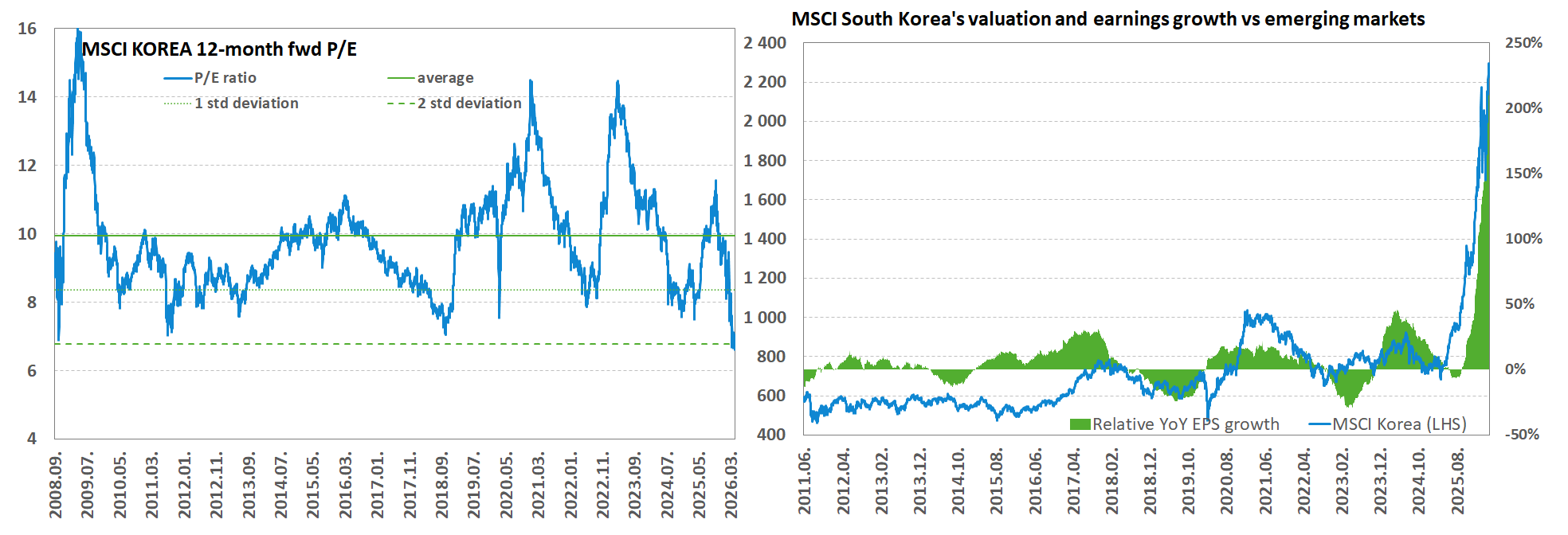
Forward-looking earnings estimates for the MSCI Korea Index have risen sharply so far this year. In terms of valuation, the MSCI Korea Index’s 12-month forward P/E ratio of 6.81 is lower than both the MSCI Emerging Markets Index (11.8) and the MSCI ACWI Index (17.91), as well as the MSCI Korea Index’s long-term average.
In addition to the tailwind provided by the artificial intelligence boom, corporate governance reforms may also have significantly contributed to the rise in the local stock market. In February, the South Korean parliament amended the Commercial Code once again: listed companies must cancel their newly acquired treasury shares. The amendment aims to close legal loopholes that, in certain cases, company management has exploited to consolidate control over their firms. If companies fail to repurchase their own shares within one year, they will be subject to an administrative fine. It is also worth noting that dual listings for companies on the capital market are being tightened.
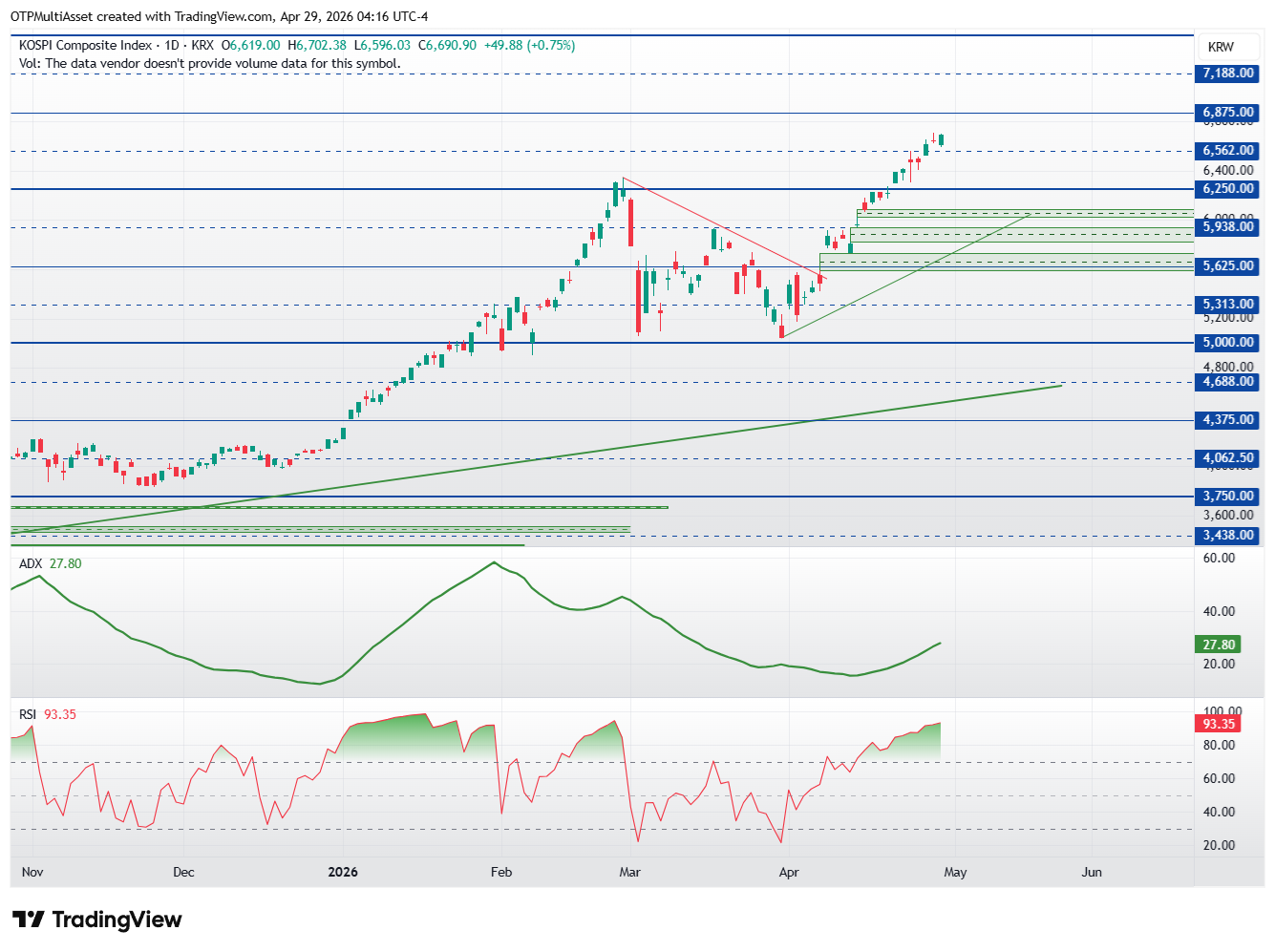
The index first broke through the 5,000-point level—a target previously set by the South Korean president—in January, and by February, the KOSPI had already surpassed the 6,000-point mark. Later, the conflict with Iran halted the rise, as South Korea imported ~20% of its LNG needs and ~70% of its oil needs from the Middle East last year. Amid concerns over the closure of the Strait of Hormuz, the South Korean stock market suffered its largest single-day drop in history on March 4. By the end of April, however, having fully recovered from earlier losses, the index hit a series of new closing highs. In the short term, news flow regarding the war in Iran and the corporate earnings season will likely be decisive. Looking further ahead, market participants are focusing on several risks: potentially persistently high energy costs in the wake of the Middle East conflict, as well as a slowdown in the artificial intelligence investment cycle due to the protracted Iranian war and deteriorating growth prospects, could leave their mark on both the South Korean stock market and the economy.
The break above 5625 triggered the ongoing upward trend. Despite the overshoot, the day when we might see heavy selling has not yet arrived. We do not yet see a reversal pattern forming; above 6875, correction days could easily occur that could reach a 10% decline.
Get more out of your investments!
Global Markets Services
OTP Global Markets offers a broad range of services in the field of local and international money and capital markets.
Read morePrivate Banking Services
Personal care and expertise with OTP Private Banking, along with the knowledge, security, and innovations of a multinational banking group.
Read more