
Why India?
Related content
US bank shares fell
The third-quarter earnings season in the US has picked up pace following the release of the latest figures from US banks. Based on preliminary expectations, the third quarter is likely to have closed with strong earnings growth for S&P 500 companies, led by the energy and technology sectors. The major US banks have still achieved solid growth on an annual basis, indicating that their operations remain strong, but the pace has clearly slowed in many cases, which has tended to result in negative share price reactions.
Commodities - Technical Analysis
Gold and silver continued their downward trend, bouncing off key levels. Until their downward trends are broken, they will not be able to produce a significant rise. The fall in oil prices reversed from the $87.5 level and began a slight upward movement. Natural gas remained in an uptrend; a significant rise could even occur if it breaks out upwards. The price of copper has become stuck in a wider range, so the oversold and overbought zones may offer more favourable trading opportunities. The falling prices of wheat and corn have reached key support levels; a buying reaction from these levels could present favourable long opportunities with limited risk.
India is the world’s most populous country and has been one of the world’s fastest-growing economies over the past two decades. Today, India is the world’s sixth-largest economy, and according to the prime minister’s plans, the country is set to be transformed into a developed economy by 2047, the centennial of its independence. We present India, which is also featured in our Investment Outlook, in a multi-part analysis, focusing primarily on the country’s economy and its key stages of development in this first installment.
Where did it start?
Following the partition of British colonial India in 1947, independent India was established, and after the adoption of the constitution, it became a sovereign republic in early 1950. The constitution formally abolished caste-based discrimination within society, but the elimination of inequalities was a slow process.
After the country gained independence, the economy was initially characterized by a distinctly Soviet-style, state-controlled, overregulated planned economy. Centralized planning dominated, focusing primarily on key industries, railways, and energy production in economic development. The Green Revolution of the 1960s brought fundamental changes to agriculture: in addition to higher-yielding seed varieties, modern irrigation techniques and fertilizer application were adopted, thereby increasing agricultural productivity and improving food security. This was vital, as the population began to grow explosively following the country’s independence.
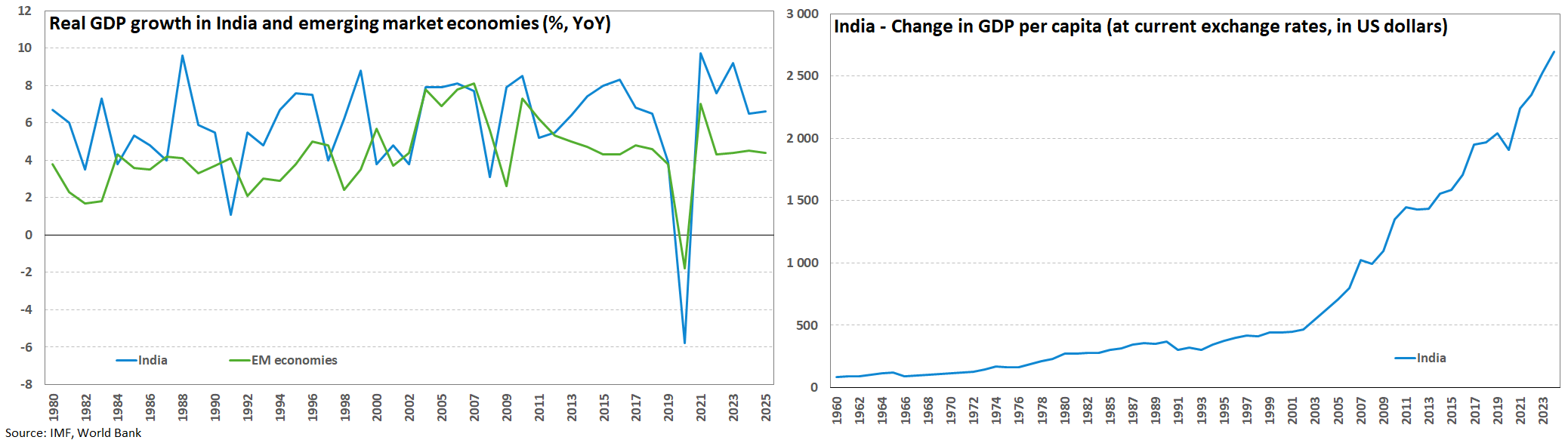
Despite efforts to develop the economy, growth remained modest until the 1970s, then began to accelerate in the 1980s, supported not only by initial reforms but also by fiscal expansion financed by foreign and domestic sources. The real breakthrough, however, came with the 1991 balance of payments crisis, as this forced the country to break with the socialist model and launch far-reaching reforms and liberalization. As a result, the Indian economy’s growth rate was visibly faster after the 1990s compared to its growth in the preceding period and the growth rates of other emerging market economies.
Changed gears
Economic growth gradually accelerated following the reforms of the 1990s: according to the World Bank, the post-1990s growth trajectory can be divided into three phases. The first growth phase (between 1991 and 2003) was characterized by an average annual economic growth rate of 5.4%, representing an acceleration of one percentage point per year compared to the previous two decades. Following the reforms, both the economic structure and the regulatory framework underwent significant changes.
The door was opened to private investment in a significant portion of the industrial sector, and domestic and foreign private investment was permitted in several sectors. The rupee was made partially convertible, and tariffs and non-tariff barriers were reduced. The tax system was also overhauled; in addition to simplifying taxation and lowering tax rates, indirect tax reforms were implemented.
The second phase of growth—the few years preceding the 2008 crisis—was characterized by a period of strong growth, supported not only by rapid global growth and abundant liquidity but also by the reforms of previous years. Between 2004 and 2008, the average annual GDP growth rate was nearly nine percent. In addition to strong domestic demand, investment, and a rise in industrial production, growth in export volumes also played a role. India increased its share of global export markets to an all-time high for both goods and services. India’s most important export products include, among others, refined petroleum products, non-industrial diamonds, jewelry, as well as electrical and electronic equipment.
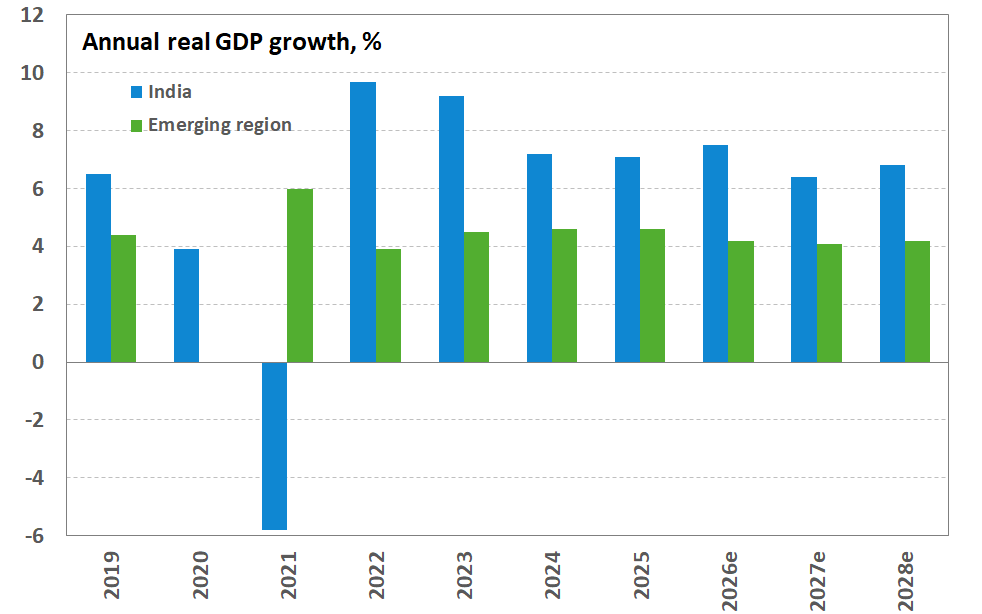
In the third phase, the growth rate then slowed; this period coincided with the onset of the 2008–09 crisis, which plunged many economies into a severe recession globally. Following the crisis, India’s economic growth accelerated again, and the growth rate remained higher (between 2010 and 2025) compared to that of other emerging market economies. This situation persists to this day; as the World Bank projected a 6.6% GDP growth rate for India in fiscal year 2027 (the twelve months beginning in April 2026), even as the Iran war and supply chain disruptions take their toll on economic activity. However, despite the slowdown, India remains one of the world’s fastest-growing economies, and growth is expected to outpace that of other emerging markets in the coming years.
Get more out of your investments!
Global Markets Services
OTP Global Markets offers a broad range of services in the field of local and international money and capital markets.
Read morePrivate Banking Services
Personal care and expertise with OTP Private Banking, along with the knowledge, security, and innovations of a multinational banking group.
Read more