
What does the coming year hold for Brazil?
Related content
US bank shares fell
The third-quarter earnings season in the US has picked up pace following the release of the latest figures from US banks. Based on preliminary expectations, the third quarter is likely to have closed with strong earnings growth for S&P 500 companies, led by the energy and technology sectors. The major US banks have still achieved solid growth on an annual basis, indicating that their operations remain strong, but the pace has clearly slowed in many cases, which has tended to result in negative share price reactions.
Commodities - Technical Analysis
Gold and silver continued their downward trend, bouncing off key levels. Until their downward trends are broken, they will not be able to produce a significant rise. The fall in oil prices reversed from the $87.5 level and began a slight upward movement. Natural gas remained in an uptrend; a significant rise could even occur if it breaks out upwards. The price of copper has become stuck in a wider range, so the oversold and overbought zones may offer more favourable trading opportunities. The falling prices of wheat and corn have reached key support levels; a buying reaction from these levels could present favourable long opportunities with limited risk.
The Brazilian stock market may end the year on a high note, and the future also promises to be eventful. The US president recently withdrew tariffs on several Brazilian food products, although it appears that a trade agreement between the US and Brazil will have to wait a while longer. The Brazilian base rate is still at its highest level in nearly two decades, but if inflation could remain below the central bank's target range by the end of the year, this could pave the way for interest rate cuts early next year, and the Brazilian stock market may already be pricing in the impending monetary easing. The 2026 presidential election could also be an important catalyst, although it is not due until next fall. However, the heightened expectations were clearly demonstrated by the fact that the announcement by the son of former president Jair Bolsonaro that he would run in the presidential election thoroughly frightened market participants. Overall, in addition to the attractive valuation of the Brazilian market, the upcoming interest rate cuts may also be favorable, while the presidential election year may still hold some surprises. All in all, it will be worth keeping an eye on the Brazilian stock market next year.
It was good news for Brazil when Donald Trump withdrew tariffs on several Brazilian food products at the end of November: among other things, the US president decided to withdraw the high tariffs imposed in July on coffee, cocoa, fruit, and beef. The United States justified the imposition of higher tariffs on Brazil with criminal proceedings against the former Brazilian president, while the Brazilian Supreme Court ordered Jair Bolsonaro to serve a 27-year prison sentence. The White House justified its latest decision in part by stating that the United States cannot produce enough of the relevant products to meet domestic demand, but the president also focused on the affordability of food, as commentators suggested that rising food prices may have played a role in the decline in his popularity.
Trade negotiations between the US and Brazil are continuing, and in early December, the presidents of the two countries discussed sanctions and trade issues over the phone. It is unclear when the United States and Brazil will reach a trade agreement, but even so, the US tariff relief on Brazilian food products was good news. However, preliminary expectations already anticipated that the continuous economic growth of the past quarters could slow down in the third quarter, which could have been influenced by the strict monetary policy and the 50% tariffs imposed by the US on Brazilian exports.
Compared to the second quarter, the Brazilian economy grew by 0.1% in the third quarter (slightly below the 0.2% expectation), while year-on-year GDP growth was 1.8% (the consensus expected 1.7% growth). Interest rates are at their highest levels in nearly two decades, and the Brazilian central bank's tight monetary policy is slowing down the economy. While some expect that if the central bank starts cutting interest rates soon, most of the stimulating effect of monetary easing will not be felt until 2027. Expectations for this year are for GDP growth of 2.2%, while next year could see a further slowdown, with the consensus currently expecting growth of 1.7% for 2026.
The possibilities for increasing public spending are limited, while external demand is weakening; however, some expectations are that raising the income tax exemption threshold, which provides more resources to some middle-income households, could be supportive. The question is when the central bank will act: inflation rose by 0.09% in October compared to the previous month (the consensus expected a 0.15% increase), while annual inflation slowed from 5.17% to 4.68%, the slowest pace since September 2024. If the rate of price increases remains in line with expectations for the rest of the year, inflation would remain below the central bank's target range by the end of the year; according to some commentators, this could pave the way for interest rate cuts early next year.
The rise in the Brazilian stock market since the end of October may have been supported by expectations of local monetary easing, so the market may already have begun to price in the upcoming interest rate cuts. A trade agreement with the United States, if concluded, and the 2026 elections could be further important catalysts in the future. Although the latter is not due until the fall of 2026, the heightened expectations surrounding the elections were clearly reflected in the Brazilian stock market's sharp decline from its historic high in early December, after the son of the imprisoned former president, Flavio Bolsonaro, announced that he could run for president next year with his father's support, which seems to have thoroughly frightened investors. Some market participants probably expected that the governor of Sao Paulo, who is considered more market-friendly, would be the right-wing's most likely candidate to defeat the current president.
President Lula has already announced that he may run for re-election next year, and the latest opinion polls show Lula ahead of Sao Paolo Governor Tarcisio de Freitas. Although it is not yet clear whether Flavio Bolsonaro will actually run for president, commentators note that presidential nominations will only be officially confirmed at party conventions next August. In this regard, it will be an important indicator that in April, executive officials running for the presidency will have to resign from their positions (unless they are running for re-election).
Brazilian stock market could end a good year
Overall, the Brazilian stock market may close this year on a high note, and next year also promises to be very exciting. In parallel with the rise of the Brazilian stock market, valuations have also crept up, but the MSCI Brazil index's 12-month forward P/E ratio of 9.63 remains lower than the MSCI Emerging Markets index's forward P/E ratio of 13.49. Brazilian 12-month forward EPS expectations have been creeping up again since early August, while 12-month analyst expectations for the Bovespa index currently suggest upside potential of ~12.7%.
Looking ahead, favorable valuation and possible interest rate cuts could also provide support. The trade agreement between the US and Brazil will likely require more time, while the 2026 presidential election could be an important catalyst, particularly with regard to the candidates' proposals on public finances and structural reforms. All in all, it will be worth keeping an eye on the Brazilian stock market next year.
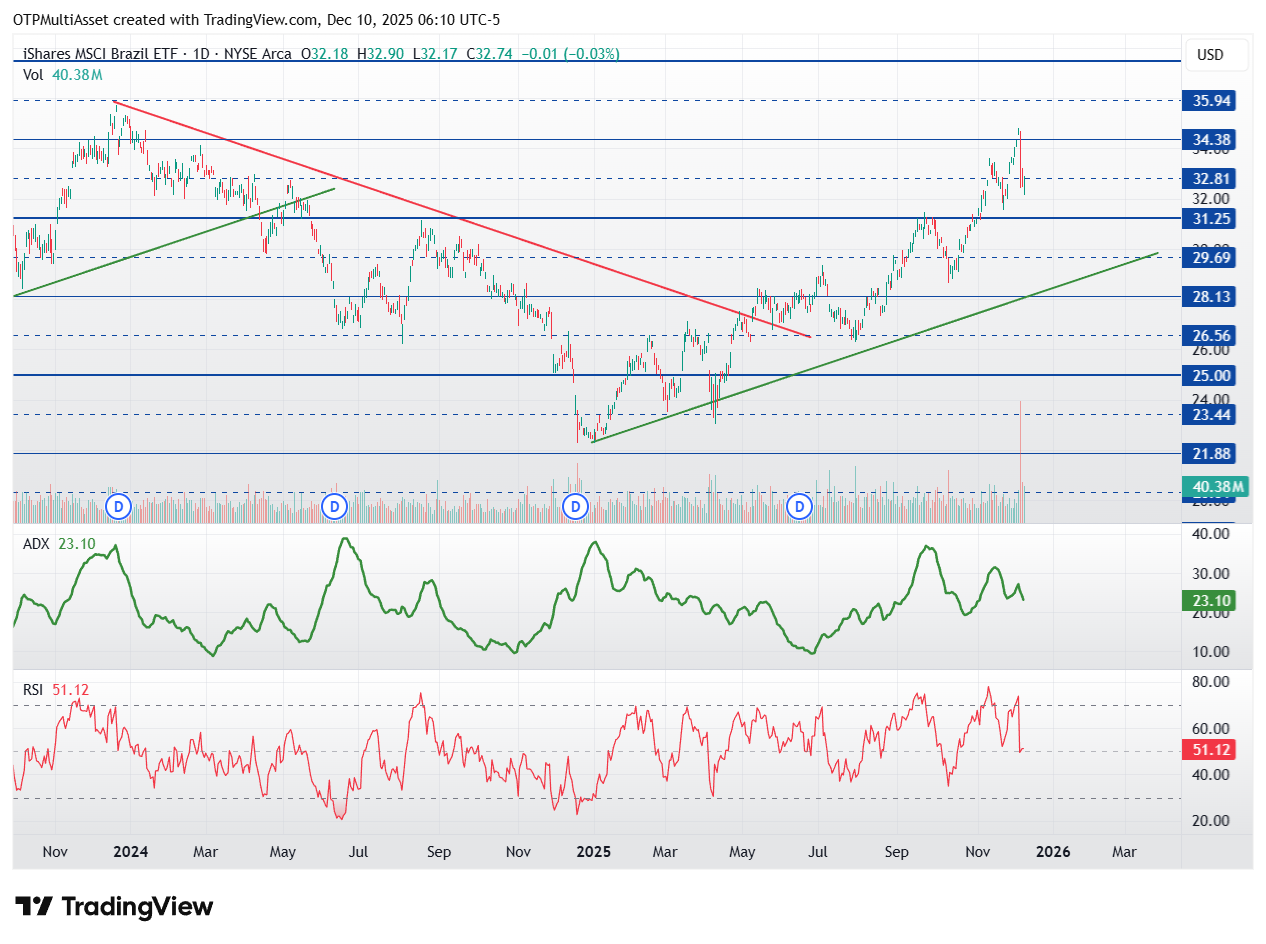
EWZ - iShares MSCI Brazil ETF – technical picture
Recently it reached the zone above 34.38, which was already considered a selling area. The rapid decline last week also suggests that buying liquidity has weakened significantly in this range. This weakening momentum confirms this, so it is not worth opening a buying position on this curve at the moment. The 31.25 level may serve as support in the short term, but the only really strong long zone is around 28.13. If the price does try to reach a new high, the 37.50 level would be very strong resistance and could also be suitable for opening a short position.
Get more out of your investments!
Global Markets Services
OTP Global Markets offers a broad range of services in the field of local and international money and capital markets.
Read morePrivate Banking Services
Personal care and expertise with OTP Private Banking, along with the knowledge, security, and innovations of a multinational banking group.
Read more