
What can we expect from Japan next year?
Related content
US bank shares fell
The third-quarter earnings season in the US has picked up pace following the release of the latest figures from US banks. Based on preliminary expectations, the third quarter is likely to have closed with strong earnings growth for S&P 500 companies, led by the energy and technology sectors. The major US banks have still achieved solid growth on an annual basis, indicating that their operations remain strong, but the pace has clearly slowed in many cases, which has tended to result in negative share price reactions.
Commodities - Technical Analysis
Gold and silver continued their downward trend, bouncing off key levels. Until their downward trends are broken, they will not be able to produce a significant rise. The fall in oil prices reversed from the $87.5 level and began a slight upward movement. Natural gas remained in an uptrend; a significant rise could even occur if it breaks out upwards. The price of copper has become stuck in a wider range, so the oversold and overbought zones may offer more favourable trading opportunities. The falling prices of wheat and corn have reached key support levels; a buying reaction from these levels could present favourable long opportunities with limited risk.
Japan has had an eventful few months, and the local stock market is also set to close a strong year: the Nikkei broke through the 50,000 mark for the first time this year, as market participants responded with increased optimism to the new prime minister and Sanae Takaichi's growth-oriented policy stance, in addition to ongoing corporate governance reforms. However, in terms of valuation, the Japanese stock market has become expensive in the meantime, and although there are still arguments in its favor, we believe that market participants have now almost completely priced in the good news and that the scope for further gains currently appears rather limited. We have therefore decided to remove Japan from our list of preferred regions.
Japan has had an eventful few months: the new leader of the ruling party was finally elected prime minister after a new coalition was formed, and in mid-December, the upper house of parliament approved an extra budget of approximately $118 billion to finance the comprehensive economic package previously approved by Sanae Takaichi's government.
Japan's GDP declined in the third quarter, and according to revised data, the economy contracted by 2.3% (annualized). Among other factors, weaker exports played a role in the decline, following front loading of shipments ahead of the introduction of US tariffs. Although some commentators believe that this may strengthen the government's arguments for further fiscal stimulus, others expect that the economic upturn will not stall after what is expected to be only a short-term downturn.
Inflation in Japan rose to 3% in October, as expected (year-on-year, following 2.9% in the previous month), while core inflation, excluding food and energy prices, rose to 3.1% after prices for household goods and leisure services also increased in the second half of the fiscal year, partly due to higher labor costs and a weaker yen. Based on the subsequent Tokyo inflation data, inflation appeared to remain sticky: headline inflation in November remained unchanged at 2.7%, while annual core inflation was 2.8% (unchanged from the previous month, but still above the central bank's 2% target), while the consensus forecast was 2.7%. Comprehensive Japanese inflation data for November will be released on December 19, shortly before the Bank of Japan's interest rate decision.
At its December meeting, the Bank of Japan is likely to raise interest rates again, by 25 basis points to 0.75%. Market participants have most likely already priced in this move, so investors are mainly focusing for the central bank's forward guidance. The central bank governor is likely to be cautious in his messaging and will not hint at the timing of future rate hikes, but his comments on the neutral interest rate level are likely to be of particular interest.
The Japanese prime minister is not in an easy position
The prime minister, who supports fiscal stimulus, is not in an easy position: although commentators say that the fuel tax reduction and energy bill subsidies included in the recently announced package may reduce inflation somewhat, there is a risk that the potentially higher incomes of households as a result of the stimulus, combined with stronger demand, could also push up inflation. In addition, market participants are paying close attention to whether the prime minister will try to exert pressure on the central bank or influence monetary policy in other, more covert ways; if this happens, it could be politically very risky for the government as inflation expectations rise.
The government appears open to intervening in the currency market if further yen weakness requires it. However, following the recent rise in Japanese long-term bond yields, and a cautious tone was evident in communications, with the finance minister recently stating that the government is carefully seeking a balance between supporting the economy and avoiding further inflation.
It is also worth mentioning that the prime minister's earlier comments on Taiwan caused diplomatic tension between Japan and China. Although Japanese politicians have made behind-the-scenes attempts to defuse the situation, preliminary industry estimates suggest that Japan's GDP growth could decline by a total of ~0.1 percentage points if tensions between the two countries persist.
We are removing Japan from our list of favorite regions
Overall, the Japanese stock market is set to close the year on a high note: the Nikkei broke through the 50,000 mark for the first time this year, as market participants responded with increased optimism to the new prime minister and Sanae Takaichi's growth-oriented policy stance, in addition to ongoing corporate governance reforms.
However, given the increasing risks, the Japanese stock market is no longer cheap in terms of valuation, with the MSCI Japan index's 12-month forward P/E ratio of 16.71 more than one standard deviation above the index's long-term average, and if we exclude the period surrounding the Covid pandemic, based on historical examples, there is virtually no room for further increases in valuations. Thus, the local stock market should also increasingly rely on earnings growth: forward EPS expectations are rising, and the weaker yen may also provide support, along with the fiscal support provided by the Takaichi administration. However, if interest rates are indeed raised in December, it is questionable how much further the Bank of Japan can raise interest rates next year and how quickly the tailwind provided by monetary policy could turn into a headwind for the stock market in the future.
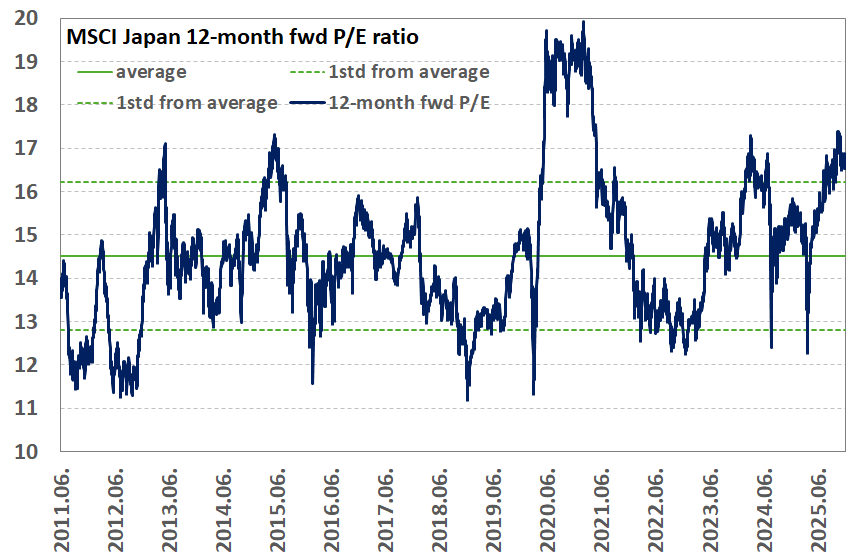
Despite the uncertainties, it will be worth keeping an eye on the Japanese stock market in 2026: although we do not see any significant risks associated with the local stock market and there are still arguments in favor of Japanese stocks, we believe that market participants have already priced in most of the positives. Thus, looking ahead to next year, there may still be some room for growth, but at present this seems rather limited, so we are removing Japan from our list of preferred regions.
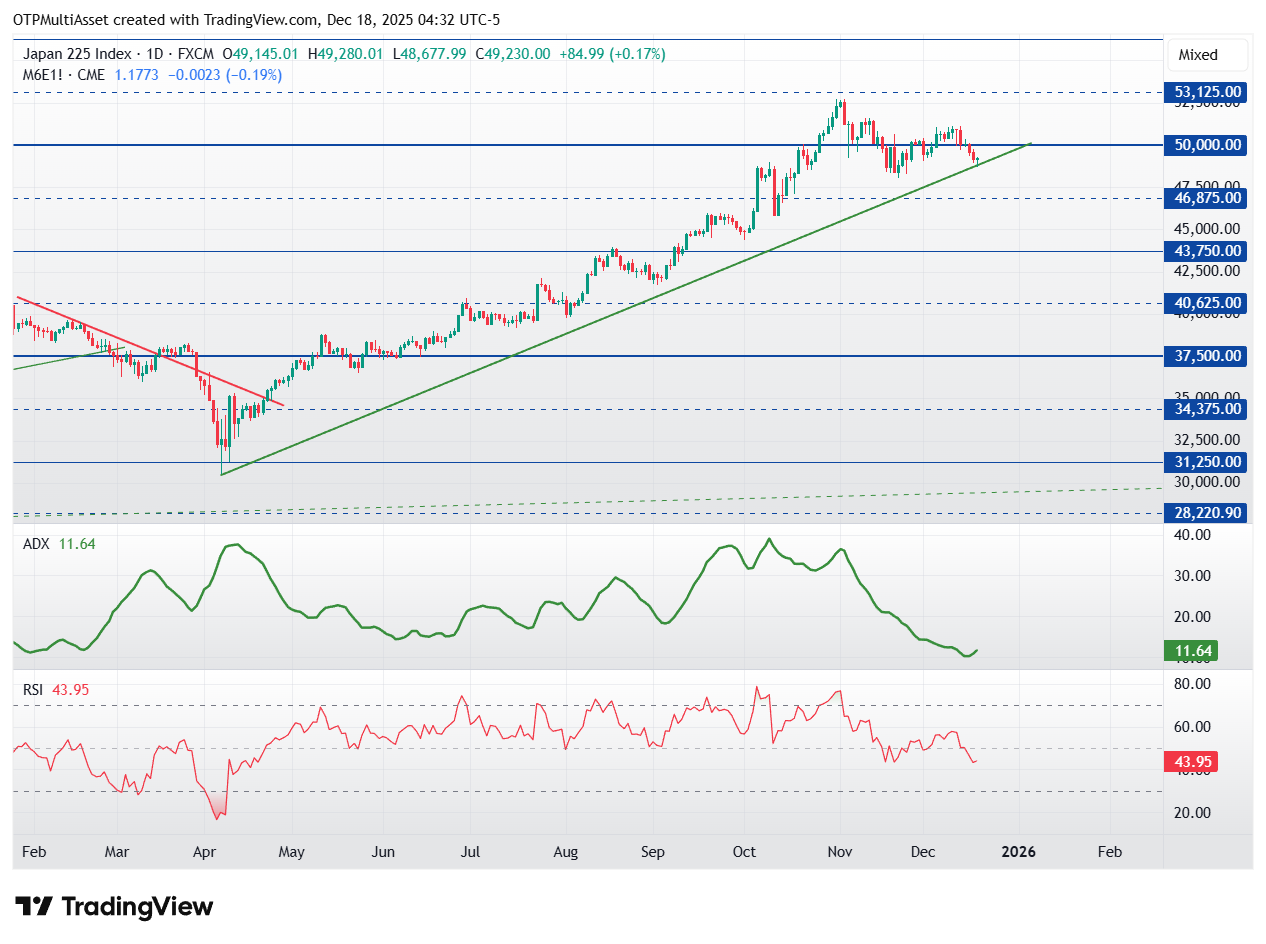
Nikkei technical picture
A break in the uptrend is on the agenda; closing below the minor natural level of 48437 could signal a short and turn the movement into a downward trend. In this case, the minimum expected level would be around 43750. It is worth waiting to buy; this pattern is not suitable for long-side entry.
Get more out of your investments!
Global Markets Services
OTP Global Markets offers a broad range of services in the field of local and international money and capital markets.
Read morePrivate Banking Services
Personal care and expertise with OTP Private Banking, along with the knowledge, security, and innovations of a multinational banking group.
Read more