
What can we expect from India this year?
Related content
US bank shares fell
The third-quarter earnings season in the US has picked up pace following the release of the latest figures from US banks. Based on preliminary expectations, the third quarter is likely to have closed with strong earnings growth for S&P 500 companies, led by the energy and technology sectors. The major US banks have still achieved solid growth on an annual basis, indicating that their operations remain strong, but the pace has clearly slowed in many cases, which has tended to result in negative share price reactions.
Commodities - Technical Analysis
Gold and silver continued their downward trend, bouncing off key levels. Until their downward trends are broken, they will not be able to produce a significant rise. The fall in oil prices reversed from the $87.5 level and began a slight upward movement. Natural gas remained in an uptrend; a significant rise could even occur if it breaks out upwards. The price of copper has become stuck in a wider range, so the oversold and overbought zones may offer more favourable trading opportunities. The falling prices of wheat and corn have reached key support levels; a buying reaction from these levels could present favourable long opportunities with limited risk.
This year has started off excitingly for India after it managed to conclude a trade agreement with the European Union, and it may soon do the same with the United States, which could lead to a reduction in the high US tariffs imposed on India. All this has a positive impact on this year's growth prospects and may also help boost profit growth in the corporate sector. Although forward-looking profit expectations have been growing nicely since last summer, the Indian stock market is by no means cheap in terms of valuation. However, looking further ahead, we continue to see potential in India, which is also included in our investment outlook.
US tariffs on India may be reduced
In early February, the US president announced that tariffs imposed on India would be reduced. The two countries have published an interim trade framework, and an official trade agreement between India and the United States could be signed in March, although the parties say that further negotiations are needed to finalize it. US import tariffs on Indian products could thus be reduced from 25% to 18%. India also plans to purchase US goods, oil, gas, precious metals, aircraft, and aircraft parts, among other things, worth USD 500 billion over five years. As part of the agreement, India will also eliminate or reduce tariffs on all US industrial goods and on a number of US food and agricultural products.
At the same time, Donald Trump is removing the additional 25% tariff previously imposed on Indian products by executive order, after India committed to halting Russian oil imports. US officials are monitoring the situation and may later propose reinstating the tariff if India resumes purchasing Russian oil. Thus, with the elimination of tariffs related to Russian oil purchases and the reduction of tariffs on Indian products, tariffs on Indian products exported to the US could be reduced from 50% to 18%.
There are still some details to be clarified, but the agreement between the US and India could have a positive impact on Indian growth, as well as reducing geopolitical headwinds. Although the Indian economy is not primarily export-driven, around one-fifth of the country's total exports go to the United States. India reportedly wanted to negotiate a 15% tariff (similar to Japan and South Korea), but the 18% US tariff that was agreed upon is still somewhat more favorable than the tariffs of other major Southeast Asian exporting countries.
With the recently announced 18% (reciprocal) tariff, the average US tariff on imports from India could fall to 16% (from 35%). India's GDP derives ~1.7% from exports of goods to the US, and according to preliminary industry estimates, only ~0.4% of India's GDP could be at risk if the new tariffs are introduced (compared to ~0.9% of GDP that could have been at risk under the higher tariffs in place prior to the announcement).
India has also reached an agreement with the European Union
Not long ago, India also managed to conclude a free trade agreement with the European Union, which is expected to double EU exports to India by 2032 by reducing or eliminating customs duties. In addition, over the next seven years, the EU will reduce tariffs on goods imported from India by 99.5% and reduce tariffs on Indian marine goods, leather and textile products, and chemicals to zero. Certain agricultural products (soybeans, rice, beef) are not covered by the agreement, but India would reduce tariffs on European cars from 110% to 10% over five years, affecting a quarter of a million cars annually with price tags above €15,000, with tariffs falling immediately to 30-35% once the agreement comes into force.
According to preliminary industry estimates, the free trade agreement between the EU and India could increase EU exports by nearly $20 billion annually and raise EU GDP by 0.1 percentage points per year. Based on preliminary expectations, India could gain $11.7 billion annually (which could mean 0.3% GDP growth, based on 2024 GDP data). Some commentators say that this also represents a strategic shift in geopolitical terms, as a trade agreement with the European Union could benefit both sides and provide diversification vis-a-vis the United States and China.
The next annual budget was announced
In addition to trade agreements, it is also worth mentioning the recently presented budget for the next financial year. In fiscal year 2027 (ending in March 2026), growth is expected to be between 6.8% and 7.2%, according to government projections, while the budget deficit target is set at 4.3% of GDP, compared to the 4.4% target for the current fiscal year, which is expected to be met. According to credit rating agency S&P, India will meet its deficit target for fiscal year 2027, even though the government is expecting lower revenues from goods and services taxes as a result of previous tax rate simplifications.
Despite the planned reduction in the deficit, the government has planned to borrow 17.2 trillion rupees (USD 187 billion) for the next fiscal year, which is higher than expected and would represent an increase of ~18% compared to the revised figures for the current year. There are plans to increase the program for the electronic components sector (to 400 billion rupees), and the government will invest 100 billion rupees in biopharmaceutical research over the next five years. Defense spending—on new military equipment and other assets—will increase by 18% in the next fiscal year.
Some of the comments on the budget note that the ISM 2.0 (India Semiconductor Mission) framework has shown a shift towards AI and semiconductors, which previously relied heavily on assembly using imported technology, but would later focus on high-value segments of the global value chain, including the manufacture of equipment and materials, reinforcing India's full intellectual property rights in the fields of semiconductors, artificial intelligence, biotechnology, defense, and advanced manufacturing. To encourage capital investment in digital infrastructure, the budget proposes tax exemptions until 2047 for foreign companies providing global cloud services that use Indian data centers and local resellers.
However, some market participants reacted negatively to the budget proposal to raise the securities transaction tax on stock futures from 0.02% to 0.05% and to increase the tax on option premiums and option exercises to 0.15%. However, looking a little further ahead, the budget shows that India would increase domestic production and reduce its dependence on imports, especially from China. In the next fiscal year, 80 billion rupees will be allocated as manufacturing subsidies for semiconductor and display manufacturing, with vehicles, IT hardware, and pharmaceuticals also receiving a significant share.
What can we expect from India this year?
Following US tariff concessions and the expected imminent conclusion of a trade agreement, the rupee strengthened significantly against the dollar in early February, and some market participants believe there may still be some room for further strengthening in the short term. Following the trade announcements, the Indian central bank held an interest rate meeting, at which it left interest rates unchanged (at 5.25%, in line with majority expectations). With inflation below the 4% target, the central bank has cut interest rates by a total of 125 basis points since February last year. Higher government spending could boost economic performance, and the trade agreement with the US was also good news, so the central bank's neutral stance and comments suggested that interest rates are unlikely to change in the coming months.
Indian stock indices corrected downward from their historic highs at the beginning of the year, and despite the trade agreement with the EU, news about the next fiscal year's budget failed to improve sentiment, while the aforementioned plan to raise the securities transaction tax was understandably not well received by market participants. However, the upcoming trade agreement with the US came as a positive surprise, and both the Sensex and Nifty50 indices jumped in early February.
While the securities transaction tax has cast a shadow over the mood, India is clearly focusing on longer-term goals: lower US tariffs could remove one of the most important external barriers to Indian growth, easing pressure on exports and investment. All this could make India more attractive to companies looking to diversify their manufacturing, reinforcing the prime minister's ambition to transform India into a developed market economy by 2047.
Forward-looking earnings expectations for the Indian stock market have been rising steadily since July last year, albeit with minor interruptions. In terms of valuation, however, the Indian market is not cheap, with MSCI India's forward P/E ratio of 21.74 higher than both the MSCI Emerging Markets Index (13.02) and the MSCI ACWI Index (19.04).
However, in the longer term, there are still reasons to be optimistic about India: its favorable demographics, its significant domestic market, and the shift from a former agriculture-driven economic model to a service-driven one, with a focus on digitalization, financial services, and technological transformation. According to BlackRock's CEO, India has the potential to become one of the defining global growth stories of the next 20-25 years, so investors should also look at the country's development from a long-term perspective. We will also be closely monitoring developments in India's economy and stock market, which is included in our Investment Outlook.
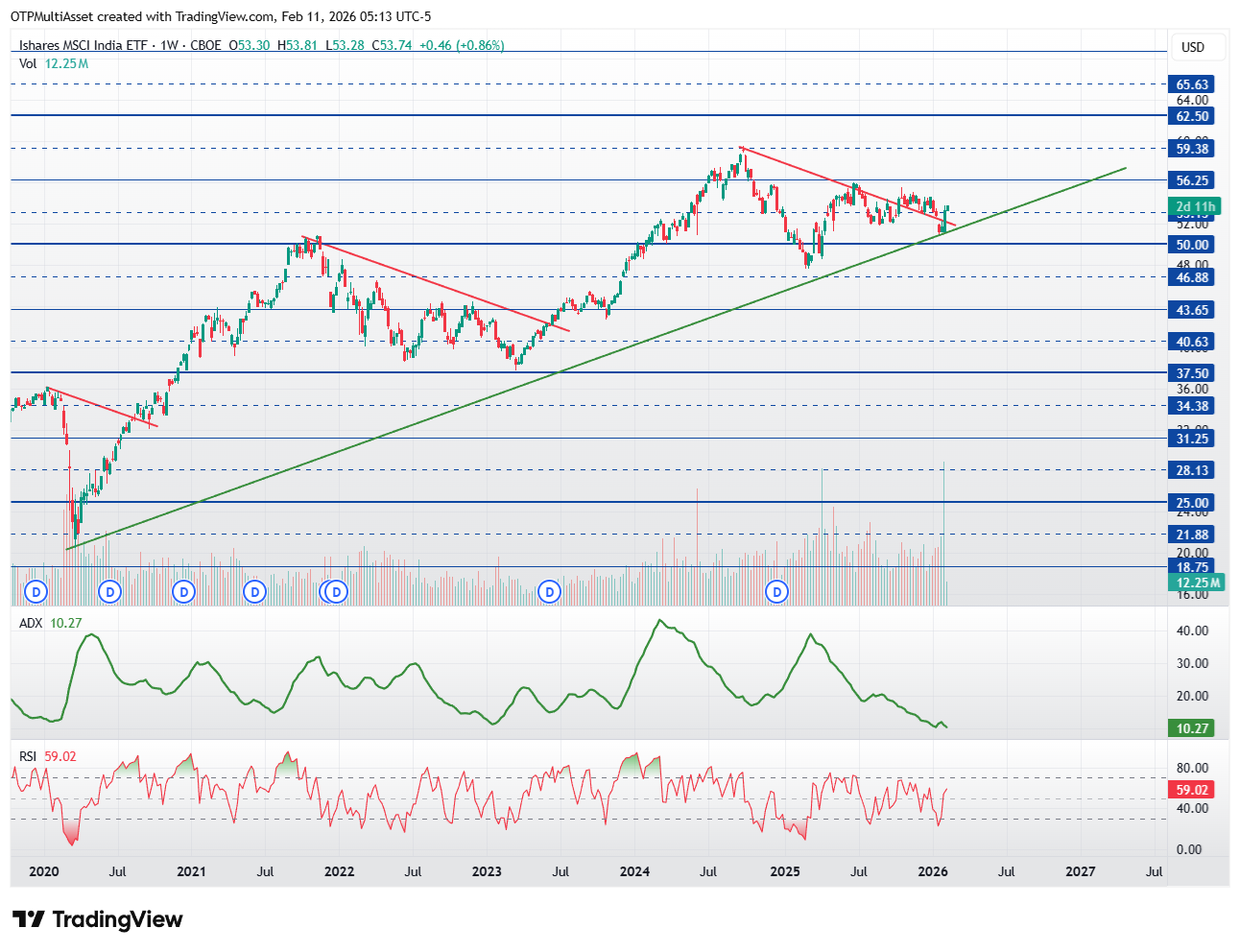
MSCI India ETF technical picture
On the weekly chart, the thick green trendline indicates an uptrend. There has been a breakout from this line in recent days, so the long trend may remain intact. The trend could break if the price closes below 51.5. There is still room for upward movement, and if the rise is confirmed, the previous high (59.38) could also be reached.
Get more out of your investments!
Global Markets Services
OTP Global Markets offers a broad range of services in the field of local and international money and capital markets.
Read morePrivate Banking Services
Personal care and expertise with OTP Private Banking, along with the knowledge, security, and innovations of a multinational banking group.
Read more