
US companies may see a big jump in earnings, but will that be enough?
Related content
The government crisis is over – what lies ahead for Romania?
Romania has experienced five turbulent months on the domestic political front. Nevertheless, after several prime ministerial candidates failed to secure parliamentary support, a new government was finally formed in late October. The Romanian equity market, which had performed strongly during the first half of the year, lost momentum towards the end of August and entered a downward correction in September. It then rebounded in October, partly reflecting the reduced risks of a snap election and a sovereign rating downgrade to below investment grade. While domestic political tensions have subsided, the BET index has yet to recover to the vicinity of its August peak. At the same time, Romanian equities no longer appear particularly inexpensive from a valuation perspective.
Commodities - Technical Analysis
Signs of a turnaround have emerged for gold and silver, and a strong upward move could trigger the next upward wave. A breakout above the key downtrend lines could also be on the horizon, which would further reinforce the positive turnaround. The price of oil has broken below the 100-day moving average, weakening the bullish outlook, and with the uptrend broken, it has entered a correction phase. Natural gas is showing a correction following a sharp decline, but has not yet managed to break through its downtrend line. Copper continues to trade within a wide range and is approaching the lower end of that range. Following a significant decline, wheat and corn prices have reached key support levels from which an upward correction—or even a new uptrend—is likely to begin.
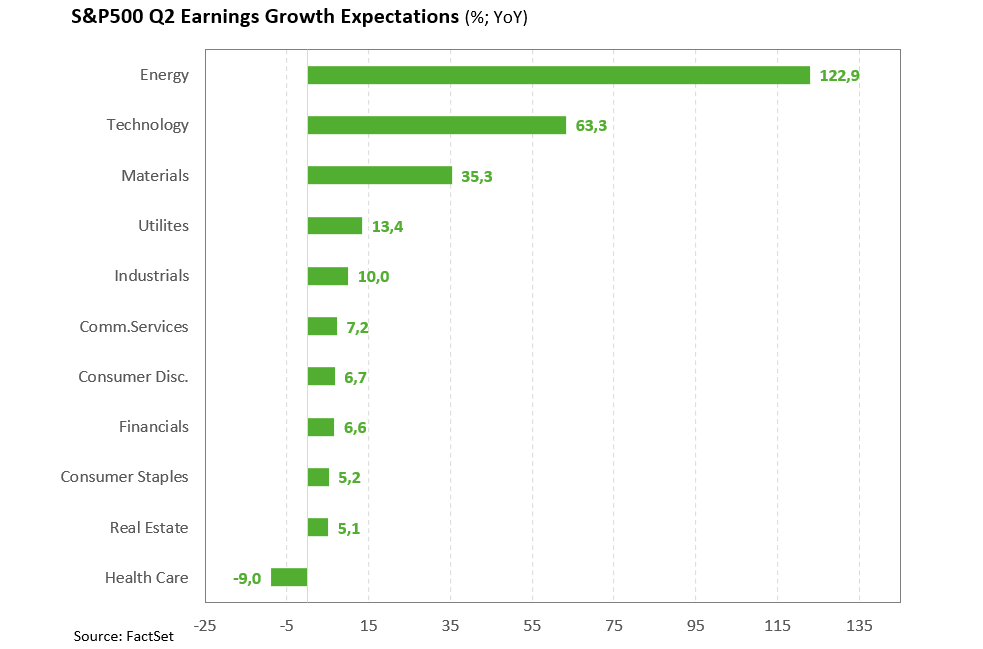
The US earnings season is picking up steam this week, with market participants set to focus on the latest figures from major US banks on Tuesday and Wednesday. The S&P 500 index could see a 23.6% increase in second-quarter earnings growth. Looking at the index’s subsectors, energy companies may have seen the strongest earnings growth in the second quarter, and significant earnings growth is also expected in the technology and materials sectors for the second quarter.
Amid renewed tensions between the U.S. and Iran, investors will focus on the second-quarter earnings season, which is set to pick up steam in the first half of the week with earnings reports from major US banks. Energy companies may have posted the strongest earnings growth, while the technology and materials sectors are also expected to report robust double-digit percentage earnings growth.
The S&P 500 is currently trading near its early June high, and market participants have become slightly more optimistic compared to their expectations at the beginning of the year. The average year-end price target for the index is currently 7,841 points, up from 7,561 points in February. Currently, Yardeni Research has the highest year-end target price forecast at 8,250 points, while BofA is the most pessimistic (7,100); the majority of forecasts fall within the range of 7,625 to 8,010 points. This year’s annual EPS expectations for the index are currently 8% higher than they were in February.
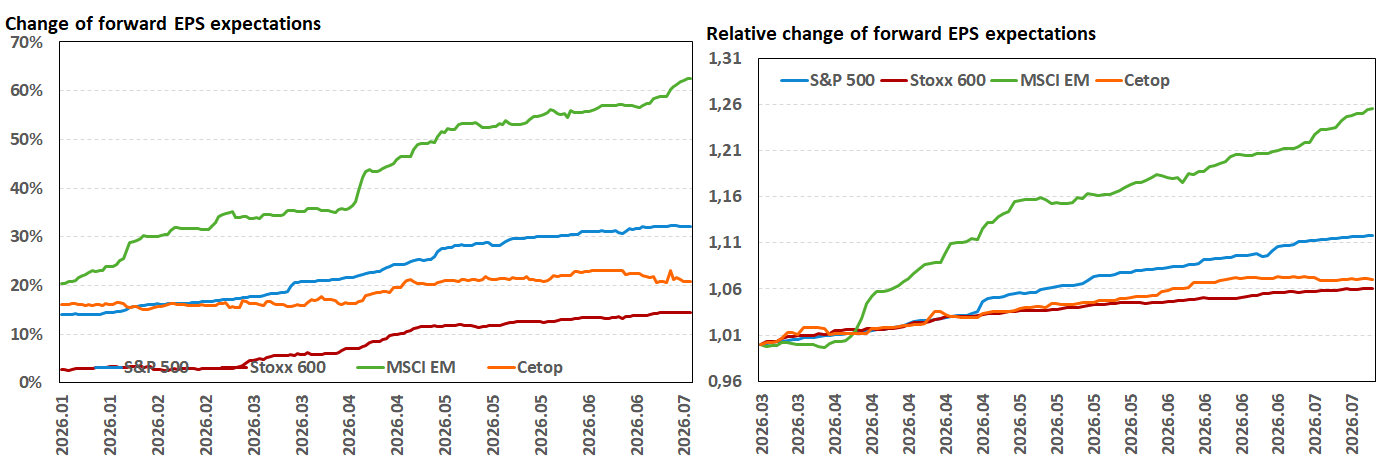
Last week, the second-quarter earnings season kicked off in the US with the latest figures from Pepsi and Delta Air Lines. Delta’s revenue and profit both exceeded expectations in the second quarter, and although the airline did not provide a forecast for this year in April, the company has now reaffirmed its January forecast of $6.50–$7.50 in annual EPS (above expectations), as demand for business and international travel offset its highest-ever quarterly fuel costs. At the same time, Delta said it was still too early to provide a forecast for 2027.
Following that, earnings reports from major U.S. banks will be released early in the week: Bank of America, Citigroup, Goldman Sachs, and JPMorgan will report on Tuesday, followed by Morgan Stanley on Wednesday. On Thursday, after the market closes, investors will be watching Netflix’s latest figures.
As of Monday afternoon, only 3.4% of the companies in the S&P 500 index had released their earnings reports so far. The seventeen companies that had already released their earnings reports reported revenue that, on average, exceeded expectations by 3.8%, while their EPS, on average, beat the consensus by 14.7%.
According to FactSet, the estimated second-quarter earnings growth rate for the S&P 500 index could be 23.6% (year-over-year), which is higher than the ten-year average earnings growth rate of 10.3%. Looking at the index’s components, 49 companies have issued negative EPS forecasts, while 62 have issued positive ones. Based on current expectations, the estimated earnings growth rate for the S&P 500 for the full year is 24.2%.
Looking at the eleven subsectors of the S&P 500, ten subsectors are expected to see earnings growth (year-over-year) in the second quarter, led by the energy sector. Based on expectations, earnings growth in the technology, materials, and utilities sectors could reach double-digit percentages. In the energy sector, higher average crude oil prices in the second quarter supported earnings growth.
In terms of expected earnings growth, the technology sector is likely to be the second-best performer in the second quarter, with semiconductor manufacturers contributing the most to earnings growth within the sector. Meanwhile, the healthcare sector is the only one expected to see a decline in earnings; however, this is attributable to one-time items related to Gilead’s acquisitions. Excluding these items, the healthcare sector could post a 7.1% increase in earnings.
S&P500 technical picture
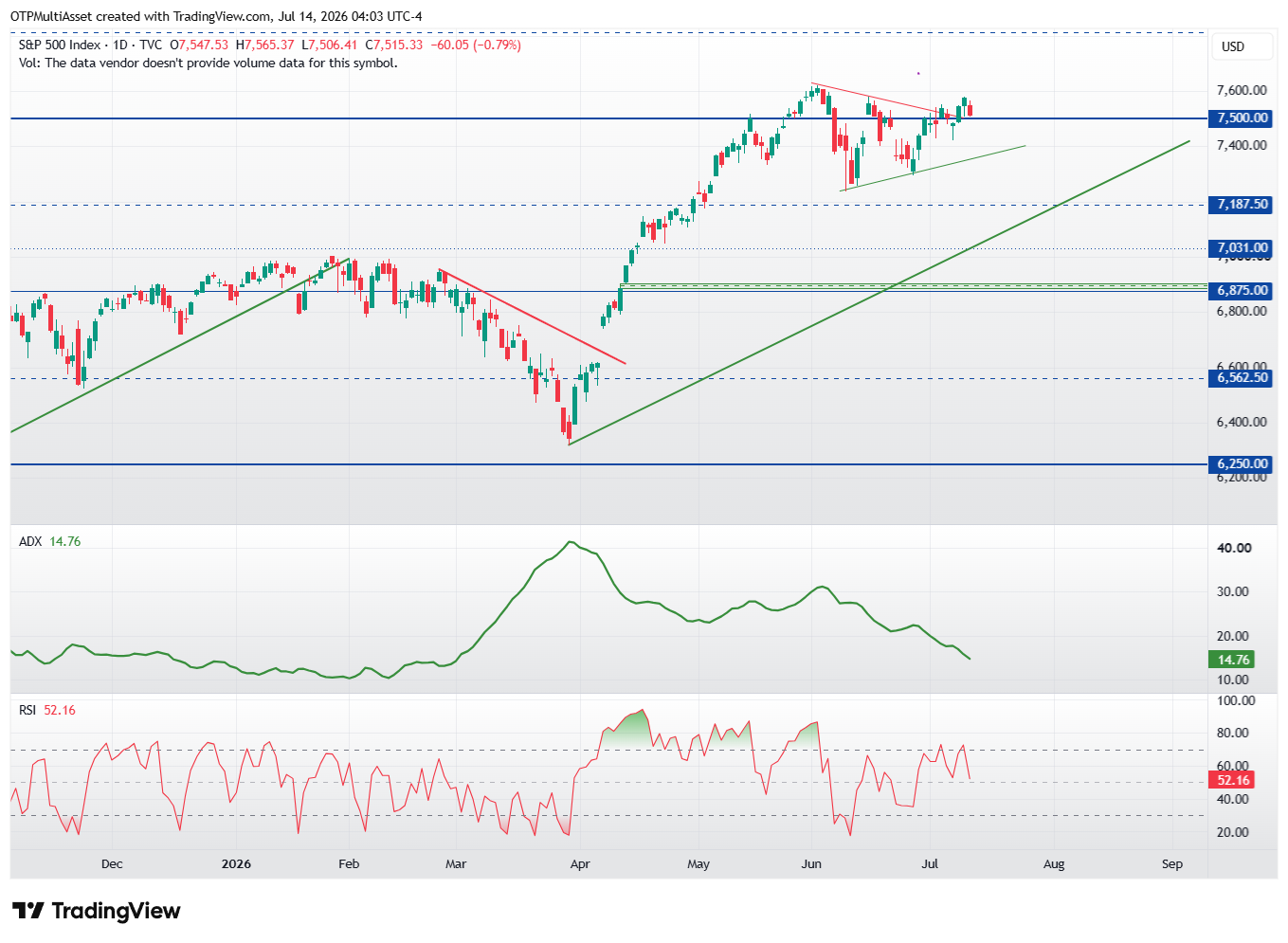
The price broke out of the contracting pattern three days ago, paving the way for another upward wave; however, only a moderate, lackluster rise has been observed so far. As long as the price remains above 7,500, the possibility of a new high cannot be ruled out. The uptrend structure remains intact, so a decisive, strong bearish candle would be required for a trend reversal. A close below the 7,500 level would already indicate a weakening of buying pressure. The long-term technical picture would only deteriorate significantly if the lower uptrend line were broken. Stronger support may be found around the 6,875-point zone.
Get more out of your investments!
Global Markets Services
OTP Global Markets offers a broad range of services in the field of local and international money and capital markets.
Read morePrivate Banking Services
Personal care and expertise with OTP Private Banking, along with the knowledge, security, and innovations of a multinational banking group.
Read more