
US bank shares fell
Related content
Commodities - Technical Analysis
Gold and silver continued their downward trend, bouncing off key levels. Until their downward trends are broken, they will not be able to produce a significant rise. The fall in oil prices reversed from the $87.5 level and began a slight upward movement. Natural gas remained in an uptrend; a significant rise could even occur if it breaks out upwards. The price of copper has become stuck in a wider range, so the oversold and overbought zones may offer more favourable trading opportunities. The falling prices of wheat and corn have reached key support levels; a buying reaction from these levels could present favourable long opportunities with limited risk.
Our Fixed Income Top Picks
The rise in yields seen over recent months has created a new environment across global fixed-income markets. With U.S. 10-year Treasury yields above 5%, increasing fiscal concerns in France, and corporate credit spreads remaining historically tight, the importance of selection has increased. In our latest top pick list, we highlight bonds that may offer attractive risk-adjusted return potential as part of a suitably diversified portfolio.
The third-quarter earnings season in the US has picked up pace following the release of the latest figures from US banks. Based on preliminary expectations, the third quarter is likely to have closed with strong earnings growth for S&P 500 companies, led by the energy and technology sectors. The major US banks have still achieved solid growth on an annual basis, indicating that their operations remain strong, but the pace has clearly slowed in many cases, which has tended to result in negative share price reactions.
Quarterly earnings growth may have been strong
The third-quarter earnings season has kicked off in the US, whilst market participants are primarily keen to see how well US companies are performing amidst a rising yield environment and higher oil prices. Although the S&P 500 last closed at a new high in early October, whilst two years ago, at the index’s historic highs, an average of 78% of companies were trading above their 200-day moving average, this proportion has now fallen to an average of ~66%. At the index’s last peak in early October, only around 47% of its constituents were trading above their 200-day moving average, which could mean that the index is being driven by a smaller group of companies.
Based on current expectations, the third-quarter earnings season could deliver strong growth: revenue growth for S&P 500 companies could reach 12.4%, whilst the index’s estimated earnings growth rate could be 29.6%, according to FactSet (year-on-year), which is more than double the ten-year average earnings growth rate of 12.6%. Of the companies in the index, 72 have issued positive EPS forecasts for this quarter, whilst 44 have issued negative earnings forecasts. Looking at the full year, annual earnings growth for the S&P 500 index is expected to reach 32.7%, according to current expectations.
Every sub-sector of the S&P 500 is expected to report an increase its earnings in the third quarter (year-on-year), whilst, looking at the index as a whole, the energy, technology and communications services sectors are likely to see the highest annual growth rates in earnings.
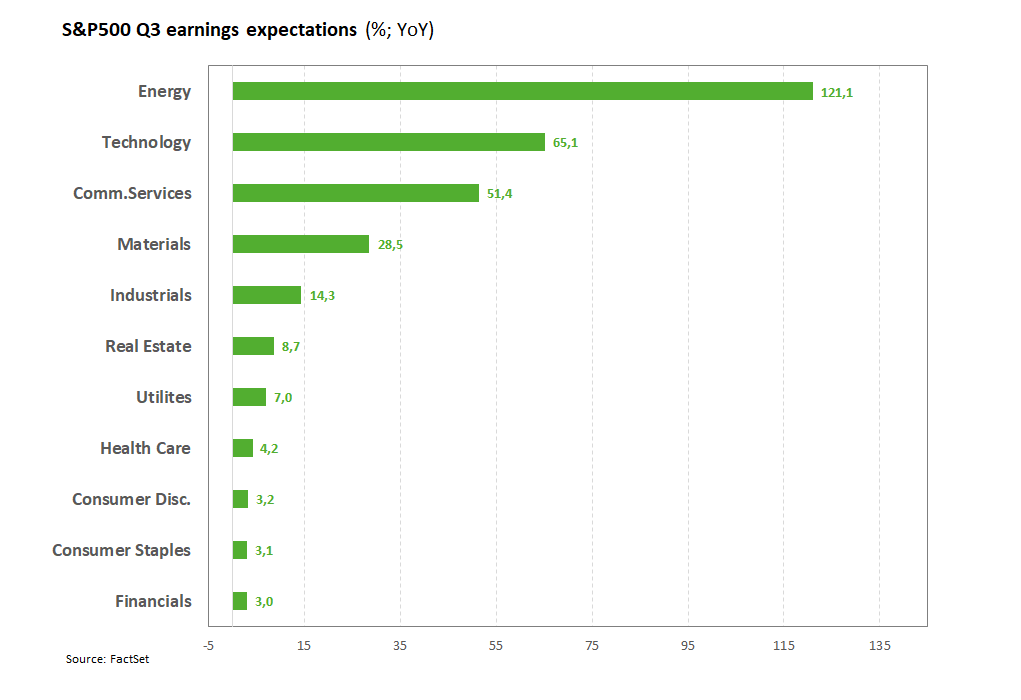
Based on the expected earnings growth for the third quarter, the energy sector leads the way; here, the rise in oil prices has contributed to the sector’s earnings growth, following an increase of ~30% in oil prices between the end of June and the end of September. Following the end of the second quarter, average EPS expectations rose for nearly half of the sector’s companies; amongst these, average EPS expectations rose by more than 10% over the period for companies including Marathon Petroleum, Valero Energy and Exxon.
In terms of expected quarterly earnings growth, the technology sector could be the second-best performer. Average EPS forecasts have risen for 80% of companies in the sector since the end of the second quarter, and for nearly half of these companies, average EPS forecasts have risen by more than 10%; amongst them, earnings forecasts have risen most significantly at Super Micro Computer, Dell and Intel since the end of the second quarter.
Equity traders at the major banks performed well
Although the S&P 500 was expected to close the quarter with significant earnings growth, the financial sector may have recorded the lowest quarterly earnings growth rate, according to FactSet’s forecasts. This week, the third-quarter earnings season picked up pace with earnings reports from major US banks; market participants were keen to see, amongst other things, how these US banks had performed in a rising interest rate environment.
JP Morgan’s figures painted a mixed picture: revenue from equities trading and investment banking both exceeded expectations, whilst revenue from fixed income and currency trading fell by 4% to $5.37 billion, falling short of expectations. Third-quarter revenue rose by 8% to $50.9 billion, though this fell short of the forecast of $51.37 billion. The average loan portfolio grew by 10 % year-on-year and by 2% quarter-on-quarter, whilst quarterly net interest income rose by 13%, and the bank also raised its net interest income forecast for the current year. The bank also recorded net investment securities losses of $658 million during the quarter. Earnings per share came in at $5.57, falling short of the forecast of $5.92.
According to Jamie Dimon, economic growth has been supported not only by strong corporate investment but also by sustained growth in consumer spending. Meanwhile, the changes brought about by the large budget deficit, persistent inflation and rising interest rates appear to be manageable, but they are prepared for various possible outcomes.
Goldman Sachs’s equity trading revenue rose sharply in the third quarter, whilst record advisory revenue offset the performance of the fixed income and currency trading division. The bank’s equity trading revenue rose by 72% to $6.44 billion, which, whilst exceeding expectations, fell short of the record set in the second quarter, whilst revenue from fixed income, currency and commodities trading revenue fell by 1% to $3.47 billion, falling short of the expected $3.72 billion.
Overall, third-quarter revenue rose by 23% to $18.7 billion, whilst EPS stood at $17.01, exceeding analysts’ expectations in both cases. According to commentators, the strong growth in the capital markets division demonstrated that the bank is capable of operating profitably even in complex circumstances, whilst management’s comments may have hinted at a further strengthening of trading and banking activities.
In the case of Citigroup, revenue from fixed income, currency and commodities trading rose by 4% to $4.4 billion in Q3, exceeding expectations, whilst revenue from equities trading rose by 14% during the quarter, although it fell short of expectations. Quarterly revenue rose by ~8% to $23.8 billion, whilst earnings per share stood at $2.85, exceeding expectations in both cases.
However, following the earnings report, Citi’s share price ultimately closed down by more than 5% after management indicated that trading revenue for the final quarter was expected to be more subdued due to seasonal trends. Furthermore, management’s comments, which appeared cautious regarding the timing of share buybacks, may also have contributed to the negative share price reaction.
Bank of America’s equity trading revenue rose by 10%, whilst fixed income, currency and commodities revenue fell by 17%, with both figures falling short of expectations. Third-quarter revenue totalled $29.96 billion, which also fell short of expectations. The quarter was also weighed down by a regulatory fine of $1.2 billion, imposed on the company for failing to detect potential money-laundering activity. Q3 EPS was $0.91 (expected: $1.09). In the quarter ending in September, amidst rising bond yields, the bank reported an unrealised loss of $109 billion on its bond portfolio (following a figure of $85 billion in the previous quarter), however, the majority of these securities were classified as held-to-maturity, which the bank has no intention of selling. Bank of America ultimately closed 4.8% lower following the earnings report.
Morgan Stanley, on the other hand, exceeded expectations in terms of both revenue and EPS. Amid market volatility, the bank’s equity traders performed very well, with equity trading revenue rising by 41%, whilst revenue from fixed income and currency trading fell by 7% in the third quarter. The former exceeded expectations, whilst the latter fell short of consensus forecasts. Revenues from the wealth management division rose by 10%, setting a new record. Third-quarter revenue stood at $20.3 billion, whilst EPS came in at $3.03. Following the earnings report, Morgan Stanley’s share price fell by 2.8%, although Wednesday’s negative sentiment on the stock market may also have played a part in this.
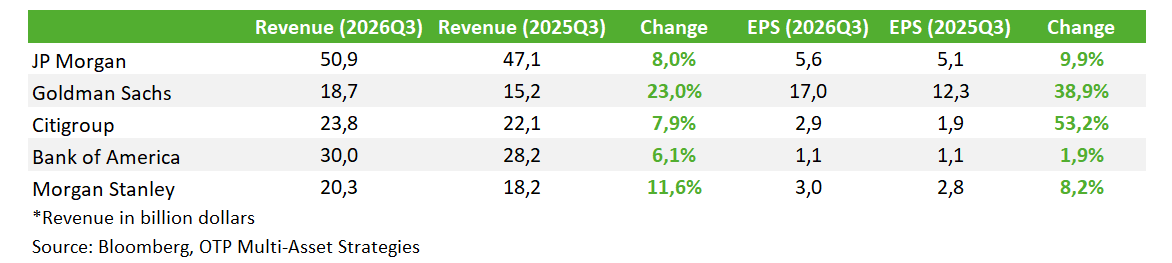
It is worth noting that the performance of the equity trading divisions was strong, with all five of the above banks recording double-digit percentage growth year-on-year without exception; however, on a quarter-on-quarter basis, all companies showed a decline. In the case of fixed income, currencies and commodities trading, the quarter presented a less favourable picture against a backdrop of higher interest rates. Here, declines were evident on both a quarter-on-quarter and year-on-year basis (with Citi being the sole positive exception in the latter case).
Investors are primarily keen to know to what extent rising funding costs and market volatility might jeopardise the banks’ ability to generate profits. The big question is whether higher interest rates will dampen optimism amongst US consumers and businesses. Jamie Dimon, CEO of JP Morgan, summed up the situation as follows: ‘Hopefully we'll enjoy this good environment for a while, we just don't know when it's going to stop.’
Get more out of your investments!
Global Markets Services
OTP Global Markets offers a broad range of services in the field of local and international money and capital markets.
Read morePrivate Banking Services
Personal care and expertise with OTP Private Banking, along with the knowledge, security, and innovations of a multinational banking group.
Read more