
Uncertainty is mounting in Mexico
Related content
US bank shares fell
The third-quarter earnings season in the US has picked up pace following the release of the latest figures from US banks. Based on preliminary expectations, the third quarter is likely to have closed with strong earnings growth for S&P 500 companies, led by the energy and technology sectors. The major US banks have still achieved solid growth on an annual basis, indicating that their operations remain strong, but the pace has clearly slowed in many cases, which has tended to result in negative share price reactions.
Commodities - Technical Analysis
Gold and silver continued their downward trend, bouncing off key levels. Until their downward trends are broken, they will not be able to produce a significant rise. The fall in oil prices reversed from the $87.5 level and began a slight upward movement. Natural gas remained in an uptrend; a significant rise could even occur if it breaks out upwards. The price of copper has become stuck in a wider range, so the oversold and overbought zones may offer more favourable trading opportunities. The falling prices of wheat and corn have reached key support levels; a buying reaction from these levels could present favourable long opportunities with limited risk.
For Mexico, one of the most important news stories of recent weeks was the announcement in early July by the U.S. Trade Representative that the United States would not extend its trade agreement with Canada and Mexico. The USMCA is subject to annual reviews, and as part of these annual reviews, the three countries will attempt to reach an agreement during the next ten years; if they fail to do so, the agreement will expire in 2036. In light of all this, we examined what lies ahead for Mexico.
The Background to the Trade Agreement
The North American Free Trade Agreement (NAFTA) was established in the early 1990s following the collapse of the Soviet Union; its adoption led to the elimination or reduction of trade barriers and investment restrictions between the United States, Canada, and Mexico. The United States-Mexico-Canada Agreement (USMCA) entered into force in 2020 after Donald Trump, during his first term as president, renegotiated NAFTA.
The participating countries held a joint review this July, as required by the USMCA six years after its entry into force. Initially, the participating parties had three possible courses of action: they could have extended the agreement for another sixteen years this year, or if any participating country had decided to withdraw from the agreement, it would have had to notify the other countries six months in advance. If the parties are unable to reach an agreement, annual reviews will take place until the agreement expires (in 2036).
Donald Trump’s previous statements regarding the agreement were ambiguous, and the president—likely as part of his usual negotiating tactics—applied pressure on Canada and Mexico ahead of the July deadline, saying that the U.S. would be better off without the agreement. Since the USMCA enjoys bipartisan support in the House of Representatives, a U.S. withdrawal from the trade agreement did not initially seem like a likely scenario. However, based on the president’s statements—and given that Donald Trump seemed dissatisfied with the current form of the agreement—it appeared there was a chance that the USMCA would not be automatically extended.
What happened in early July?
On July 1, the U.S. Trade Representative announced that the United States would not extend its trade agreement with Canada and Mexico, and that it would be reviewed annually, while the Trump administration would continue to work with the two countries to address the agreement’s shortcomings. This doesn't mean that the USMCA is instantly coming to an end, nor does the announcement immediately change the trade rules: the agreement remains in effect, and trade between the U.S., Canada, and Mexico is governed by the existing legal framework.
The stakes, however, are high: after Donald Trump began imposing new tariffs during his second term as president, imports into the United States from Mexico and Canada that comply with USMCA rules increased, as the new tariffs encouraged the two countries to formally bring their exports into compliance with the trade agreement’s rules. Currently, approximately 90 percent of imports into the U.S. from Canada and Mexico comply with the USMCA. The USMCA has shielded most Canadian and Mexican goods from Trump’s tariffs, with a few exceptions, such as steel and aluminum.
What happens next?
It appears that the worst-case scenario has been averted and the U.S. will not withdraw from the USMCA, although Donald Trump may well use this as a threat to strengthen his negotiating position. Last year, the effective average tariff rate on Mexican exports to the U.S. was approximately 8%, which was one of the lowest tariff rates globally. According to preliminary industry estimates, in the absence of the USMCA agreement, Mexico’s relative tariff advantage could have been significantly reduced compared to other countries.
In addition to the U.S. president’s unconventional negotiating style, it is also worth noting that the value of trade among the three countries under the USMCA is approximately two trillion dollars (this figure has increased by ~four hundred billion dollars since the agreement took effect in 2020), and approximately one-third of the raw materials imported into the U.S. for manufacturing purposes come from Canada and Mexico; furthermore, Canada and Mexico are the United States’ two most important agricultural export markets. Thus, it seems unlikely that the president would actually follow through on his threat to withdraw from the free trade agreement.
In the future, during the annual reviews, the U.S., Canada, and Mexico may attempt to reach an agreement among themselves; if they are unable to do so, the agreement will expire in 2036. According to commentators, Donald Trump could use the decision to not to extend the USMCA and the shift to ongoing negotiations to put pressure on Mexico and Canada. Although there is currently a great deal of uncertainty regarding U.S. tariffs, negotiations between the U.S. and Mexico will resume at the end of July.
Neither the Mexican stock market nor the USDMXN showed any sharp fluctuations following the announcement by U.S. trade representative; the decision may have already been largely priced in, and it is quite possible that some market participants are also hopeful that the parties will soon be able to reach an agreement. This would also be in Mexico’s interest, as comments suggest that the economic slowdown is due in part (alongside weak domestic demand) to declining investment activity caused by trade uncertainty.
USDMXN technical picture
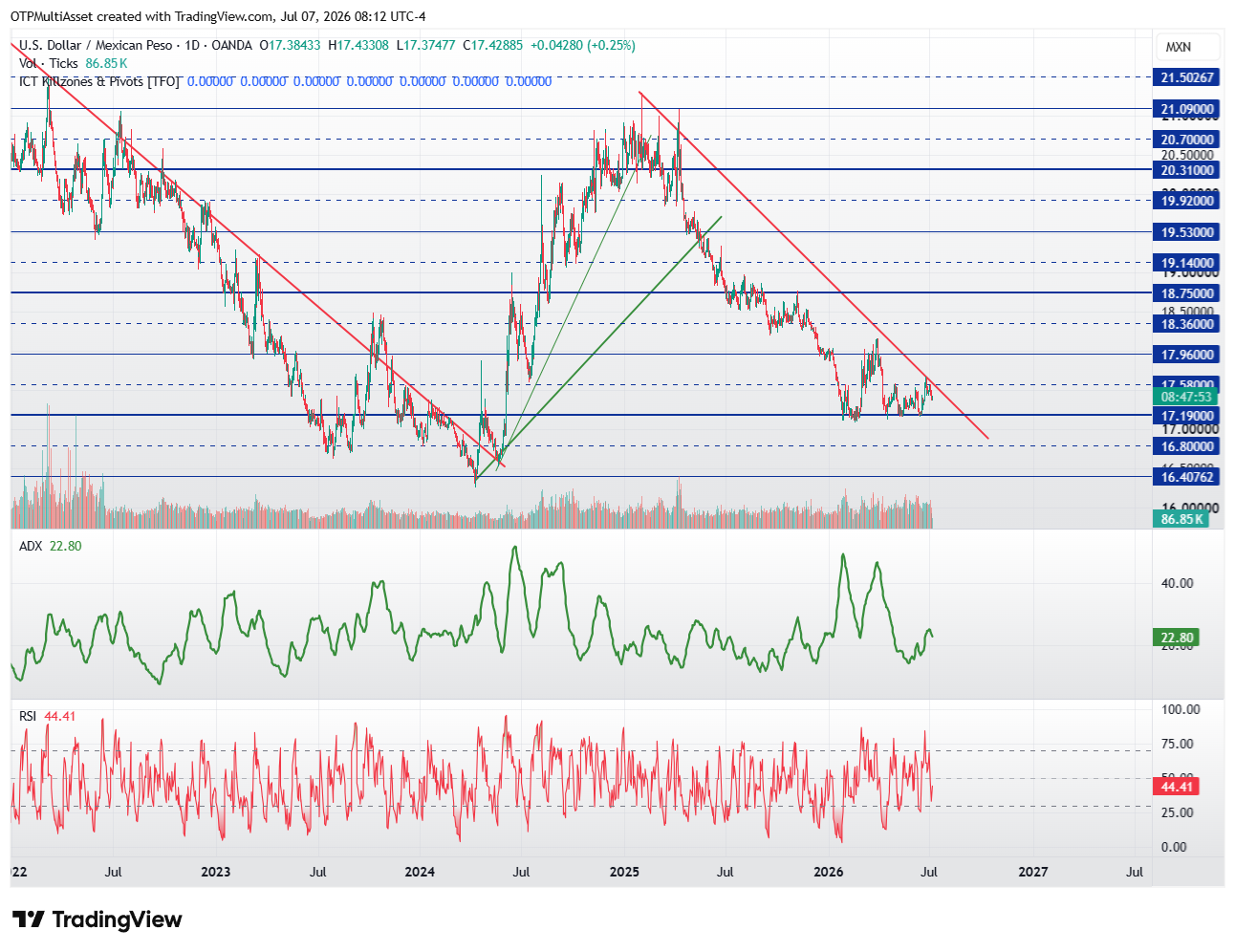
Exports accounted for approximately 40 percent of Mexico’s GDP last year, and about 80 percent of Mexico’s exports are destined for the United States. If an agreement with the U.S. cannot be reached in the foreseeable future, prolonged uncertainty and the resulting potential decline in investment could cast a shadow over the outlook for the Mexican economy.
Get more out of your investments!
Global Markets Services
OTP Global Markets offers a broad range of services in the field of local and international money and capital markets.
Read morePrivate Banking Services
Personal care and expertise with OTP Private Banking, along with the knowledge, security, and innovations of a multinational banking group.
Read more