
Uber Falls on Negative News
Related content
Investors are worried – what lies ahead for Brazil?
In a major surprise, Lula won the second round of Brazil’s presidential election, even though markets had previously expected Flávio Bolsonaro to prevail. Lula’s victory triggered a sharp repricing of Brazilian assets, while sentiment deteriorated further shortly afterwards following an unorthodox proposal calling for a substantial reduction in the central bank’s policy rate. For now, it appears that no such plan is under consideration in Brazil, and the president has reaffirmed his commitment to fiscal discipline. Investors, however, remain largely sceptical. Market participants are waiting for concrete measures, and in the near term the key question for Brazil will be whether the anticipated fiscal measures can stabilise the country’s debt trajectory and how the president will reconcile them with his campaign promises.
Hungary: Headline inflation accelerated in line with expectations, while underlying inflation pressures remained elevated
Hungary's headline inflation rose by 0.4 ppts to 2.0% year-on-year in October, up from 1.6% in September. The data was in line with the market consensus (2.0%) and marginally above our forecast (1.9%). The main reason for the acceleration of headline inflation was the further increase of fuel inflation while processed food prices decreased less than expected mainly due to sugar and confectionaries. However, food prices still significantly contributed to the low inflation in Hungary, so the fact that prices of several agricultural commodities have started to rise in recent months, reinforces our view that food prices will no longer contribute to disinflation in 2027.
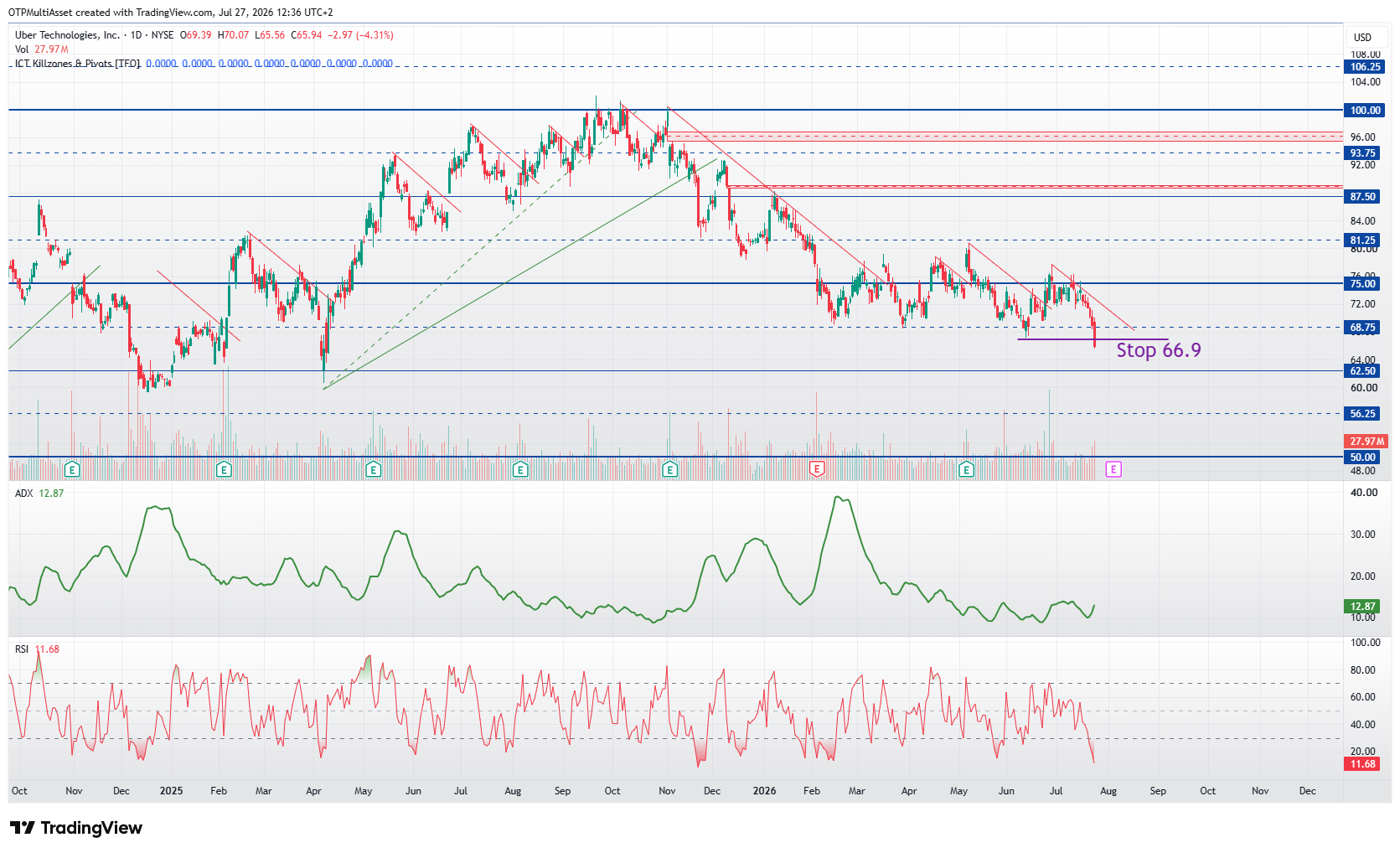
Uber shares failed to follow through on their breakout attempt, and on Friday, negative news concerning the company’s robotaxi business pushed the share price down to the stop-loss level specified in our trading idea.
The decline was not triggered by news related to Uber’s current operations, but rather by a reassessment of the company’s long-term positioning in the robotaxi market. The immediate catalyst was the announcement that, from 2028, Waymo will operate through its own app in Austin and Atlanta, ending its exclusive availability through the Uber app in those markets. Although the near-term financial impact is negligible, the market reacted strongly because the development raises uncertainty over whether Uber’s platform will ultimately be needed for autonomous ride-hailing services at all.
We continue to believe that Uber’s platform and its global user base of more than 200 million represent significant value, and that the service will remain relevant in the era of autonomous taxis. Even if Waymo succeeds in building a standalone service in the United States, Uber may retain a competitive advantage globally. Moreover, Uber continues to expand its autonomous-vehicle strategy in cooperation with several other partners, so we would by no means write the company off. The prospect of intense competition in this subsector is also nothing new, as Uber already faces significant competitive pressure in both mobility and delivery.
Admittedly, it is difficult to identify the eventual winners in such a nascent market. Meanwhile, Uber’s core business continues to grow. The company recently acquired Delivery Hero, significantly strengthening its presence in the delivery market. The nearly USD 15 billion acquisition will give Uber access to several new markets. However, the transaction is expected to close only in the second half of 2027 and naturally carries execution and integration risks. Uber is scheduled to report its quarterly results on August 5, which could also trigger a sizeable move in the share price.
From a technical perspective, the stock failed to act on the long signal issued one month ago. Following three weeks of unsuccessful attempts to move higher, the shares entered a clearly defined downtrend three days ago. The formation of a new swing low may also signal a continuation of the bearish trend. The next major support level is located around USD 59, followed by a stronger support zone near USD 50.
Following the activation of the stop-loss, our trading idea published on June 25 was closed with a loss of approximately 7–8%.
Get more out of your investments!
Global Markets Services
OTP Global Markets offers a broad range of services in the field of local and international money and capital markets.
Read morePrivate Banking Services
Personal care and expertise with OTP Private Banking, along with the knowledge, security, and innovations of a multinational banking group.
Read more