
Uber: Steady growth wasn't enough this time
Related content
Meta: Burning Cash on the AI Promise
Overall, Meta’s quarterly performance continues to paint a positive picture in terms of the underlying fundamentals, while the company has also achieved significant milestones on the AI model development front. However, elevated spending is taking a substantial bite out of cash generation, with free cash flow now turning negative, which may increasingly require funding through capital market financing. Following the stock’s rally in recent weeks, valuation levels have also moved higher. In the near term, these factors may continue to put pressure on the stock, although the longer-term outlook remains constructive. Naturally, much will depend on the company’s ability to effectively monetize its investment program over time.
Netflix: Cracks Are Emerging in the Growth Story
The negative investor narrative surrounding Netflix remains unchanged. Although the headline results were solid, the slowdown in the growth rate is currently overshadowing everything else in the equity market. Questions are increasingly being raised about US engagement and the performance of the content slate. A tangible catalyst would be needed for a sustained rerating of the shares, but none is currently in sight.
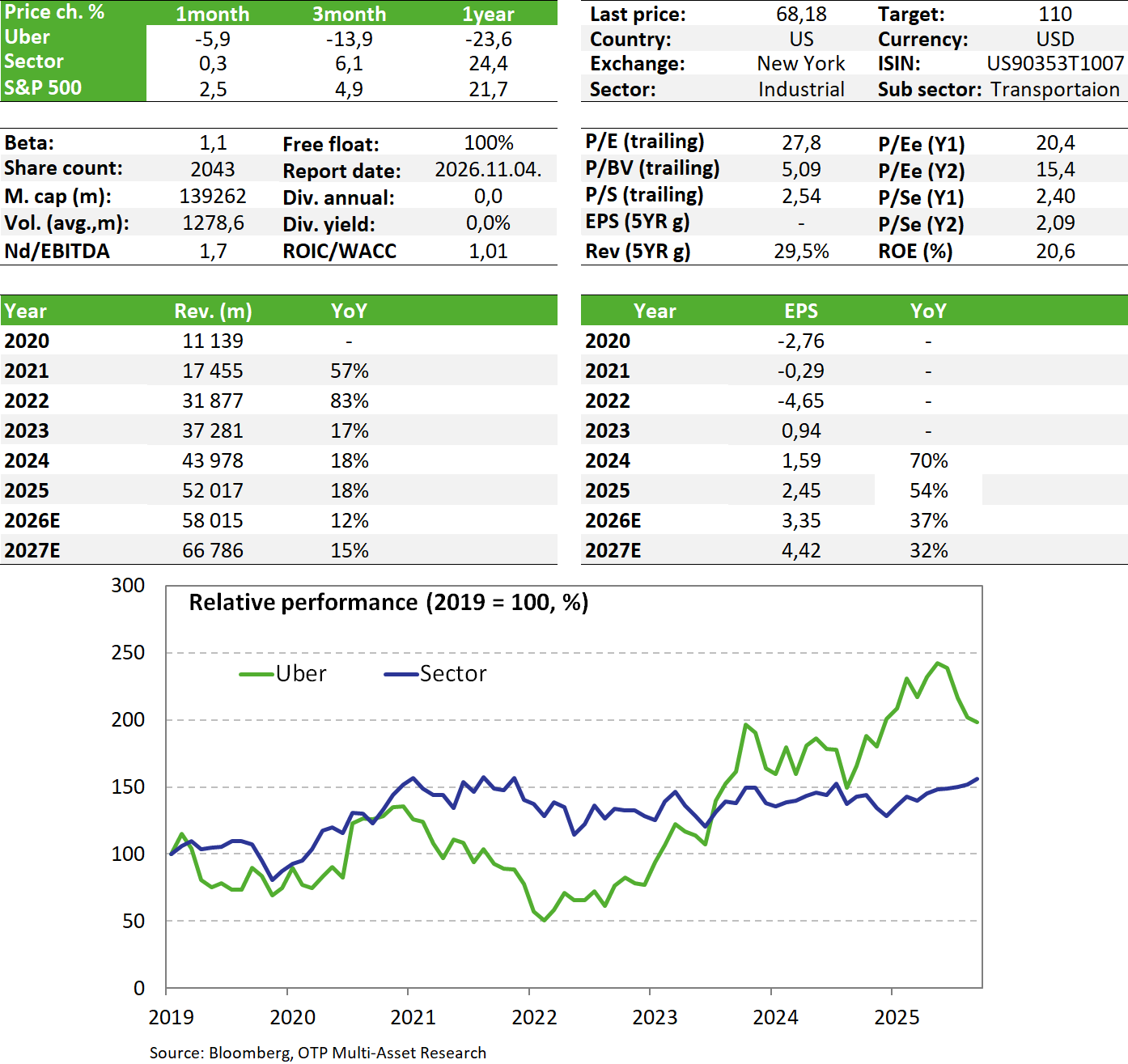
Investors have slightly reassessed Uber’s investment case following the Q2 earnings report. Although the company continues to grow rapidly, the widespread adoption of self-driving technology can only yield positive results in the long term—and it requires significant capex. In addition, the acquisition of Delivery Hero will also cost a substantial amount, leaving less money available for share buybacks and potentially resulting in more modest cash generation. In our view, however, it is better for the company to reinvest the money into its operations rather than use it for share buybacks. As a result, shareholders should expect a longer-term investment horizon when it comes to Uber.
Earnings Report
Gross bookings continued to grow by more than 20% in the second quarter, exceeding expectations. Although revenue fell slightly short of the consensus estimate (+11%), the reported revenue growth currently does not adequately reflect the platform’s underlying performance, as changes to the business model reduced the reported revenue growth rate by eight percentage points.
The number of transactions rose by 18%, driven by a 16% increase in the number of monthly active platform users and a 2% rise in the number of monthly transactions per user. The quarterly growth was therefore primarily driven by the expansion of the user base, rather than by price increases or a significant rise in spending by existing users. Adjusted EBITDA jumped 33% to $2.82 billion, slightly exceeding expectations.
Gross booking value for Mobility rose to $28.99 billion, representing a 20% increase on a currency-neutral basis. The segment’s operating profit increased by 28% to $2.22 billion. This corresponds to a segment-level operating margin of approximately 7.6% relative to gross booking value. The World Cup also helped the company, as more than eight million tourists used Uber rides in the host cities, but management says demand was strong even without that.
The gross value of shipments rose 26% to $27.5 billion (up 25% on a currency-neutral basis; year-over-year). Revenue grew by 28% to $5.25 billion, while the segment’s operating profit increased by 38% to $1.06 billion. The segment is developing nicely alongside mobility as a second, increasingly important business line.
Currently, only about 20% of Uber’s customers use both its ride-hailing and delivery services at the same time, while the number of customers using multiple services is growing approximately one and a half times faster than that of customers who use only one service. The explicit goal is to increase the number of Uber One subscribers, as this leads to better customer retention and allows the company to generate significantly more revenue from these customers.
What the market has not fully appreciated yet is that Uber has once again committed to rolling out autonomous vehicles and may spend around $10 billion on this in the coming years. On the one hand, this could involve acquiring stakes in partners, or the company might even purchase a fleet. This is not entirely new, as Uber has already announced several partnerships, but the announcement of these billion-dollar investments has not been well received on the stock markets.
Uber is currently partnering with autonomous vehicle providers in seven cities and aims to expand to fifteen cities by the end of the year. According to management, the robotaxis integrated into Uber’s network can complete 25–30 rides per day per vehicle, and in some cases slightly more. However, this also shows that self-driving rides account for less than 0.5% of Uber’s approximately 300 million weekly transactions. In other words, while the technology is strategically important, it is not yet a significant factor in the company’s operations.
With the acquisition of Delivery Hero, Uber will be able to significantly expand its presence in the food delivery market, as this nearly $15 billion acquisition will allow the company to enter many new markets. However, the transaction is not expected to close until the second half of 2027 and, naturally, carries certain risks. Synergies are also likely to materialize only around 2028–2029.
In line with management’s previous objective, the company allocated roughly half of its free cash flow to share buybacks. In the first half of the year, the company repurchased approximately $3.5 billion worth of its own shares. In the second quarter, however, it spent only $518 million on this, as it used $4 billion to purchase Delivery Hero shares. According to management, while share buybacks remain important, less money can naturally be allocated to them given the acquisition and significant investments.
In addition, the fact that Uber projected slightly lower-than-expected figures for the current quarter may also have contributed to the negative stock price reaction. The company forecast a range of $58.25 billion to $60.25 billion in gross bookings and a range of $0.84 to $0.88 in EPS. For the former, the midpoint of the range fell slightly short of the $59.33 billion consensus, while for the latter, it fell short of the expected $0.89.
In our view, this quarter has not changed the fundamentals, so we are keeping the stock on our Equity Top Pick List.
Investment story
- Uber is the world’s largest mobility platform, with 200 million monthly active users, and has already demonstrated that it can generate sustainable free cash flow while continuing to grow. Both Mobility and Delivery operate in structurally growing markets, where Uber holds a leading global position.
- The Uber One program increases user engagement and helps stabilize revenue. Advertising revenue is already at a multi-billion-dollar run-rate, generates high margins, and still offers meaningful additional growth potential.
- Uber is not developing autonomous-driving technology in-house; rather, it provides the demand layer and the platform. As a result, it assumes less capital intensity and technological risk than many competitors. If robotaxis become economically viable, Uber could be one of the most scalable beneficiaries. Of course, to do this, they will also have to invest a significant amount—according to recent reports, about $10 billion—over the next few years.
- Main risks: The core business could be affected by weaker demand in the event of a slowing economy and softer consumer spending. The adoption of autonomous taxis may take longer than expected, while intense competition could also pressure profitability. Regulatory or safety-related issues could hinder the broader rollout of autonomous vehicles.
Get more out of your investments!
Global Markets Services
OTP Global Markets offers a broad range of services in the field of local and international money and capital markets.
Read morePrivate Banking Services
Personal care and expertise with OTP Private Banking, along with the knowledge, security, and innovations of a multinational banking group.
Read more