
Uber: Waiting for the Next Catalyst
Related content
Take-Two: GTA VI Success Could Trigger a Technical Turnaround
Last week’s decline occurred amid extremely strong negative momentum. In such an environment, it is natural that on the buy side—especially when using momentum-based screening—we find very few potential candidates. Accordingly, we are unable to recommend any stocks this week that would show a clear buy signal. Take-Two, however, which appears on our list of Favorite Stocks, could come close to a buy signal if certain conditions are met. The stock is holding up well despite the negative market sentiment, so it’s worth keeping on your watchlist, as it could benefit from a broad market turnaround. In addition, GTA VI’s better-than-expected sales figures could serve as a significant growth catalyst for the company.
International Markets - Technical Analysis
Despite last week’s sharp sell-off, U.S. stock markets had already been moving in a downward correction trend. If the current pace continues, they may soon reach levels from which they could stage a meaningful upward correction. In contrast, the DAX and Stoxx 600 indices only experienced a strong sell-off last week, which broke their upward trends during the week and also altered the market structure. The emerging markets index has so far shown only a moderate correction, but even it could not avoid the decline. The target of the downward trend-confirming pattern that has formed may soon be reached for this index as well.
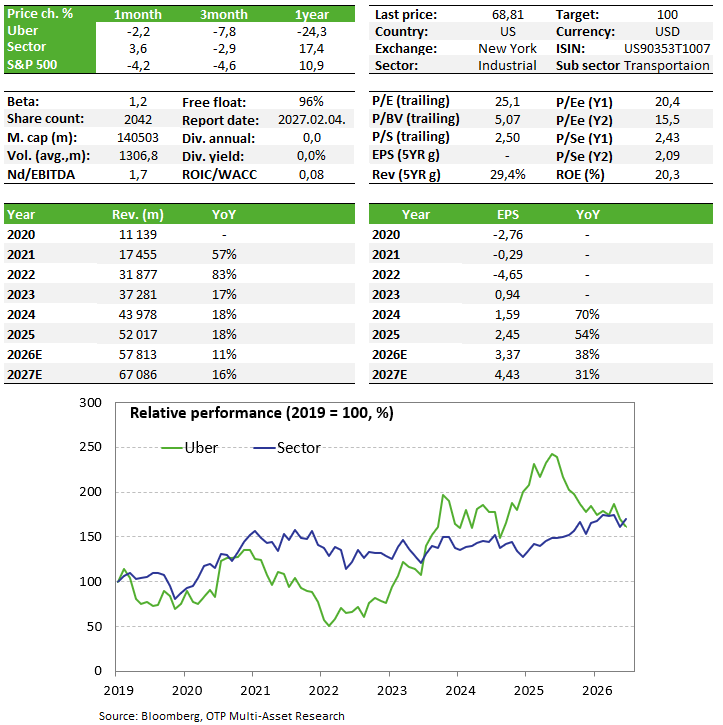
Uber’s profitability remains strong, but that is not reflected in the share price. Growth remains in the double digits and earnings generation is solid. However, because it is still unclear how autonomous vehicles will reshape the mobility industry, investors continue to apply a larger discount to the stock. We believe Uber is well positioned to remain a leading global mobility platform even in the era of autonomous vehicles.
Quarterly Report
This year has not been a breakthrough one for Uber, as the stock has largely traded within a broad range after the sharp decline earlier in the year. The quarterly earnings report released in early November triggered a modest rebound in the shares, but the stock has since struggled to build further momentum.
Overall, there are no major issues on the operational side of the business. Gross bookings increased by 20% in the third quarter, marking the fifth consecutive quarter with growth above 20%. The combined number of trips and deliveries rose 16% to 4.06 billion. Monthly active platform users increased 14% to 215 million, while monthly transactions per user improved by a further 2%.
Revenue reached $14.77 billion, slightly ahead of expectations, but grew only 9.6% year-over-year. This was primarily due to changes in accounting practices in certain markets, which reduced the reported growth rate by approximately 8 percentage points according to management. Previously, Uber recognized the full amount paid by customers as revenue and then deducted payments made to drivers. Under the new accounting treatment, only the net amount is recorded as revenue. In other words, the company ultimately retains the same amount of money, but reports it differently. This is also reflected in the much stronger growth seen across the profitability metrics.
Adjusted EBITDA increased 31% to $2.96 billion, while operating income rose 38% to $2.30 billion. Adjusted EPS came in at $0.88, representing 35% year-over-year growth and exceeding expectations. These results demonstrate Uber’s ability to monetize its network effectively, with initiatives such as Uber One and advertising revenue helping to expand margins. The company is also generating significant cash flow, with trailing twelve-month free cash flow surpassing $10 billion.
Even after adjusting for the accounting changes, some challenges remain visible within the mobility segment. Driver supply remains constrained in certain markets, limiting growth potential, while high fuel prices, particularly in emerging markets, continue to weigh on demand. The conflict in the Middle East reduced mobility growth by approximately 75 basis points in the third quarter, and the company expects a negative impact of around 100 basis points in the fourth quarter.
The delivery business has become an increasingly important growth engine in recent quarters, and that trend continued in the third quarter. Gross bookings in the segment increased 22%, while revenue grew 23% and segment operating profit rose 30%. Beyond food delivery, grocery and other retail categories are also expanding rapidly, with annual growth running at roughly 40%. The company has also entered into a partnership with Amazon, allowing U.S. Amazon Prime members to order food directly through Amazon’s website and app, with deliveries fulfilled by Uber Eats.
Autonomous Vehicles
Regarding autonomous vehicles, Uber stated that by the end of this year approximately 700 fully driverless vehicles could be operating on its platform, while that number may exceed 2,000 by the end of 2027. The company also expects a more meaningful acceleration from 2028 onward, potentially reaching tens of thousands of vehicles. However, such projections should be viewed with some caution.
Management believes that autonomous vehicles operating on the Uber network could achieve utilization rates up to 30% higher than comparable alternatives operating outside the platform. Uber can provide strong demand, route optimization, payment infrastructure, and local market access, eliminating the need to build a customer base from scratch. That said, it will still likely take several years before autonomous vehicles make a meaningful contribution to the company’s profits.
Overall, in light of the quarterly results, we are maintaining the stock on our Equity Top Pick List.
Investment Story
- Uber is the world's largest mobility platform with more than 200 million monthly active users and has already proven that it can generate sustainable free cash flow while continuing to grow. Both mobility and delivery are structurally growing markets where Uber holds a leading global position.
- Uber One increases user engagement and helps stabilize revenue. Advertising revenue has already reached a billion-dollar scale, generates high margins, and still offers significant growth potential.
- Uber does not develop autonomous driving technology itself, but instead provides the demand side and platform infrastructure. This means lower capital requirements and less risk than many competitors. If robotaxis become economically viable, Uber could be one of the biggest beneficiaries, although the company may still need to invest around $10 billion over the coming years.
Risks
- Core operations could be affected by weaker demand if economic growth and consumer spending slow.
- The adoption of autonomous taxis may take longer than expected, while intense competition could also put pressure on profitability.
- Regulatory or safety concerns could slow the rollout of autonomous vehicles.
Get more out of your investments!
Global Markets Services
OTP Global Markets offers a broad range of services in the field of local and international money and capital markets.
Read morePrivate Banking Services
Personal care and expertise with OTP Private Banking, along with the knowledge, security, and innovations of a multinational banking group.
Read more