
This year will be an important one for Mexico
Related content
US bank shares fell
The third-quarter earnings season in the US has picked up pace following the release of the latest figures from US banks. Based on preliminary expectations, the third quarter is likely to have closed with strong earnings growth for S&P 500 companies, led by the energy and technology sectors. The major US banks have still achieved solid growth on an annual basis, indicating that their operations remain strong, but the pace has clearly slowed in many cases, which has tended to result in negative share price reactions.
Commodities - Technical Analysis
Gold and silver continued their downward trend, bouncing off key levels. Until their downward trends are broken, they will not be able to produce a significant rise. The fall in oil prices reversed from the $87.5 level and began a slight upward movement. Natural gas remained in an uptrend; a significant rise could even occur if it breaks out upwards. The price of copper has become stuck in a wider range, so the oversold and overbought zones may offer more favourable trading opportunities. The falling prices of wheat and corn have reached key support levels; a buying reaction from these levels could present favourable long opportunities with limited risk.
The year got off to a strong start for the Mexican stock market, but the war in Iran intervened at the end of the first quarter. Mexico is in a relatively better position due to the energy price shock caused by the war in Iran; however, in addition to the conflict in the Middle East, several country-specific events are likely to have a greater impact on market movements in the coming months. In addition to several important reform initiatives, investors will be watching the review of the free trade agreement between the US, Canada, and Mexico: news related to the USMCA agreement could drive market movements in the coming period, and market participants expect that the agreement is more likely to remain in place.
How is the Iranian crisis affecting Mexico
Mexico is a major oil-producing country; in terms of production, it ranked fourth (in 2024) on the American continent, behind the United States, Canada, and Brazil. Hydrocarbons play an important role in the Mexican economy, accounting for approximately thirty percent of government revenue. According to data from the U.S. Department of Commerce, the United States imports more than 400,000 barrels of crude oil from Mexico daily, while the U.S. exports nearly 2 million barrels of refined petroleum products to Mexico daily, covering more than two-thirds of its domestic consumption. According to the Mexican president, Mexico will not benefit from the rise in Brent crude oil prices in terms of oil exports, as this will be offset by price increases for gasoline, kerosene, and LPG, which Mexico continues to import.
Following the rise in oil prices, the Mexican government extended the voluntary fuel price cap by six months, renewing the agreement with gas station operators under which the price of gasoline at Mexican gas stations will remain below 24 pesos per liter. In addition, they sought to curb price increases by adjusting the excise tax on fuels. Overall, Mexico is in a relatively more favorable position due to the energy shock caused by the war in Iran, as there is no risk of direct energy imports from the region, and the country’s oil exports are also significant. Several important events related to Mexico will be worth watching this year: in addition to the ongoing reforms, the renegotiation of the USMCA free trade agreement will also take place soon.
The USMCA agreement is being reviewed
The review of the USMCA free trade agreement between the United States, Mexico, and Canada—which is of paramount importance to Mexico—is due to take place this year. In early March, the U.S. Trade Representative and the Mexican Minister of Economy announced the first round of bilateral negotiations, while meetings with Canada are set to begin in early May. The parties must submit their proposals for amending the agreement by early June, after which a joint review of the USMCA will take place in early July.
Donald Trump had reportedly considered withdrawing from the free trade agreement, though he did not give any clear indication that he would actually do so, so this is likely just part of the U.S. president’s negotiating strategy. Although commentators say it is highly unlikely that the U.S. would withdraw from the agreement, the loss of duty-free status could significantly reduce exports of Mexican and Canadian goods to the United States and, according to preliminary industry estimates, threaten approximately 6% of both countries’ GDP.
Regarding the possible outcomes of the negotiations, market participants see a low probability of the agreement expiring, and the likelihood of a quick agreement also appears to be lower. The most likely scenario appears to be renegotiation and extension; however, some commentators estimate that, due to the complexity of the negotiations, talks could drag on until 2027 or beyond, though an agreement will ultimately be reached. Reaching an agreement before the U.S. midterm elections does not appear to be a priority for the Trump administration. That said, some market participants in Mexico also considered a scenario in which the free trade agreement could be renegotiated annually, but overall, they viewed this as less likely than the conclusion of a new agreement.
It is also worth mentioning the trade uncertainty caused by tariffs, following the U.S. Supreme Court’s February ruling invalidating tariffs imposed under the International Emergency Economic Powers Act (IEEPA), after which Donald Trump decided to introduce new global tariffs. These tariffs, set at 10%, have already taken effect, and the U.S. administration is working to raise them to 15%. These tariffs are temporary, but for Mexico, this is good news in the short term: tariffs on products exported to the U.S. could drop from 25% to 15%, while products covered by the USMCA agreement are exempt for Mexico (and Canada).
Approximately 85% of Mexican exports met USMCA requirements, so the new, lower global tariff is expected to reduce Mexico’s effective tariff rate by ~0.3–0.4 percentage points; as a result, Mexico can maintain a better relative position thanks to its USMCA exemption. Following the U.S. Supreme Court’s decision, the weighted average tariff rate for Mexico will fall to ~6.8% (BBVA estimate); at the same time, the tariff burden on the U.S.’s other trading partners has also decreased, so while Mexico’s absolute tariff burden has fallen, the country’s relative advantage has also narrowed.
Focus on the latest reforms
Several important reforms are on the agenda this year: President Claudia Sheinbaum has set a goal of overhauling Mexico’s electoral system, but the lower house of parliament initially rejected the reform. The reform package would have reduced state funding for electoral authorities and political parties by 25 percent, while eliminating the 32 Senate seats selected under the long-standing proportional representation system (the number of Senate seats would have been reduced from 128 to 96), and would also have amended the rules governing the election of members of the lower house under the proportional representation system. In the 500-member House of Representatives, the number of proportional representation seats would have been reduced from 200 to 100, and the remaining 100 seats would have been allocated to the candidates who finished second in individual constituencies.
The Senate then approved a watered-down version of the electoral reform, known as Plan B, which will now go to the House of Representatives for approval. Under the amendments, proposals aimed at limiting parties’ control over candidate selection were removed (which would have required a constitutional amendment); instead, the focus shifted to reducing the significant state subsidies provided to political parties. The reform approved by the Senate limits the compensation of party leaders and election officials, reduces bureaucracy, and tightens controls on campaign financing.
It is also worth noting, however, that the labor reform backed by the president has been successfully enacted, meaning that over the next four years, the standard workweek in Mexico will gradually be reduced from 48 hours to 40 hours; in addition, the reform guarantees employees one mandatory (paid) day off per week. The transition to the shorter workweek will begin next year, with the weekly workweek decreasing by two hours each year. Although some critics argued that the changes would lead to higher labor costs and lower productivity, the legislature unanimously supported the labor reform.
The Mexican economy may grow faster this year
In February, the Bank of Mexico kept interest rates at 7%, pausing its nearly two-year easing cycle. Market participants were divided ahead of the March meeting; in March, the central bank cut the interest rate by 25 basis points to 6.75%, signaling that it remains concerned about the economy’s weakness despite accelerating inflation. Given the uncertainty surrounding the war in Iran, the interest rate may remain at current levels; according to forward guidance, there may even be another rate cut if conditions permit.
In March, the central bank revised its inflation forecasts upward; based on current projections, both headline- and core inflation are expected to peak in the first quarter of this year, after which inflation is projected to gradually decline by the fourth quarter. However, the forecast has not yet taken into account the effects of the conflict in the Middle East. Shortly after the interest rate decision, the central bank governor also indicated that the cycle of interest rate cuts could soon come to an end.
The Mexican economy performed slightly better than expected at the end of last year, and growth is expected to accelerate somewhat this year compared to 2025. Following a weak performance in the third quarter of last year, Mexico’s GDP expanded by 0.9% in the final quarter, while year-over-year growth stood at 1.8%. Nevertheless, for the full year, the Mexican economy grew by 0.6%, which, while slightly higher than the preliminary estimate, was significantly lower than the 1.4% GDP growth recorded in 2024.
GDP growth slowed for the fourth consecutive year in 2025; however, there is a chance of a modest turnaround in 2026, with the consensus currently forecasting 1.5% growth for this year, followed by an expected 1.9% increase in GDP in 2027. The Mexican cabinet is optimistic that the recently unveiled investment plan could already begin to boost growth this year. By 2030, the cabinet aims to increase investments by 5.6 trillion pesos (~$323 billion) in infrastructure and other sectors through public-private partnerships. The government will acquire a majority stake in all joint ventures covering projects in the energy, rail, healthcare, water management, education, and airport sectors, among others. The plan would encompass approximately 1,500 projects and is part of the president’s “Plan Mexico” initiative, which aims to stimulate growth through local and foreign investment.
How might all this affect the Mexican stock market?
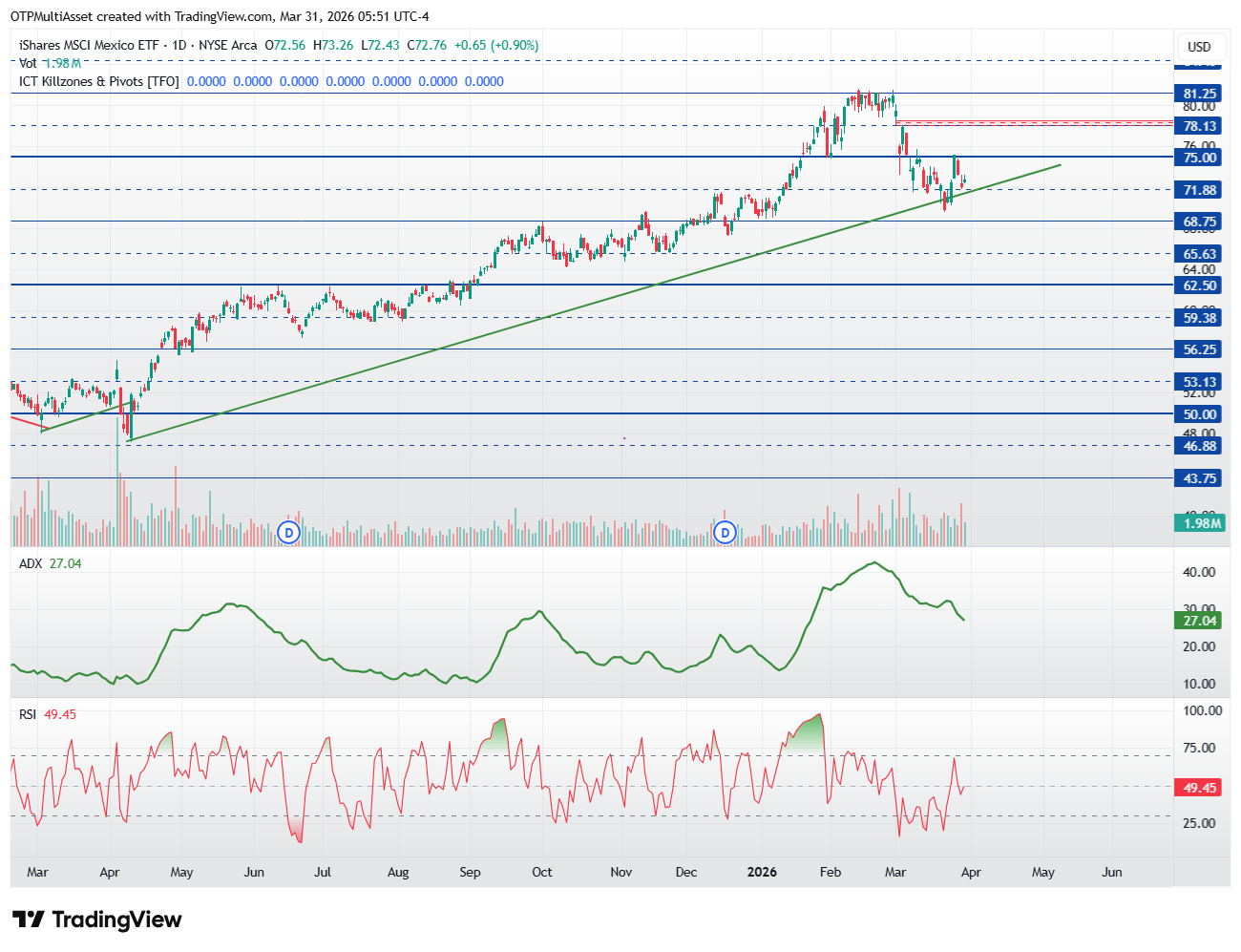
Like other emerging markets, the EWW—iShares MSCI Mexico ETF, which tracks the Mexican stock market—started the year very strongly, but then, amid global risk aversion following the escalating conflict in Iran, the Mexican stock market also fell significantly. Although there was a rebound at the end of March, it appeared to have run out of steam for the time being.
For the MSCI Mexico Index, the upward trend in forward earnings estimates that had been in place since late April of last year came to a halt in early March, which calls for caution. That said, it is also worth noting that earnings estimates continue to rise for the two largest components of the EWW ETF (the primarily copper-producing Grupo Mexico and Grupo Financiero Banorte). The MSCI Mexico Index’s forward P/E ratio of 12.81 is higher than that of the emerging markets index (11.54), but lower compared to the MSCI ACWI Index’s valuation (16.78).
As mentioned earlier, Mexico is in a relatively more favorable position with regard to the effects of the conflict in the Middle East; however, several factors of uncertainty continue to loom over the local stock market. The most important of these is the renegotiation of the free trade agreement between the US, Canada, and Mexico: JP Morgan assigns a 65% probability to the scenario of renegotiating and extending the USMCA, while in the absence of this, they view the likelihood of a transition to bilateral agreements as significantly lower (20%), and the probability of a quick agreement (or failure to reach an agreement) is even lower than that. News regarding the free trade agreement could be a market mover in the upcoming period; it is also worth noting that this year’s soccer World Cup, co-hosted by the U.S., Canada, and Mexico, could provide a modest boost to the Mexican economy.
EWW – iShares MSCI Mexico ETF technical picture
The price tested the uptrend a week ago but has not broken it yet. A gap formed on the downside from the 78.1 level, which in itself could be interpreted as a sell signal. If the trend breaks, further downside could open up toward the 62.5 level, which is considered a strong support. For now, there are no visible buy signals or reversal patterns, so it is advisable to wait and see with long positions.
Get more out of your investments!
Global Markets Services
OTP Global Markets offers a broad range of services in the field of local and international money and capital markets.
Read morePrivate Banking Services
Personal care and expertise with OTP Private Banking, along with the knowledge, security, and innovations of a multinational banking group.
Read more