
There is going to be a new prime minister in Japan
Related content
US bank shares fell
The third-quarter earnings season in the US has picked up pace following the release of the latest figures from US banks. Based on preliminary expectations, the third quarter is likely to have closed with strong earnings growth for S&P 500 companies, led by the energy and technology sectors. The major US banks have still achieved solid growth on an annual basis, indicating that their operations remain strong, but the pace has clearly slowed in many cases, which has tended to result in negative share price reactions.
Commodities - Technical Analysis
Gold and silver continued their downward trend, bouncing off key levels. Until their downward trends are broken, they will not be able to produce a significant rise. The fall in oil prices reversed from the $87.5 level and began a slight upward movement. Natural gas remained in an uptrend; a significant rise could even occur if it breaks out upwards. The price of copper has become stuck in a wider range, so the oversold and overbought zones may offer more favourable trading opportunities. The falling prices of wheat and corn have reached key support levels; a buying reaction from these levels could present favourable long opportunities with limited risk.
Japan's Liberal Democratic Party elected Sanae Takaichi as its leader, who is likely to become Japan's next prime minister if approved by parliament. The Japanese stock market welcomed the result, with the Nikkei jumping to a new high, while the yen weakened against the dollar. Although Takaichi's comments did not hint at immediate or large-scale fiscal stimulus, she may be ready to take measures to boost growth. Takaichi's premiership may be supportive of several sectors (including defense and technology) as it focuses on economic security, but the Japanese stock market is currently at a new high and valuations are rather stretched. Thus, while it cannot be ruled out that there may still be some room for the Japanese market to rise, as we have pointed out before, it may be overly optimistic to expect valuation levels to climb higher than they are currently.
Sanae Takaichi may be the new Japanese prime minister
In early September, Japanese Prime Minister Shigeru Ishiba announced that he would be stepping down from his post after his party, the Liberal Democratic Party (LDP), lost its majority in the lower house of parliament last October and then also became a minority in the upper house following the July election. As a result, Japan will elect a new prime minister in just over a year.
The new leader of the LDP was elected in early October, and the party leader is likely to become Japan's next prime minister. Based on opinion polls, two candidates appeared to be the frontrunners: if Sanae Takaichi had won, she could become Japan's first female prime minister, while Shinjiro Koizumi would have been the country's youngest leader since World War II.
On October 4, the LDP elected Sanae Takaichi as its leader, this is followed by a parliamentary vote (usually within a few days or weeks). The candidate must obtain a majority of the votes to become prime minister, which is likely, as the LDP is the largest party in the Japanese parliament (although, following previous election defeats, it no longer has a majority in either the lower or upper houses of parliament). Although commentators say it is theoretically possible for the opposition parties to join forces to prevent the election of an LDP prime minister, this seems unlikely given the fragmentation of the parties. The new LDP leader's term is for three years, but depending on the outcome of future elections, it could be shorter (as was the case with outgoing Prime Minister Shigeru Ishiba).
In terms of Japanese foreign policy, Takaichi is likely to prioritize continuity, but some observers believe that her hardline views could lead to tensions with several of Japan's key partners (including the US and China). If elected, she will face a number of high-profile diplomatic events in the coming weeks: in addition to the East Asia Summit in Malaysia, the Asia-Pacific Economic Cooperation (APEC) leaders' summit in South Korea, and a possible visit by President Donald Trump to Japan are all expected by the end of October. All this may reduce the time available for forming a government and defining its political program.
Numerous challenges await the new prime minister
The new LDP leader will have the task of uniting the divided party and steering the fragile coalition government, while inflation above the central bank's 2% target may also require some form of support for households. Although the Japanese economy has grown for five consecutive quarters, the population remains concerned about higher living costs.
Commentators note that Takaichi, who is in favor of stimulus measures, has recently toned down her messages on fiscal and monetary policy, while showing openness to cooperation with opposition parties to secure legislative support. With the LDP losing its parliamentary majority, this will likely be necessary for the new prime minister. Takaichi's victory could push Japanese fiscal policy in a more expansionary direction, while the pace of tightening by the Bank of Japan may be somewhat slower.
Following the LDP leadership election, Takaichi spoke about supporting households and small businesses affected by rising prices, and while emphasizing coordination between the government and the central bank, she did indeed seem to be pushing the Bank of Japan toward slower monetary tightening. In her view, inflation continues to be driven primarily by rising costs, so policy support should remain in place until consumer price increases are followed by wage or demand growth.
The new prime minister would maintain a looser monetary policy, while the central bank would take another step toward achieving a neutral interest rate level, so market participants believe that the next interest rate hike is by no means a foregone conclusion at the October interest rate decision. Some commentators believed that, in addition to possible further tightening by the central bank, fiscal support from the government could be a workable compromise.
Japanese stock market hits new high
According to market participants, Takaichi's election as prime minister is positive for stock market sentiment due to her plans to stimulate the economy, while the possibility of fiscal stimulus could weigh on longer-term government bond yields. However, comments pointing towards a looser monetary policy could weaken the yen.
This was also evident in initial market reactions: the yen weakened above the 150 level against the dollar on October 6, while the Japanese stock market rebounded sharply, with the Nikkei closing at a new high after rising more than 5 percent, supported by both the weaker yen and expectations of economic stimulus measures.
If Takaichi is indeed elected prime minister, one of her first steps could be to abolish the provisional tax on fuel, which would provide relief to Japanese households on the one hand, and, according to preliminary industry estimates, could boost Japan's GDP by up to 0.3% while reducing inflation.
Although it was to be expected that all candidates running for the LDP leadership would attempt to introduce some kind of package of measures to support the population in order to offset the effects of inflation. According to Takaichi's previous promises, in addition to cash payments, she would also help households with tax refunds and indicated that she would raise the tax-free income threshold before the end of the year.
As we have pointed out previously, the Japanese market’s valuation is near its local high, and even if the Bank of Japan delays its interest rate hike somewhat, the tailwind for stock markets may diminish over time due to gradual central bank tightening. The MSCI Japan 12-month forward P/E ratio is 16.01, putting the index one standard deviation above its long-term average, although the Japanese market is undervalued compared to the MSCI US (23.03) and MSCI ACWI (19.49) indices.
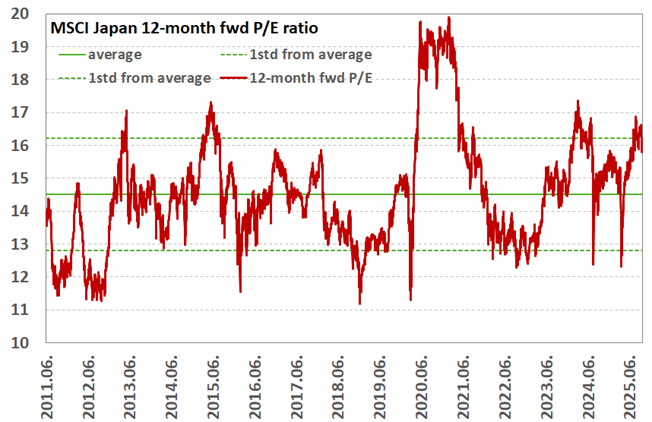
It is questionable how much room for maneuver the future prime minister will have in terms of the fiscal stimulus, and Takaichi tried to strike a cautious tone regarding her views on reflationary policy before her election. Some commentators noted that Takaichi's remarks did not suggest immediate or large-scale fiscal expansion, but that her political orientation would allow her to actively use fiscal tools to support growth if necessary. With inflation is being sticky, the prime minister's more expansionary policy stance could easily fuel further increases in the cost of living, while rising yields may make policymakers more cautious.
The Takaichi administration's focus on economic security could be supportive for several sectors (including defense and technology). However, the Japanese stock market is at a new high and valuations are rather stretched, so as we have pointed out before, further increase in valuation levels may be too optimistic at this point (although a possible fiscal stimulus could provide some tailwind). Even so, it is worth considering the possibility of a correction after the massive rise in recent months. Monetary conditions may tighten further over time, and earnings growth may become even more important for the local stock market. Going forward, it is important that corporate reforms do not stall, and overall, the long-term structural investment story remains favorable for Japan, which is also included in our investment strategy.
Nikkei technical picture
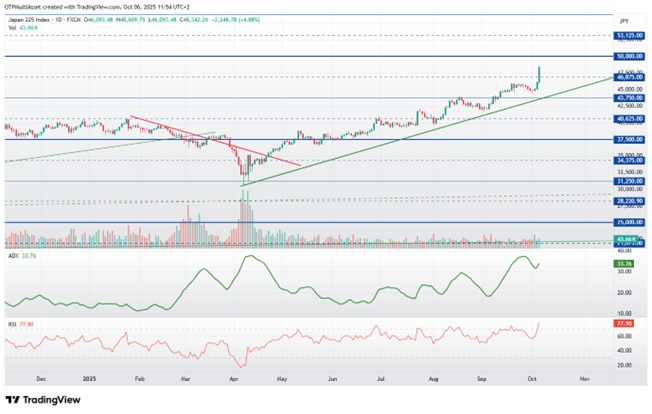
The Japanese stock market index shifted to an upward trend in April this year and has been following an ideal trendline marked in green ever since. The curve is characterized by continuously higher swing lows, which has so far confirmed the uptrend. Currently, the technical support level is at 43,750, which, if broken, could interrupt the upward trend. For the time being, however, this level is not in danger, the price remains open to further gains, and no reversal pattern has emerged. Based on the trend-reinforcing pattern that has emerged over the past two years, the next target level can be set at around 50,000. Above this level, however, seeking further long positions without a correction no longer offers an adequate risk/return ratio, so in the current situation, it may be more appropriate to wait and see.
Get more out of your investments!
Global Markets Services
OTP Global Markets offers a broad range of services in the field of local and international money and capital markets.
Read morePrivate Banking Services
Personal care and expertise with OTP Private Banking, along with the knowledge, security, and innovations of a multinational banking group.
Read more