
The government crisis is over – what lies ahead for Romania?
Related content
Commodities - Technical Analysis
Signs of a turnaround have emerged for gold and silver, and a strong upward move could trigger the next upward wave. A breakout above the key downtrend lines could also be on the horizon, which would further reinforce the positive turnaround. The price of oil has broken below the 100-day moving average, weakening the bullish outlook, and with the uptrend broken, it has entered a correction phase. Natural gas is showing a correction following a sharp decline, but has not yet managed to break through its downtrend line. Copper continues to trade within a wide range and is approaching the lower end of that range. Following a significant decline, wheat and corn prices have reached key support levels from which an upward correction—or even a new uptrend—is likely to begin.
FX - Technical Analysis
The dollar's momentum has eased, but confirming a trend reversal would require a decisive bearish session against the euro. Against the British pound, however, the exchange rate remains in an uptrend. EUR/HUF continues to trade within a narrowing range, while the dollar remains in an uptrend against the forint. USD/JPY has broken out to the upside from its consolidation pattern, suggesting further upside potential. EUR/CHF previously broke below a key support level that had defined its uptrend, and the pair is now characterized by a downtrend.
Romania has experienced five turbulent months on the domestic political front. Nevertheless, after several prime ministerial candidates failed to secure parliamentary support, a new government was finally formed in late October. The Romanian equity market, which had performed strongly during the first half of the year, lost momentum towards the end of August and entered a downward correction in September. It then rebounded in October, partly reflecting the reduced risks of a snap election and a sovereign rating downgrade to below investment grade. While domestic political tensions have subsided, the BET index has yet to recover to the vicinity of its August peak. At the same time, Romanian equities no longer appear particularly inexpensive from a valuation perspective.
Protracted Domestic Political Uncertainty in Romania
Romania has experienced a turbulent few months. The fiscal consolidation carried out in the first half of the year was supported by a combination of previously approved tax increases, spending cuts, more efficient tax collection and the accelerated absorption of EU funds. Despite the improvement in the fiscal position, Romania continued to face significant economic headwinds. Inflation peaked at nearly 11 percent in May, while the war in Iran and the associated rise in oil prices led the government to intervene in fuel and food pricing. The economy slipped into a technical recession, although investors’ attention soon turned to developments on the domestic political front.
In April this year, mounting tensions within Romania’s pro-EU, four-party coalition eventually resulted in a rupture when the Social Democratic Party (PSD) withdrew its support for Prime Minister Ilie Bolojan. The PSD’s six ministers subsequently resigned from the government after Bolojan refused to step down. Shortly afterwards, the PSD joined forces with the Alliance for the Union of Romanians (AUR) to table a no-confidence motion. The motion passed in early May with 281 votes, well above the 233 required, bringing down the Bolojan government.
While the increasingly uncertain political environment may have somewhat intensified concerns over a potential derailment of fiscal consolidation, some commentators noted that Romania had experienced similar crises in the past and had ultimately managed to navigate its way out of them. The Romanian stock market therefore recovered relatively quickly from the sell-off in late April and early May, before resuming its upward trajectory.
In early June, Romanian President Nicusor Dan initially tasked Eugen Tomac, a member of the European Parliament, with forming a government. Tomac eventually relinquished his mandate after failing to build sufficient support for a technocratic cabinet. Dan subsequently turned to Adrian Vestea of the National Liberal Party (PNL), but Ve?tea’s proposed government failed to secure the necessary votes in parliament at the end of June.
This left the president facing a difficult choice. He needed to nominate another prime ministerial candidate capable of commanding a parliamentary majority, or Romania would risk moving closer to a snap election. Dan was likely reluctant to call an early vote, particularly as opinion polls placed the Alliance for the Union of Romanians (AUR) in the lead.
For a while, markets largely ignored the political crisis. Then sentiment shifted
The Romanian equity market continued to perform strongly despite the government crisis, although the emergence of a double-top pattern over the summer was followed by a negative correction. As the political impasse dragged on, market tensions gradually intensified. The BET index fell almost continuously in September, while Romania’s ten-year government bond yield rose towards 8 percent. Investor concerns increased further after parliament rejected the third prime ministerial candidate, Siegfried Muresan, a member of the European Parliament. This coincided with an approaching sovereign rating review by S&P, raising the possibility that Romania’s debt rating could be cut to below investment grade.
In the end, S&P left Romania’s sovereign rating unchanged at BBB-, the lowest rung of investment grade, with a negative outlook. Nevertheless, the agency warned that Romania could be downgraded if the prolonged political turmoil prevented the government from reducing the budget deficit over the following two years. The deficit remained among the highest in the EU. Romania’s ten-year government bond yield subsequently declined, while the local equity market rebounded after the country avoided a downgrade.
The government crisis, which had dragged on for more than five months, was finally brought to an end in late October when the Romanian parliament approved Luca Niculescu and his cabinet with 280 votes in favour. Niculescu had previously overseen Romania’s OECD accession process in his capacity as a state secretary at the Ministry of Foreign Affairs. The minority government, composed of 12 Social Democratic ministers and six independent technocrats, faces a formidable challenge. It must restore economic growth while simultaneously reducing one of the EU’s largest budget deficits. According to the government programme, the authorities aim to bring the deficit below 3 percent of GDP by 2030, relying, among other measures, on curbing tax evasion and improving tax collection efficiency.
The non-partisan prime minister will have to carefully navigate between the political parties, not least to secure parliamentary approval for next year’s budget. Commentators have warned that, without the backing of a stable parliamentary majority, his ability to push through additional spending cuts and structural reforms may remain limited. Investors will therefore closely scrutinise the new government’s performance, particularly for any signs of fiscal slippage.
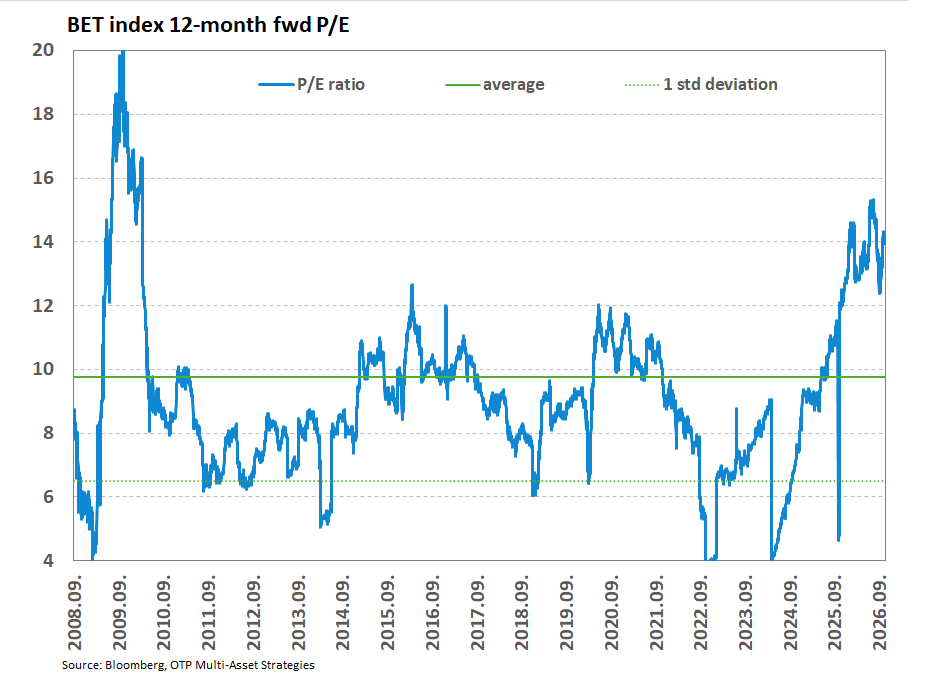
Romania ultimately avoided both a credit rating downgrade and an early election. As political risks receded, the Romanian equity market recovered most of the ground lost during the September correction. However, the BET index has yet to return to the vicinity of its August peak. From a valuation perspective, Romanian equities no longer appear particularly cheap. The BET index is trading at a 12-month forward P/E multiple of 14.08, above both its long-term average of 9.78 and the corresponding valuation multiple of the MSCI Frontier Markets Index.
BET index technical picture
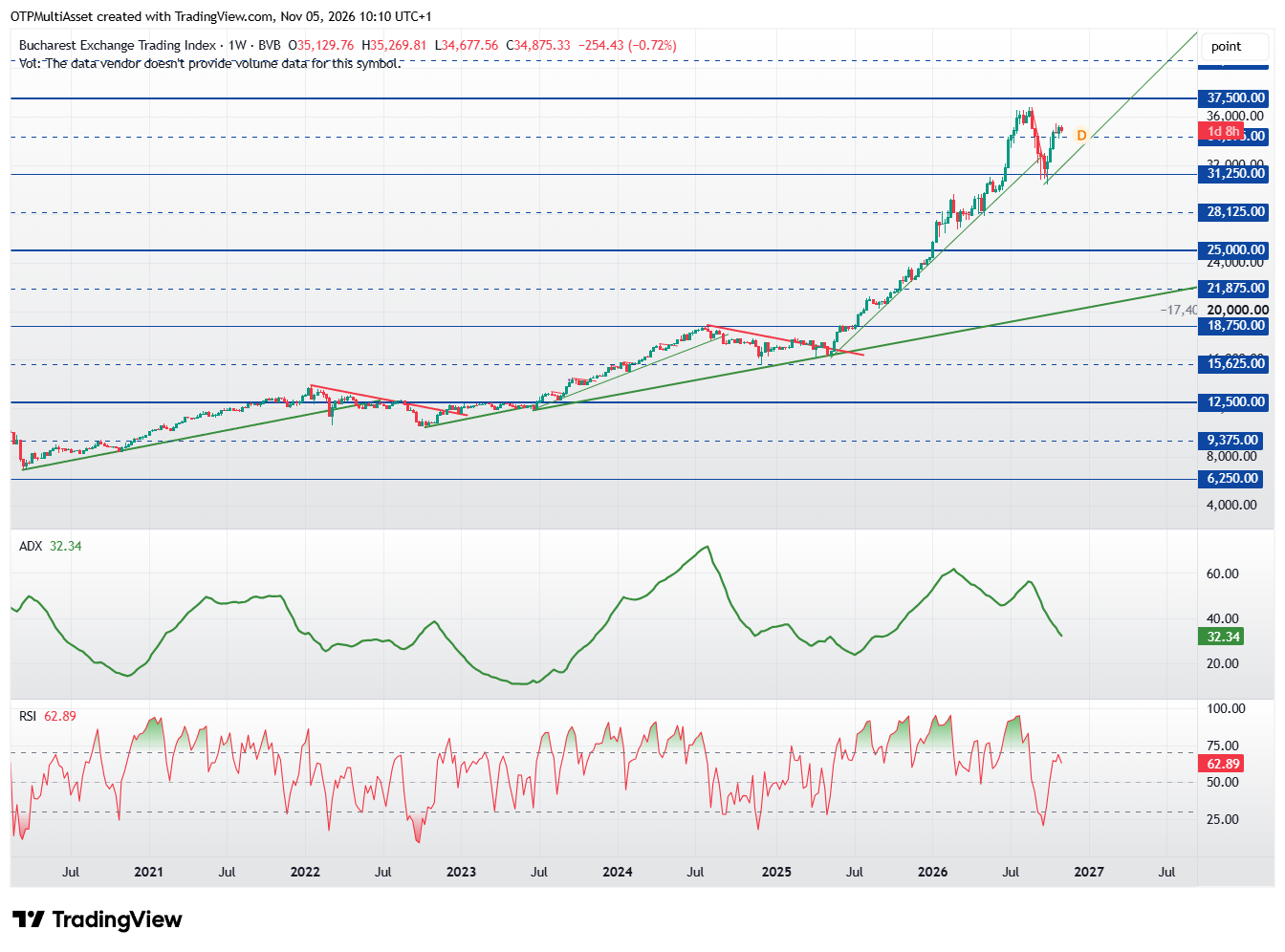
On the weekly timeframe, the Romanian index has entered a key resistance zone. The breakout above 18,750 in mid-2025 provided a strong buy signal, but a long-position exit signal has recently emerged on the chart. The price action observed over the past few weeks appears to be corrective in nature.
In an ideal scenario, the correction would run its full course with a temporary move below 31,250, which would require another leg lower from current levels. Conversely, even if the index were to set a new all-time high by breaking above the peak reached three months ago, the 37,500 area would likely act as strong resistance and could disrupt the upward momentum. The current setup therefore does not support initiating new long positions, and investors are advised to remain on the sidelines for the time being.
Get more out of your investments!
Global Markets Services
OTP Global Markets offers a broad range of services in the field of local and international money and capital markets.
Read morePrivate Banking Services
Personal care and expertise with OTP Private Banking, along with the knowledge, security, and innovations of a multinational banking group.
Read more