
One of the world’s largest sugar producers could perform well again
Related content
Investors are worried – what lies ahead for Brazil?
In a major surprise, Lula won the second round of Brazil’s presidential election, even though markets had previously expected Flávio Bolsonaro to prevail. Lula’s victory triggered a sharp repricing of Brazilian assets, while sentiment deteriorated further shortly afterwards following an unorthodox proposal calling for a substantial reduction in the central bank’s policy rate. For now, it appears that no such plan is under consideration in Brazil, and the president has reaffirmed his commitment to fiscal discipline. Investors, however, remain largely sceptical. Market participants are waiting for concrete measures, and in the near term the key question for Brazil will be whether the anticipated fiscal measures can stabilise the country’s debt trajectory and how the president will reconcile them with his campaign promises.
Hungary: Headline inflation accelerated in line with expectations, while underlying inflation pressures remained elevated
Hungary's headline inflation rose by 0.4 ppts to 2.0% year-on-year in October, up from 1.6% in September. The data was in line with the market consensus (2.0%) and marginally above our forecast (1.9%). The main reason for the acceleration of headline inflation was the further increase of fuel inflation while processed food prices decreased less than expected mainly due to sugar and confectionaries. However, food prices still significantly contributed to the low inflation in Hungary, so the fact that prices of several agricultural commodities have started to rise in recent months, reinforces our view that food prices will no longer contribute to disinflation in 2027.
We are optimistic about the outlook for the broader agricultural sector and, within it, the sugar market. Factors contributing to this include, among others, the growing demand for biofuels and this year’s already extreme weather conditions. In addition, the conflict in Iran remains unresolved, which is affecting fertilizer and fuel prices and could indirectly drive up agricultural commodity prices. This is where the German company Südzucker comes into the picture, which is one of the world’s largest sugar producers and a leading European player in biofuel production. The company’s sugar division—which is large but has struggled in recent years—could benefit significantly from potentially higher sugar prices, hence we open a trading idea for the company’s stocks.

Europe's leading sugar producer
Südzucker is a German company engaged in agricultural and food industry activities and it is one of the world’s largest sugar producers and Europe’s leading producer of ethanol (biofuel). The company has more than 18,000 employees and organizes its operations into five different segments:
- Sugar production: this generally refers to the processing of sugar beets (with less emphasis on cultivation), sugar refining, and the sale of various products, ranging from crystalline sugar to liquid sugar and caramels.
- Special products: this includes frozen and refrigerated pizzas, pasta dishes, and other packaged products (one of the world's largest pizza manufacturers).
- CropEnergies: this essentially covers ethanol production (mostly biofuel) and animal feed production.
- Starch: the main activity here is the production and sale of starch (from corn, potatoes, and wheat).
- Fruits: this one includes a large variety of fruit products and concentrates.
Südzucker also holds a 41.9% stake (directly and indirectly) in AGRANA, which is engaged in similar activities (sugar production, starch production, fruit products, bioethanol, etc.). Most of these are consolidated in the financial statements.
Strong cyclical performance
The company’s last financial year (March 2025–February 2026) was not particularly strong, primarily due to challenging conditions in the sugar market. EBITDA at the group level was 535 million euros, with special products accounting for 50% of that figure and fruit products for 30%.
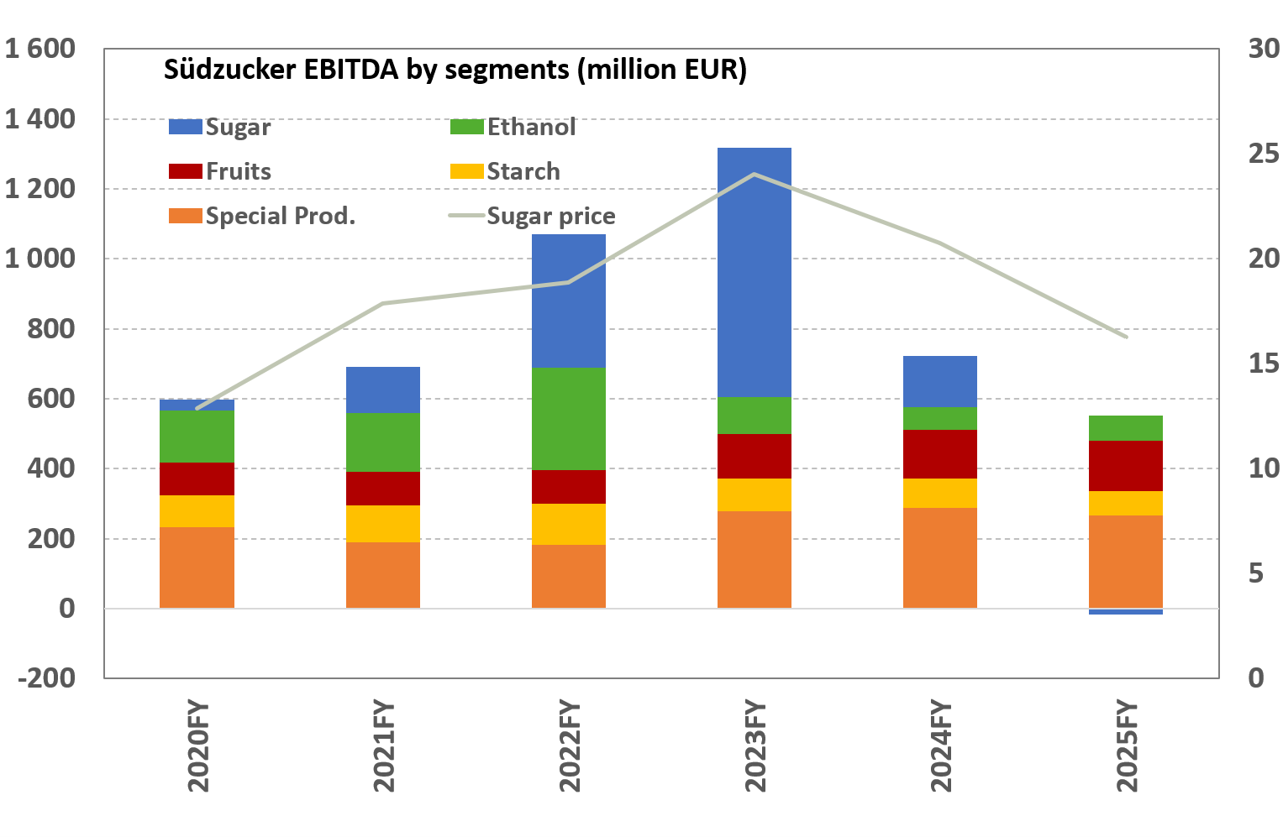
Source: Südzucker, Bloomberg, OTP Multi-Asset Strategies
The Sugar division’s contribution to EBITDA was slightly negative, but as can be clearly seen in the chart above, the segment’s performance is strongly correlated with sugar prices. For example, in 2023, with high sugar prices, the sugar business alone generated more EBITDA (over 700 million euros) than the entire company did last year. The biofuels segment is also more cyclical, while the other three business segments (special products, fruits, and starches) are fundamentally stable, generating 400–500 million euros in EBITDA annually.
Südzucker’s valuation is not high considering current low sugar prices. The EV/EBITDA ratio is 9.7x using this financial year’s expected EBITDA figure and this could fall to 7.8x next year (Bloomberg consensus).
Why might this be an interesting investment?
Based on the data above, it is clear that the company’s financial performance is heavily dependent on the results of the sugar and ethanol segments, which typically exhibit cyclical behavior; thus, the outlook for these segments is a key factor in determining both the stock price and the company’s valuation.
The ethanol production business is already performing better thanks to the surge in energy prices caused by the war in Iran (this is reflected in the first-quarter figures as well), since this has led to a jump in demand for biofuels. In addition, there is an ongoing discussion in the EU about raising the ethanol blending ratio in gasoline from 10% to 20%, which would also be favorable for the company. However, sugar prices have not yet surged (and this would be more important for the company), but we expect a change in this regard as well.
On the one hand, higher demand for ethanol diverts a portion of sugarcane crops, since a significant portion of biofuel production is sugar-based, leaving less raw material for sugar production. This is already evident in production figures from Brazil, the world’s largest sugar producer (according to a report by the Brazilian Sugarcane and Bioenergy Industry Association, sugar production fell by 2%, while ethanol production surged).
On the other hand, the stronger El Nino weather phenomenon expected this year could also cause production problems, as more severe droughts and lower rainfall volumes are anticipated in some regions (though net effects are difficult to assess). In India, for example, this June was the fifth driest since 1901, and rainfall was nearly 40% below the long-term average. This is significant because the country is the world’s second-largest sugar producer.
Third, sugar prices remain at multi-year lows, so even minor positive developments could push prices higher. In addition, the conflict in Iran has not been fully resolved, which is affecting fertilizer prices and availability, and fuel prices have also remained elevated. These factors could also provide a tailwind for sugar prices, although from Südzucker’s perspective, the picture is more mixed (as sugar beet prices would also rise alongside sugar prices).
Overall, we expect the company’s sugar production segment to show improved performance over time, while the biofuel division is also expected to perform well this year, which could lead to higher stock prices.
What does the technical picture show?
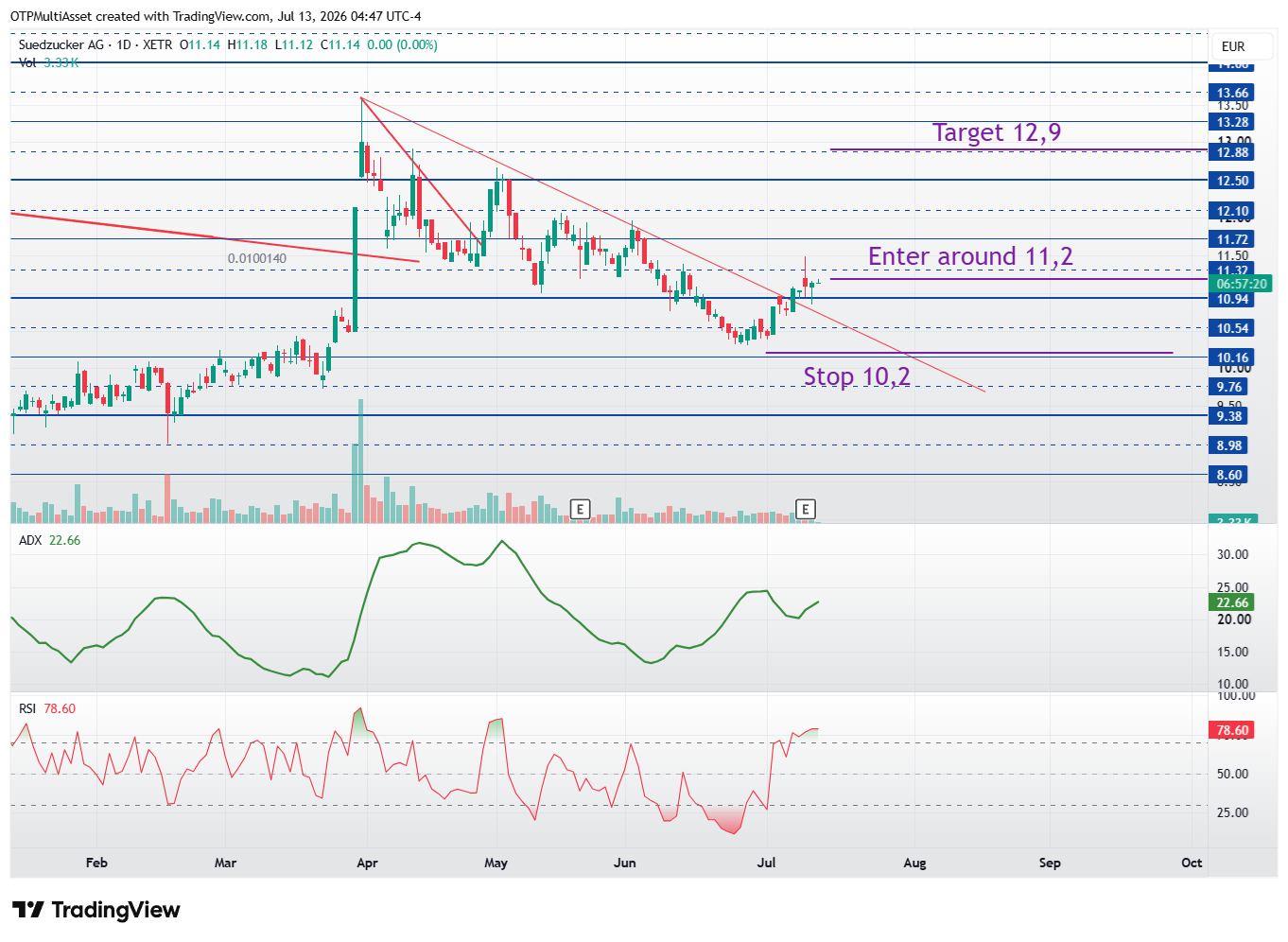
As early as March, a sharp rise indicated that the long-term downtrend was running out of steam and that a trend reversal might be taking shape. In recent weeks, a correction has unfolded, proceeding at a relatively moderate pace. The level around 10.94 served as an important support; although the stock price briefly dipped below this level, no significant selling pressure developed.
Buying interest has resurfaced in recent days, while the breakout above the downtrend line has created a favorable opportunity to enter a long position. At current price levels, around 11.2 euros, we are opening a long position, placing the stop order below the previous swing low. We set the target price near the previous high, so the expected return is about 1.7 times the risk taken.
Get more out of your investments!
Global Markets Services
OTP Global Markets offers a broad range of services in the field of local and international money and capital markets.
Read morePrivate Banking Services
Personal care and expertise with OTP Private Banking, along with the knowledge, security, and innovations of a multinational banking group.
Read more