
AI Propels SpaceX to New Heights
Related content
European Markets at Risky Levels
European stock markets have also started to pull back from levels near their all-time highs. While our screening lists continue to generate a handful of candidates, the quality of these opportunities does not yet justify a buy recommendation. In fact, a momentum-based approach is increasingly favoring short positions, making it more challenging in the coming weeks to identify long ideas that offer both outstanding upside potential and an attractive risk-reward profile. Given these unfavorable trends, we are not issuing a buy recommendation this week. It may be more prudent to remain patient and wait for a more meaningful correction, at which point attractive entry opportunities could emerge again in selected stocks.
Hungarian Equities - Technical Analysis
The BUX index has rebounded to a level where it could form a lower high. However, this would require a trading session in the coming days that reflects strong selling pressure. MOL’s share price continues to move within a downtrend, and until it breaks through the key trendline, a sustained, trend-following rally is unlikely. Richter has broken out upward from an ascending triangle pattern, so this trend-confirming formation may continue to provide room for the rally to continue. Magyar Telekom has already begun its third upward wave, which could even signal the end and peak of the current uptrend. Opus continues to move within a downtrend, while no technical signals indicating a reversal have emerged yet. Rába also continued its range-bound movement but has still not managed to break out significantly from the established consolidation range.
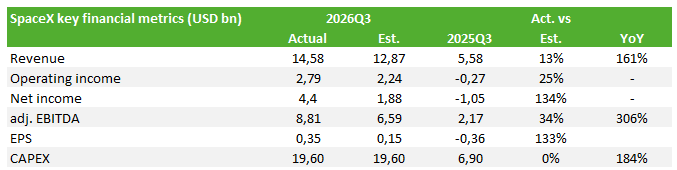
SpaceX delivered a quarter that far exceeded expectations. Revenue from the AI segment increased ninefold, while growth at Starlink continued to be accompanied by high profitability. However, the rapid expansion also entails exceptionally heavy investment requirements. Capital expenditure reached USD 20 billion in the third quarter and could double in Q4, while next year the company’s investment spending may rise to levels comparable with those of the major hyperscalers. Investors nevertheless welcomed the results, sending the share price sharply higher.
SpaceX reported exceptionally strong growth figures for the previous quarter, so it was hardly surprising that the share price jumped by more than 8 percent. The AI business is scaling much faster than previously expected, while Starlink continues to generate high profitability. Net income exceeded expectations by 134 percent. After reporting a USD 1 billion loss a year earlier, the company generated a USD 4.4 billion profit in the latest quarter. Revenue also came in above expectations across all three business segments.
AI
Revenue in the AI segment surged to USD 7.56 billion, representing a ninefold increase year over year and almost three times the USD 2.56 billion recorded in the second quarter. The segment generated operating income of USD 431 million, compared with an operating loss of USD 1.72 billion a year earlier.
The rapid growth was driven by the commissioning of new computing capacity and the successful sale of that capacity to companies such as Anthropic and Google. The acquisition of Cursor in August also contributed to the strong performance.
According to management, newly commissioned computing capacity may have a return period of less than one year, which could justify the company’s aggressive investment programme. However, USD 16.4 billion of the USD 19.6 billion in third-quarter capital expenditure was related to AI infrastructure. Capital expenditure was more than twice the segment’s adjusted EBITDA, indicating substantial negative free cash flow.
Connectivity
Revenue in the connectivity segment increased by 69 percent to USD 5.25 billion, exceeding analysts’ expectations by 8 percent. Operating income of USD 2.37 billion translated into an operating margin of 45 percent, confirming that Starlink remains SpaceX’s most stable business segment. The number of residential subscribers increased to 13.6 million, while average monthly revenue per subscriber rose to USD 69.
Demand from airlines was strong during the quarter, and the company also secured government orders. The number of Starlink Mobile subscribers increased to 22 million. This is an important development for the adoption of satellite-based mobile services, as the business could eventually provide the company with an additional revenue stream. For the time being, SpaceX provides this service in partnership with mobile network operators. However, the company’s recent spectrum acquisition suggests that it may eventually seek to compete directly with the major telecommunications companies.
Space
Revenue in the space operations segment increased by 6 percent to USD 1.77 billion. The business reported an operating loss of USD 7 million, although this still represented a significant improvement from the USD 542 million loss recorded in the second quarter. SpaceX completed 35 rocket launches during the quarter.
The next major milestone could be the 15th Starship test flight, during which the company may attempt to catch both of the launch vehicle. This could be followed in early 2027 by the first orbital propellant-transfer demonstration. The latter would represent a critical milestone not only for NASA’s lunar programme and longer-distance missions, but also for the long-term operational viability of Starship.
What is the cost of growth?
Management expects capital expenditure of USD 35 billion to USD 40 billion in the fourth quarter. Even the lower end of this range would be almost twice the amount invested in the third quarter. Furthermore, SpaceX must simultaneously finance data centres, next-generation satellites, the Starship programme and spectrum acquisitions. The company’s total investment spending could rise next year to levels comparable with those of the major hyperscalers. Internal funding is unlikely to be sufficient to cover these requirements, potentially leading to further bond issuance.
Management guided for revenue of USD 33 billion to USD 37 billion in the first quarter of 2027, far above the previous market expectation of approximately USD 22 billion. During the post-earnings call, Elon Musk confirmed that a potential merger between SpaceX and Tesla remains under consideration. He noted that the decision was not his to make, although he would naturally support such a transaction. The combined value of the two companies would approach USD 3.5 trillion, making it the largest corporate merger in history. The news drove not only SpaceX shares higher, but also supported the share price of Tesla.
Get more out of your investments!
Global Markets Services
OTP Global Markets offers a broad range of services in the field of local and international money and capital markets.
Read morePrivate Banking Services
Personal care and expertise with OTP Private Banking, along with the knowledge, security, and innovations of a multinational banking group.
Read more