
South Korean stock market hits new highs
Related content
Commodities - Technical Analysis
Gold and silver continued their downward trend, bouncing off key levels. Until their downward trends are broken, they will not be able to produce a significant rise. The fall in oil prices reversed from the $87.5 level and began a slight upward movement. Natural gas remained in an uptrend; a significant rise could even occur if it breaks out upwards. The price of copper has become stuck in a wider range, so the oversold and overbought zones may offer more favourable trading opportunities. The falling prices of wheat and corn have reached key support levels; a buying reaction from these levels could present favourable long opportunities with limited risk.
Our Fixed Income Top Picks
The rise in yields seen over recent months has created a new environment across global fixed-income markets. With U.S. 10-year Treasury yields above 5%, increasing fiscal concerns in France, and corporate credit spreads remaining historically tight, the importance of selection has increased. In our latest top pick list, we highlight bonds that may offer attractive risk-adjusted return potential as part of a suitably diversified portfolio.
The South Korean stock market had a very strong year, with the Kospi setting two records in January: it was the best performing stock market index globally and broke through the 5,000-point level previously set as a target by South Korean president Lee Jae Myung. The significant rise was supported by a combination of factors: South Korean capital market reforms and expectations for their continuation, as well as growing demand for artificial intelligence-related semiconductors through South Korean chip manufacturers, drove the local stock market index to new highs. Forward-looking earnings expectations have been rising sharply since October last year and valuations are favorable, so as long as capital market reforms and their implementation continue, and AI-related companies continue to perform well, there may still be room for further growth in the Kospi.
Kospi breaks through the 5000-point level
At the time of our analysis of South Korea last June, the Kospi was already above its 2024 peak and had strengthened by around 30% from its April low. Despite the sharp rise, the fundamentals looked promising going forward, and the technical picture also suggested that there was still room for further gains. The 5,000-point target for the index set by the newly inaugurated South Korean president seemed achievable, but still very far off.
It is worth taking a step back in time and recalling how long it took the index to reach its previous psychological levels. The Kospi reached 1,000 points in March 1989, supported, among other things, by South Korea's accelerating export-driven industrialization. Hampered by subsequent domestic and international shocks, it took roughly another 18 years to reach the 2,000-point level (July 2007), and then, following the COVID-19 pandemic, the index broke through the 3,000-point level in early 2021, thanks to an improvement in global liquidity and a rise in technology stocks. In comparison, the South Korean stock market reached the 4,000-point level at the end of October 2025, after corporate governance reforms that shifted to a higher gear, as well as artificial intelligence and the associated increasing demand for semiconductors, together propelled the South Korean stock market to new heights.
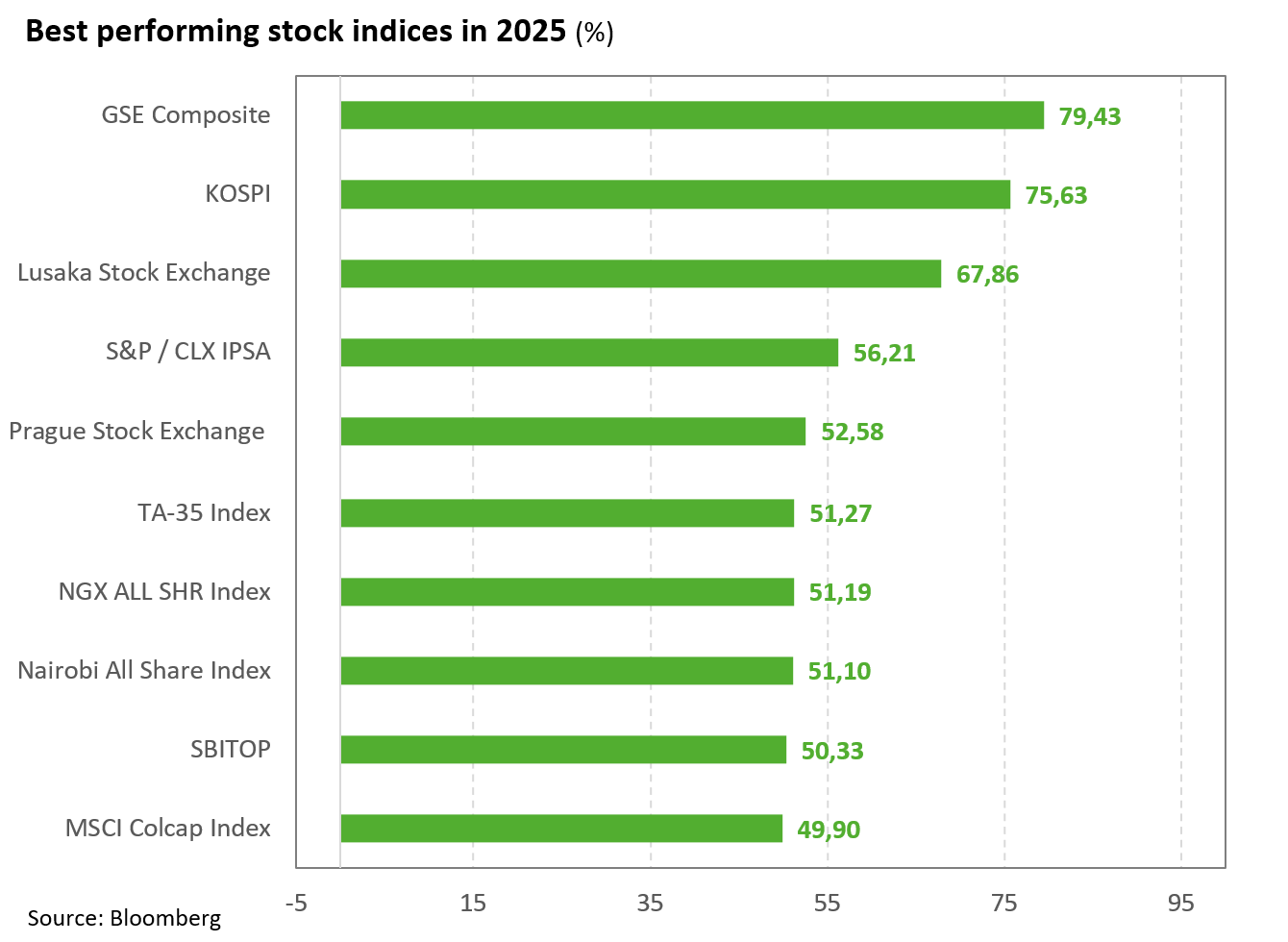
The next milestone was not long in coming: at the end of January, the Kospi broke through the 5,000-point level set by the South Korean president, which took the index roughly seven months to achieve after Lee Jae Myung's inauguration in June. With a 75% increase last year, the South Korean stock market was the second best performing stock market index globally (and the index also started this year very strongly, with the Kospi being the best performing stock market globally in January). Several factors contributed to the rise of the South Korean stock market last year. In addition to capital market reforms, the artificial intelligence-related semiconductor boom also provided a strong tailwind for the Kospi.
Further capital market reforms may be coming in South Korea
The government has taken several important measures to reduce the valuation discount on Korean stocks. Following several amendments to commercial law, members of corporate boards of directors are now legally accountable to all shareholders (not just those with larger shareholdings). Family-owned South Korean conglomerates (chaebols) have often been criticized for having management that is subservient to the owners, and the amendment to the law requiring more independent board members was intended to counteract this.
It is also important to mention the Corporate Value-Up Program launched (by the previous administration) based on the Japanese model, which aims to increase shareholder value. Part of this is the regulatory guidance aimed at helping companies develop their value creation plans. Under this program, companies disclose the exact strategy they intend to use to increase their value in the medium and long term. The Korean stock exchange has previously indicated that companies that ignore corporate value enhancement guidelines could be publicly listed. Some commentators note that while voluntary compliance was often the norm for companies in the past, the Lee administration's reforms now operate through a combination of incentives, legal requirements, and sanctions.
Capital market reforms are expected to continue. The South Korean president has called for a further review of commercial law, which would include the mandatory withdrawal of listed companies' treasury shares. This was one of President Lee's campaign promises before his election: companies can increase the value per share by reducing the number of treasury shares. According to the previously published (and at the time seemingly final) draft, newly acquired treasury shares must be withdrawn within one year, and plans for the disposal of treasury shares must be approved by the shareholders' meeting each year. If the company violates the rules, the members of the board of directors could be fined.
Some of the comments on the proposal suggested that its adoption could simplify the ownership structure of companies (due to the often complex cross-ownership of corporate conglomerates), However, one of the counterarguments from the corporate side was that treasury shares (in the absence of other solutions used in other countries) can provide protection against hostile takeovers, for example. While business lobby groups wanted to achieve more differentiated regulation, the South Korean parliament is expected to pass the law in early February.
In addition, from the middle of the year, trading hours on the South Korean stock exchange are expected to be extended, with the introduction of pre-opening and post-closing trading hours, increasing trading hours to twelve hours (from the current six and a half hours). Furthermore, 24-hour currency trading may also be introduced in July this year, with the aim of enabling South Korea to achieve MSCI developed market status in the future. In connection with the capital market rule changes effective this year, it is also worth mentioning that Korean listed companies will be required to publish their corporate governance reports starting this year, and from the middle of the year, the range of listed companies subject to English-language disclosure requirements will expand significantly. Companies above a certain asset value will be required to publish documents in English, including those relating to shareholder meetings and investment activities.
What will this year bring?
Capital market reforms (and expectations regarding their continuation) may have provided the initial impetus for the sustained rise in the Korean stock market, but this was not the only factor behind the surge in 2025. The two largest components of the MSCI Korea ETF showed stronger performance in the second half of last year compared to the beginning of the year. Samsung and chipmaker SK Hynix both posted triple-digit percentage gains in the second half of last year, as both companies benefited from increased demand for artificial intelligence-driven memory chips. It is also worth mentioning Hyundai Motors, which had previously lagged behind. Following a weak performance in the first half of last year, its stock rose by ~46% between the beginning of July and the end of December, followed by a further 68% increase in January (we will discuss these three companies in detail later).
The South Korean economy is expected to grow faster in 2026 than last year, with the consensus currently expecting 2% GDP growth for this year (while in 2025, the South Korean economy may have expanded at a rate of 1%). Stronger-than-expected exports in December were also supported by semiconductor sales, and some market participants believe that the global artificial intelligence-related investment boom could also support South Korea's growth momentum. However, it is also worth mentioning that due to the pressure on the won, South Korea may postpone its $20 billion investment pledge in the United States this year (as part of a previous trade agreement between the US and South Korea). Shortly thereafter, the US president threatened to impose a 25% tariff on South Korean imports, which Donald Trump justified by saying that the South Korean legislature had not yet been able to enact the trade agreement previously concluded by the two countries. The South Korean parliament is expected to finalize the bill on investments in the US by early March.
However, trade uncertainty did not hold back the South Korean stock market, with the index breaking through the 5,000-point level at the end of January. Although February started with a significant decline, the Kospi quickly recovered and climbed to new heights. The South Korean stock market is the best performing stock index globally this year (as of February 4). In the case of the MSCI Korea index, forward EPS expectations have skyrocketed since October last year, with the index's forward P/E ratio of 8.73 lower than both the MSCI Emerging Markets Index (12.71) and the MSCI ACWI Index (18.87).
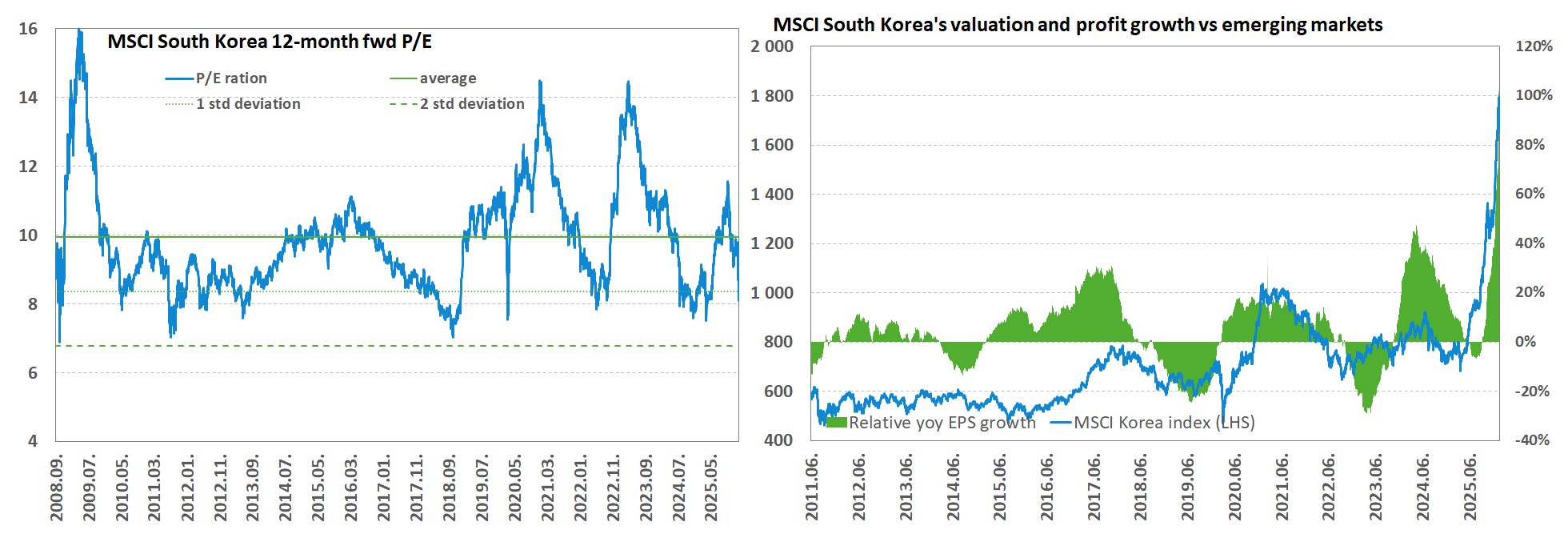
Partly due to growing demand for high-performance chips, Samsung and SK Hynix shares closed last year with significant gains, while the growing energy needs of artificial intelligence data centers provided a tailwind that also boosted the shares of other South Korean companies (Hyosung Heavy Industries, Doosan Enerbility). The broadening of the AI-related investment story was reflected in the fact that in January, the utilities and energy sectors of the MSCI Korea index outperformed the index's technology sector.
After last year's significant rise and the surge at the beginning of the year, the capitalization of the South Korean stock exchange exceeded that of the German stock exchange at the end of January. Even before breaking through the 5,000-point level, the head of the South Korean stock exchange said that the 6,000-point level was achievable. Overall, in addition to the strong performance of companies which tend to benefit from the artificial intelligence boom, it is important that the South Korean administration continues its capital market reforms and is able to implement them effectively. In addition to all this, rising earnings expectations and favorable valuations mean that there is still room for further growth on the South Korean stock market, although, as was evident in early February, the possibility of negative corrections should be taken into account in the future.
Kospi technical picture
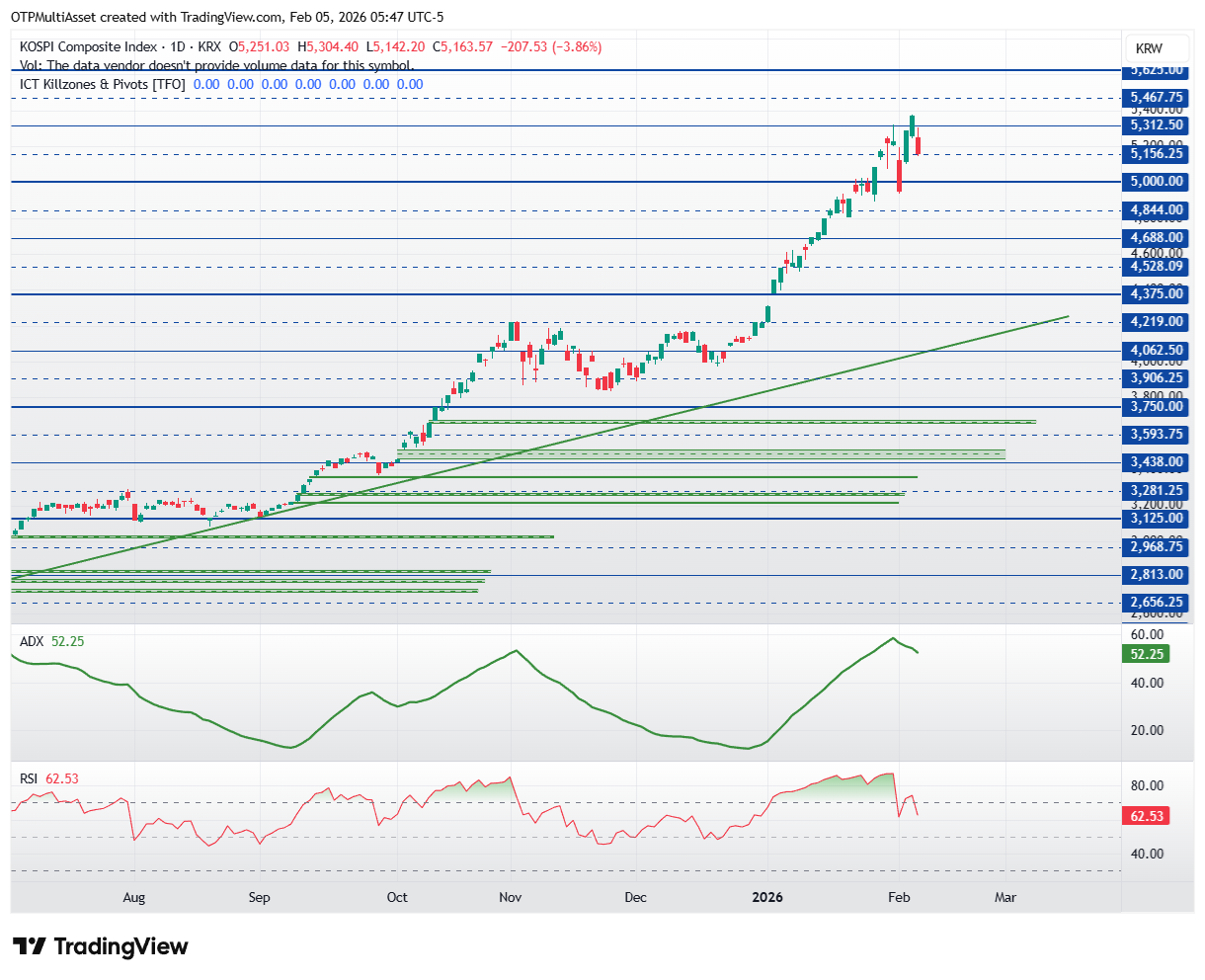
Signs of the end of the rise have appeared on the curve, target prices have been reached, and long closing signals can be seen. The main upward trend is far away, so a more serious correction may come without damaging the longer upward picture. The 4375 level is considered a stronger support level. The risk of longs is high in the zone above 5000, and another favorable long entry may only come after a correction.
Get more out of your investments!
Global Markets Services
OTP Global Markets offers a broad range of services in the field of local and international money and capital markets.
Read morePrivate Banking Services
Personal care and expertise with OTP Private Banking, along with the knowledge, security, and innovations of a multinational banking group.
Read more