
South Korean investors are on a roller coaster ride
Related content
US bank shares fell
The third-quarter earnings season in the US has picked up pace following the release of the latest figures from US banks. Based on preliminary expectations, the third quarter is likely to have closed with strong earnings growth for S&P 500 companies, led by the energy and technology sectors. The major US banks have still achieved solid growth on an annual basis, indicating that their operations remain strong, but the pace has clearly slowed in many cases, which has tended to result in negative share price reactions.
Commodities - Technical Analysis
Gold and silver continued their downward trend, bouncing off key levels. Until their downward trends are broken, they will not be able to produce a significant rise. The fall in oil prices reversed from the $87.5 level and began a slight upward movement. Natural gas remained in an uptrend; a significant rise could even occur if it breaks out upwards. The price of copper has become stuck in a wider range, so the oversold and overbought zones may offer more favourable trading opportunities. The falling prices of wheat and corn have reached key support levels; a buying reaction from these levels could present favourable long opportunities with limited risk.
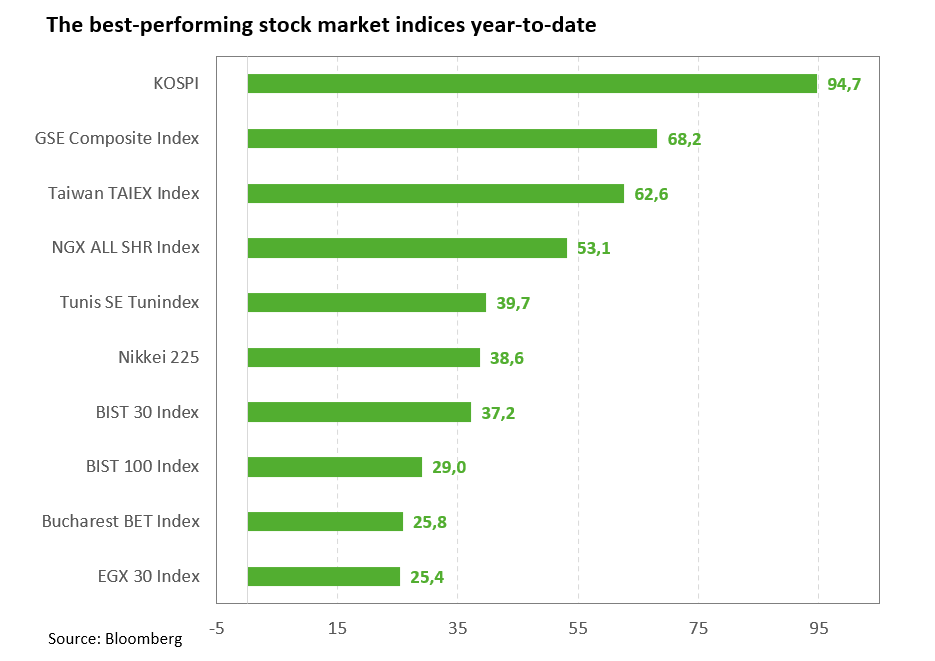
The South Korean stock market is currently the world’s best-performing stock index, even though it fell by about 10 percent on June 23. In addition to selling by foreign investors, other contributing factors in the decline could have been the selling linked to leveraged ETFs tracking local chip manufacturers, as well as forced liquidation of retail investors who had used borrowed funds to trade. Furthermore, several news reports from South Korea earlier in the week may have contributed to the sudden deterioration in market sentiment.
The South Korean stock market took a big hit
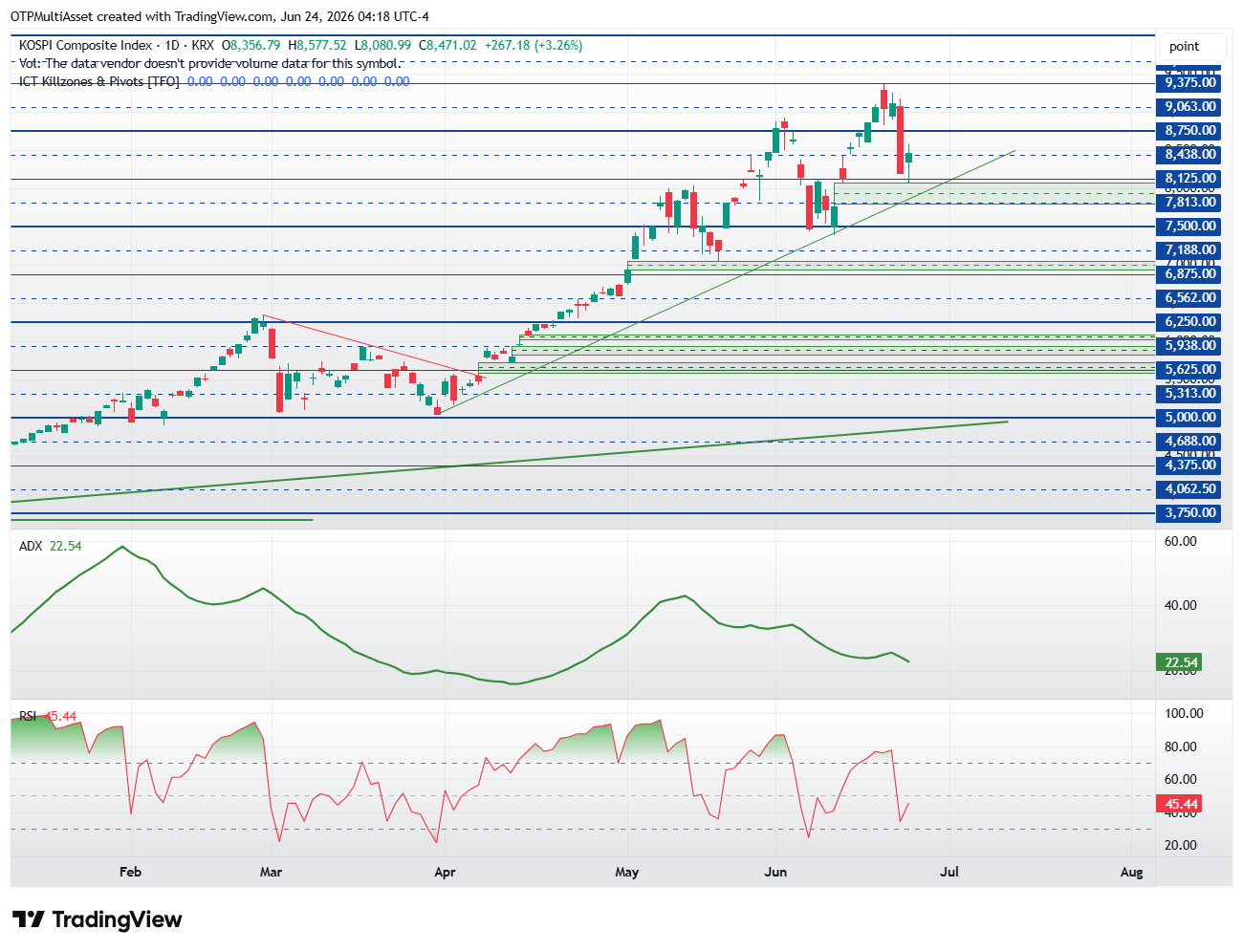
The South Korean stock market, the KOSPI, had seen a massive rally this year; on June 19, it reached a new high and closed above 9,000 points. A few days after the rally, however, a sharp reversal set in: the index fell by 10 percent, and both Samsung and SK Hynix —both of which plays a key role in the South Korean stock market’s recent rise—each plummeted by more than 12 percent.
Following Monday’s (June 22) decline in U.S. tech stocks, foreign investors sold more than two and a half billion dollars’ worth of South Korean stocks the next day. According to market commentary, the sharp decline may have been driven by both sell-offs linked to leveraged ETFs tracking Samsung and SK Hynix, as well as forced liquidation of retail investors trading on margin.
These factors were likely the main drivers of the plunge, although it is also worth noting that the news flow at the start of the week may have also contributed to the sudden deterioration in market sentiment. The head of South Korea’s financial regulator recently expressed regret that he had not prevented the launch of leveraged ETFs tracking single stocks a month ago. According to industry participants, the authorities were considering potential tightening measures, including, for example, higher minimum deposit requirements for these products. Also, earlier this week, the possibility of taxing unrealized stock market gains was raised at a South Korean parliamentary forum, a prospect that was hardly welcomed by market participants.
The drop on June 23 occurred amid high trading volume—more than 50 percent above the average for the past twenty days—and the number of trading days with daily price movements of +/- 5 percent has also increased recently. Due to the drop, trading on the South Korean stock exchange had to be temporarily suspended; this is the fourth time this has happened this year, compared to just once the year before last and none at all last year.
We have previously written about the concentration risk posed by large AI-linked chipmaker companies that have played a prominent role in the South Korean index’s rise, and it is also worth noting that the local financial regulator already issued a warning in mid-June about leveraged ETFs tracking single stocks and market volatility. The South Korean central bank has also warned investors to be cautious about increasing volatility during downturns, especially if late entrants to the market also use leveraged products.
While the South Korean stock market broke through the 9,000 mark by mid-June, data from the Korea Financial Investment Association showed that the total amount of margin loans in the domestic stock market had already reached 38 trillion won (~$24.8 billion) by mid-June, setting a record. For the KOSPI, margin loans totaled nearly 29 trillion won, while margin loans related to Samsung and SK Hynix shares accounted for 9.1 trillion won—a significant increase compared to the end of last year, when loans related to those two stocks totaled 2.5 trillion won.
Still at the top of the podium even after a fall
Even after a 10 percent plunge, the South Korean stock market remains the best-performing stock index so far this year (as of the close on June 23). At the same time, as volatility has increased, this year’s corrections have been sharp, though they typically did not last long; the South Korean index has so far been able to shake off previous losses relatively quickly and then climb to new highs.
For both Samsung and SK Hynix, forward-looking earnings expectations continue to rise, with analysts forecasting triple-digit percentage growth in both revenue and profit for both companies this year. Furthermore, valuations are not stretched: the MSCI Korea Index’s 12-month P/E ratio of 7.20 remains lower than that of the MSCI Emerging Markets Index (12.00).
However, the leveraged ETFs tracking a single stock—as mentioned earlier—could still cause some unpleasant surprises for investors. Since their launch in May, the assets of ETFs tracking South Korean chipmakers have roughly tripled, and if the local financial regulator were to ultimately impose some form of restriction on these products, it could help mitigate more severe market volatility going forward. That said, following the Kospi index’s massive rise this year, it is still worth anticipating the possibility of sharper corrections and profit-taking by investors.
Kospi technical picture
The index’s uptrend is still intact, but strong divergences and a weakening of momentum are already visible in the rally leading up to the third new high. This indicates internal dynamics suggesting that it is advisable to exercise caution and begin reducing long positions. However, the series of higher swing lows and highs has not been broken, meaning the long-term trend structure remains intact. A change in this would occur if a trend break were to happen alongside a lower high. We’ll have to wait for that, but it would be a stronger signal that the long-term trend is coming to an end.
Get more out of your investments!
Global Markets Services
OTP Global Markets offers a broad range of services in the field of local and international money and capital markets.
Read morePrivate Banking Services
Personal care and expertise with OTP Private Banking, along with the knowledge, security, and innovations of a multinational banking group.
Read more