
Snap election in Japan with surprising results
Related content
US bank shares fell
The third-quarter earnings season in the US has picked up pace following the release of the latest figures from US banks. Based on preliminary expectations, the third quarter is likely to have closed with strong earnings growth for S&P 500 companies, led by the energy and technology sectors. The major US banks have still achieved solid growth on an annual basis, indicating that their operations remain strong, but the pace has clearly slowed in many cases, which has tended to result in negative share price reactions.
Commodities - Technical Analysis
Gold and silver continued their downward trend, bouncing off key levels. Until their downward trends are broken, they will not be able to produce a significant rise. The fall in oil prices reversed from the $87.5 level and began a slight upward movement. Natural gas remained in an uptrend; a significant rise could even occur if it breaks out upwards. The price of copper has become stuck in a wider range, so the oversold and overbought zones may offer more favourable trading opportunities. The falling prices of wheat and corn have reached key support levels; a buying reaction from these levels could present favourable long opportunities with limited risk.
At the end of January, the Japanese prime minister announced early elections, which her party, the Liberal Democratic Party, not only won in early February, but also secured a two-thirds majority in the lower house of parliament, which has not been seen since World War II. Sanae Takaichi can now get to work with a strong mandate, but investors would like to see more clarity on a number of issues, including the temporary reduction in sales tax on food and the financing of the measure. The prime minister is likely aware that if the government's fiscal stimulus measures are too aggressive, it could lead to a weakening of the yen and a rise in bond yields. Meanwhile, the Japanese stock market is near its historic high, although the last time we saw similarly high valuations was during the post-COVID period. One of the most important questions for the coming period may be how much of the government's measures have already been priced in by investors, and if further fiscal stimulus is forthcoming, how it could support Japanese growth and how exactly it will be financed.
Japan's snap election brought a surprise
Japan's prime minister, who has been in office for just a few months, took a risky step at the beginning of the year: Sanae Takaichi dissolved the lower house of parliament at the end of January and called early elections for February 8. The sixteen-day campaign period is considered quite short in Japanese domestic politics, and some local election authorities had problems organizing the election due to the short time frame. In addition, the early election also meant that the adoption of the budget for the next fiscal year could face obstacles. Takaichi was very popular (significantly more so than her party, the Liberal Democratic Party), and opinion polls suggested that the LDP had a good chance of winning the early elections.
In the early elections held in early February, the LDP ultimately won 316 seats in the lower house of parliament (out of a possible 465), giving it a two-thirds majority for the first time since World War II. The LDP's coalition partner, Ishin, won 36 seats, giving the two parties a combined total of 352 seats. It is also worth noting that the Constitutional Democratic Party and the LDP's former coalition partner, Komeito, jointly formed a new party called the Centrist Reform Alliance (CRA) before the early elections. However, the CRA performed very poorly, winning only 49 seats in total, which is a significant decline compared to the 167 seats previously held (combined) by the two parties.
After the elections, the LDP now has strong control over the lower house, and the prime minister does not have to worry about new elections until the next upper house elections in 2028, which gives her room to maneuver in implementing her program. The LDP and its coalition partner can now appoint the chairs of the committees that review legislation and can override the upper house of parliament in the legislative process. In mid-February, Takaichi was officially re-elected as prime minister, and after the reappointment of her former ministers, the focus turned to the adoption of the budget for the next fiscal year (beginning in April). The early election has reduced the chances of the budget being approved at the usual time at the end of March, although the prime minister still wants to push it through by the end of March. If this proves unsuccessful, a temporary budget is likely to be approved. The temporary budget would cover the basic costs of government operations, so according to commentators, the possibility of a government shutdown similar to that in the United States is very unlikely.
Voter turnout was higher than in the last lower house elections in 2024, and based on previous surveys, Japanese voters considered the economy and measures against inflation to be the most important issues. Accordingly, the prime minister would continue negotiations on the introduction of a refundable tax credit system, which could provide targeted support to low- and middle-income earners. According to Takaichi, since its introduction will take time, a temporary reduction in the sales tax on food could be implemented in the meantime.
The prime minister considers the previously announced two-year reduction in sales tax on food to be a temporary measure, bridging the period prior to the introduction of the tax relief system involving cash payments. A cross-party body will soon be set up to draft a bill to reduce the tax to zero for two years, which is expected to be ready before the summer. The estimated cost of this is an annual tax revenue loss of ~5 trillion yen ($32 billion), although according to the finance minister, this will not require new debt issuance.
Japanese stock market nears historic high
Following the elections, Takaichi mentioned the importance of proactive and responsible fiscal policy, emphasizing the significance of the latter, also emphasizing that their goal is to build market confidence by ensuring fiscal sustainability, i.e., by continuously reducing the debt-to-GDP ratio. Following the LDP's significant victory, the yen initially strengthened against the dollar, partly due to increasing Japanese political stability, while the yield on 30-year Japanese government bonds fell below 3.4%.
The Nikkei rose to a new high on February 9, and sectors expected to benefit from the prime minister's plans (defense, artificial intelligence, semiconductors) performed well on the trading day following the election results. The Japanese stock index rose by ~13% this year (as of February 16). It is worth noting that even with this increase, the Nikkei was still unable to make it onto the list of the ten best-performing stock indices this year, which was topped by the Korean stock market with a ~30% increase.
In the case of the Japanese stock market, forward-looking earnings expectations have been rising steadily since July last year, while in terms of valuation, the MSCI Japan index's 12-month forward P/E ratio of 18.78 is virtually identical to that of the MSCI ACWI index (18.77). However, in Japan's case, similarly high valuations have only been seen in the period following COVID-19 over the past fifteen years or so.
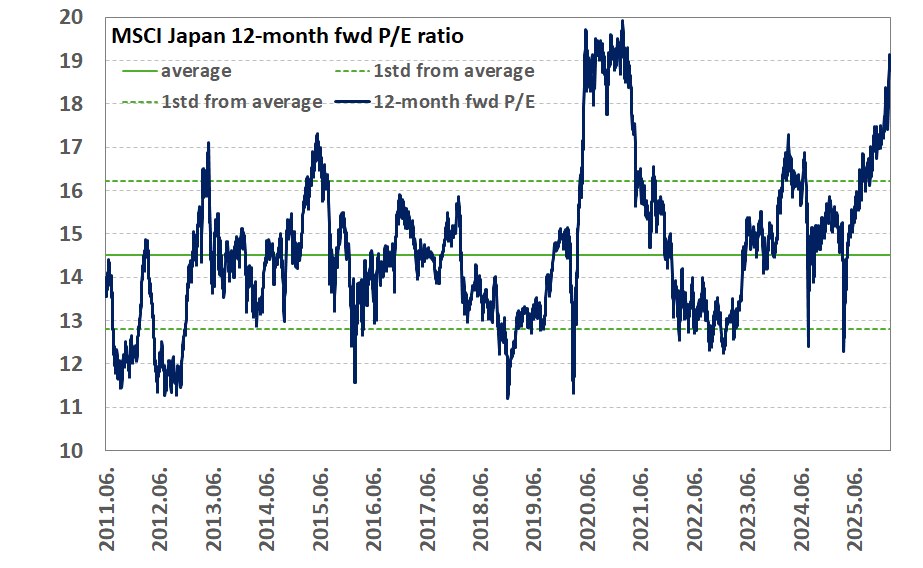
The Japanese prime minister may be aware that if the government's fiscal stimulus measures are too aggressive, it could lead to a weakening of the yen and a rise in bond yields. The most important question in the coming weeks and months may be how much of the government's measures have already been priced in by investors, what kind of growth-stimulating measures Japan may still take, and how they will be financed (e.g., in the case of a temporary reduction in the sales tax on food). It is also worth mentioning that the regulatory authority is expected to review Japan's corporate governance rules in the middle of this year and is currently considering options to strengthen companies' income-generating capacity, the introduction of which could provide further tailwinds for the Japanese stock market in the future.
Nikkei technical picture
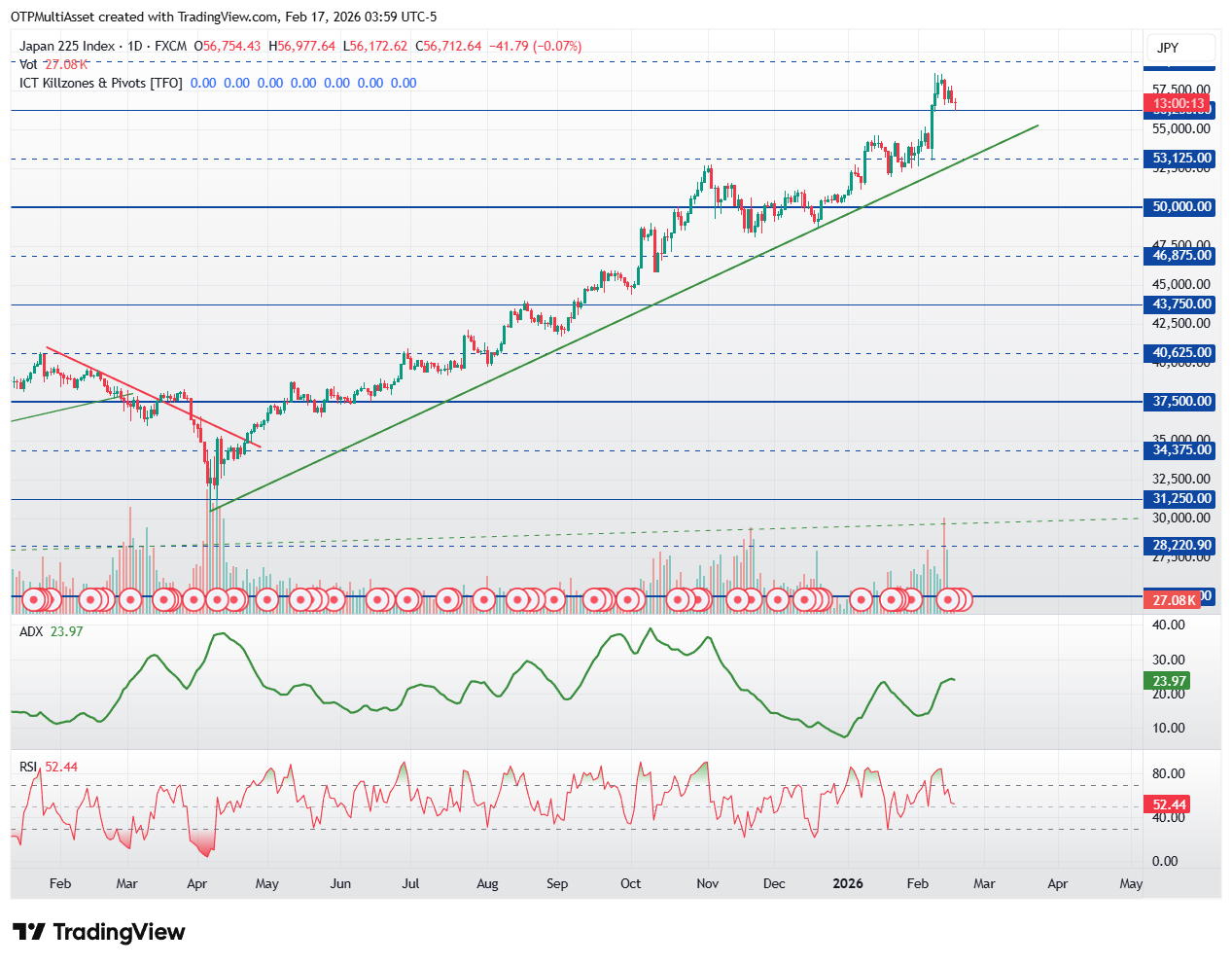
The uptrend is still alive, but a reversal pattern is still missing. The upward trend could break around 53,125. Based on the rate of increase, it may already be in the premium zone, meaning that this is not the best time to enter based on the risk/reward ratio.
Get more out of your investments!
Global Markets Services
OTP Global Markets offers a broad range of services in the field of local and international money and capital markets.
Read morePrivate Banking Services
Personal care and expertise with OTP Private Banking, along with the knowledge, security, and innovations of a multinational banking group.
Read more