
Silver has gone wild, what should we do?
Related content
US bank shares fell
The third-quarter earnings season in the US has picked up pace following the release of the latest figures from US banks. Based on preliminary expectations, the third quarter is likely to have closed with strong earnings growth for S&P 500 companies, led by the energy and technology sectors. The major US banks have still achieved solid growth on an annual basis, indicating that their operations remain strong, but the pace has clearly slowed in many cases, which has tended to result in negative share price reactions.
Commodities - Technical Analysis
Gold and silver continued their downward trend, bouncing off key levels. Until their downward trends are broken, they will not be able to produce a significant rise. The fall in oil prices reversed from the $87.5 level and began a slight upward movement. Natural gas remained in an uptrend; a significant rise could even occur if it breaks out upwards. The price of copper has become stuck in a wider range, so the oversold and overbought zones may offer more favourable trading opportunities. The falling prices of wheat and corn have reached key support levels; a buying reaction from these levels could present favourable long opportunities with limited risk.
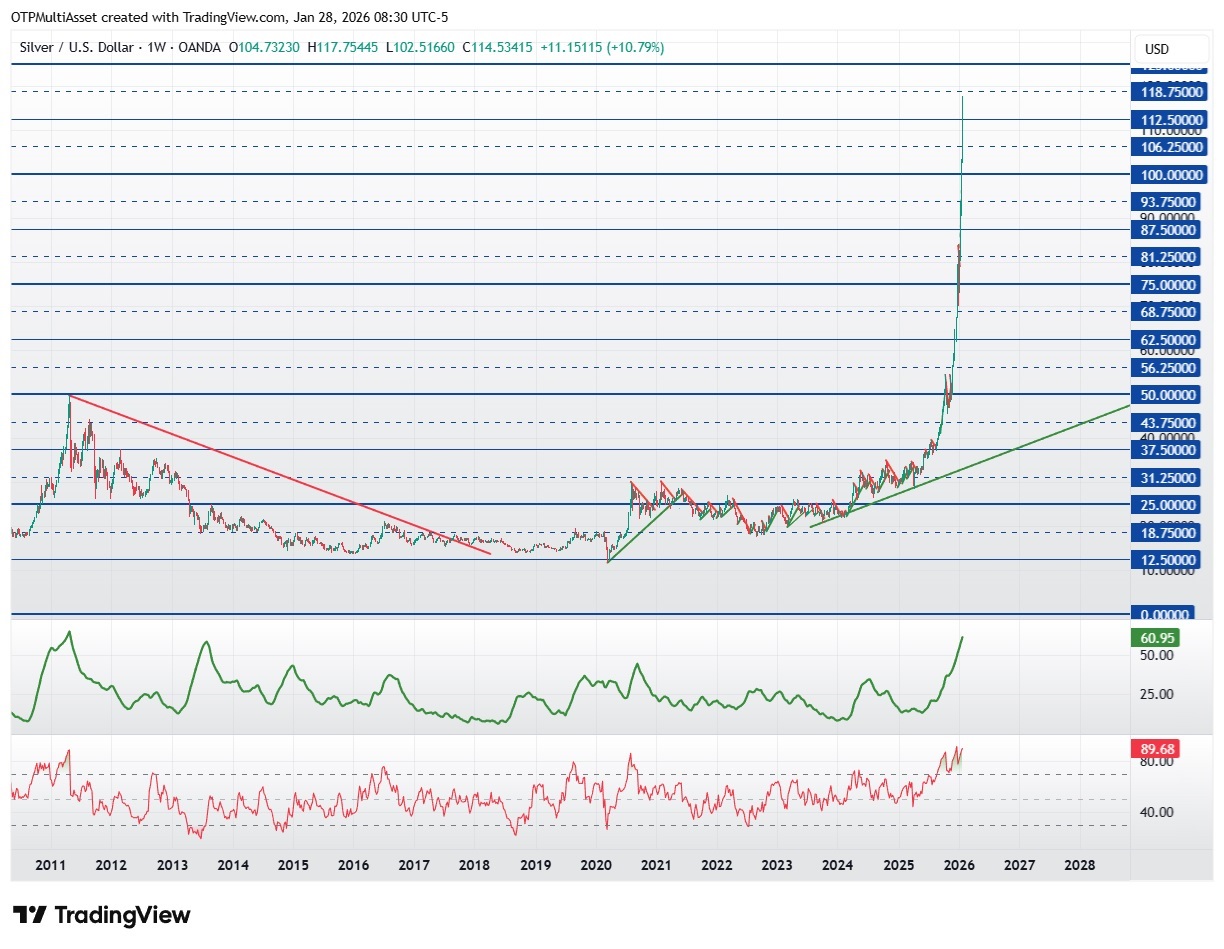
The price of silver has risen exponentially in recent months, with an increase of nearly 60% this year alone and nearly fourfold in one year. At this stage of the big rally, entering on the long side is no longer recommended on a risk-return basis (we would much rather focus on copper or other industrial metals in this regard), but it is also worth waiting to go outright short, as we could get burned very badly in the short term. As existing long positions have already accumulated nice returns, gradually reducing them at current price levels can be considered a rational decision.
The rise in silver prices is based on strong fundamentals
While in the gold market, central bank purchases represented a more significant and sustained demand-side driver from 2022 onwards compared to previous years, in the silver market, it was industrial demand, which grew at an outstanding rate (9% annual average) between 2021 and 2023, that initially provided strong fundamental support for the price to rise to a new local high in 2024. The silver market entered this period in a state of deficit (due to investment-driven silver purchases in 2020 following the COVID-19 pandemic), and inventory levels have been steadily declining ever since.
Not only did silver receive fundamental support, but the narrative built around it was also particularly promising, full of easily digestible stories based on real megatrends, such as electric cars (with a particular emphasis on charging infrastructure), renewable energy production (e.g., solar panels), and even AI-related data center infrastructure investments. Silver is the best conductor of electricity of all known electrical conductors, so each of the above-mentioned areas uses significant amounts of it (accounting for 60% of the total demand for silver), which, according to longer-term expectations, will only increase in the future. In November last year, the US Geological Survey added silver to its list of 60 elements that are critical to the country's economy and/or defense, which only added fuel to the fire in terms of silver accumulation.
Investors jumped on the bandwagon
This strong narrative, based on solid fundamentals, began to capture the imagination of investors by 2025. More and more capital began to flow into investment funds focusing on the silver market (a net 200 million ounces according to Metals Focus's 2025 estimate, which has not been seen since 2021), which suddenly further tightened the market significantly (last year may have been the fifth year of deficit), causing inventory levels to decline. The supply side is inflexible, with mine production essentially stagnant for years, and since silver is often extracted as a by-product of other metals, supply responsiveness does not depend solely on the price of silver (although the prices of many other metals have also risen significantly, meaning that there is an incentive to increase production, as the price of silver at $100 is attractive compared to production costs of around $20-30), and the recycling of surface stocks cannot satisfy such a sudden explosion in demand in such a short period of time.
Over the past year, this has been compounded by capital inflows due to the so-called debasement trade. This can simply be described as investors turning away from the dollar, which stems from high debt levels, significant budget spending and pressure on the central bank, as well as a loss of confidence due to increasingly unpredictable US politics. As a result, the dollar already suffered a significant weakening in the first half of last year, with an annual depreciation of over 10%, while capital is flowing into real assets (such as gold, silver, but also copper and stocks), whose supply side is relatively stable (at least compared to the risks of weakening the currency due to the central bank's increase in the money supply as a result of the mountain of debt).
But how long will the rise last?
As there has been no change in the factors listed above, it is very difficult to predict how long the current phase of intense investment-driven capital inflows and the resulting exponential rise in prices will last. Volatility has increased significantly, with large intraday rises followed by sell-offs, and money is flowing into certain silver ETFs in staggering amounts, with virtually everyone talking about the precious metal. In the last couple of days, the SLV ETF's daily turnover broke a record. These are classic signs that are typical of the end of an upward cycle.
On the other hand, it should not be forgotten that although there is no doubt that investor perception has a major impact on the price of silver (due to significant demand of this nature), the big difference compared to gold perhaps lies in the significant weight of industrial use. However, industrial players will not buy silver at any price, which means that beyond a certain point, the rise in the price will clearly begin to have a negative impact on industrial demand and, through this, on the price itself. Just think about it: two years ago, silver accounted for 5-6% of the cost structure of solar panels (using TOPCon technology, which now accounts for over 70% of the market), whereas at current exchange rates, it is well over 20%. Silver consumption per unit has already been steadily declining thanks to continuous efficiency improvements, and the sharp rise in prices is likely to accelerate this trend and further encourage players to switch to substitute materials such as cheaper copper. Of course, there are technological difficulties involved, and the transition is time-consuming and costly, but the wind may be starting to come out of silver's sails.
What should we do?
There are already a number of signs and factors that make long positions inadvisable. If you are looking for metal exposure, it is much better to watch the copper or other industrial metals markets. Overall, the gradual reduction of existing silver positions seems to be an increasingly rational move, but it may also be worth refraining from excessive short exposure. Although high prices will eventually weaken industrial demand, this may take some time, and if it does not become part of the narrative, investor demand may even offset this effect for quite some time. This is especially true given that, due to continuous deficits, more and more people are watching the rapid decline in inventory levels with concern, short ETFs have also seen a surge in trading (and crashes do not usually occur in a way that allows many people to profit from them), and for the time being, the net speculative long exposure of institutional players is not showing extreme values, in fact, we are below the values of previous years (CFTC), while the dollar's new low, the Fed's upcoming meeting, the announcement of the new central bank president, the increasing likelihood of US action against Iran, and the continuing escalation of geopolitical risks could even catalyze further upward movement and cause surprises. So, in the short term, sitting in a short position could still pose the risk of painful losses, which is why we would avoid it for the time being.
Get more out of your investments!
Global Markets Services
OTP Global Markets offers a broad range of services in the field of local and international money and capital markets.
Read morePrivate Banking Services
Personal care and expertise with OTP Private Banking, along with the knowledge, security, and innovations of a multinational banking group.
Read more