
Hungary: Headline inflation accelerated in line with expectations, while underlying inflation pressures remained elevated
Related content
Investors are worried – what lies ahead for Brazil?
In a major surprise, Lula won the second round of Brazil’s presidential election, even though markets had previously expected Flávio Bolsonaro to prevail. Lula’s victory triggered a sharp repricing of Brazilian assets, while sentiment deteriorated further shortly afterwards following an unorthodox proposal calling for a substantial reduction in the central bank’s policy rate. For now, it appears that no such plan is under consideration in Brazil, and the president has reaffirmed his commitment to fiscal discipline. Investors, however, remain largely sceptical. Market participants are waiting for concrete measures, and in the near term the key question for Brazil will be whether the anticipated fiscal measures can stabilise the country’s debt trajectory and how the president will reconcile them with his campaign promises.
FX - Technical Analysis
The dollar has shown a slight correction over the past two weeks, which so far has signaled a pause in its strengthening rather than a meaningful trend reversal. There are still no signs pointing to a sustained weakening. The EUR/HUF cross is trading within a narrowing range. At the same time, the forint has remained in an uptrend against the dollar. The USD/JPY exchange rate broke out of its narrowing range, but has not yet moved far enough away from the breakout level to clearly confirm the move. In the case of EUR/CHF, the first signs of a reversal are already visible; however, to confirm a sustained trend reversal, a higher low would need to form and the dominant downtrend would need to be broken.
Hungary's headline inflation rose by 0.4 ppts to 2.0% year-on-year in October, up from 1.6% in September. The data was in line with the market consensus (2.0%) and marginally above our forecast (1.9%). The main reason for the acceleration of headline inflation was the further increase of fuel inflation while processed food prices decreased less than expected mainly due to sugar and confectionaries. However, food prices still significantly contributed to the low inflation in Hungary, so the fact that prices of several agricultural commodities have started to rise in recent months, reinforces our view that food prices will no longer contribute to disinflation in 2027.
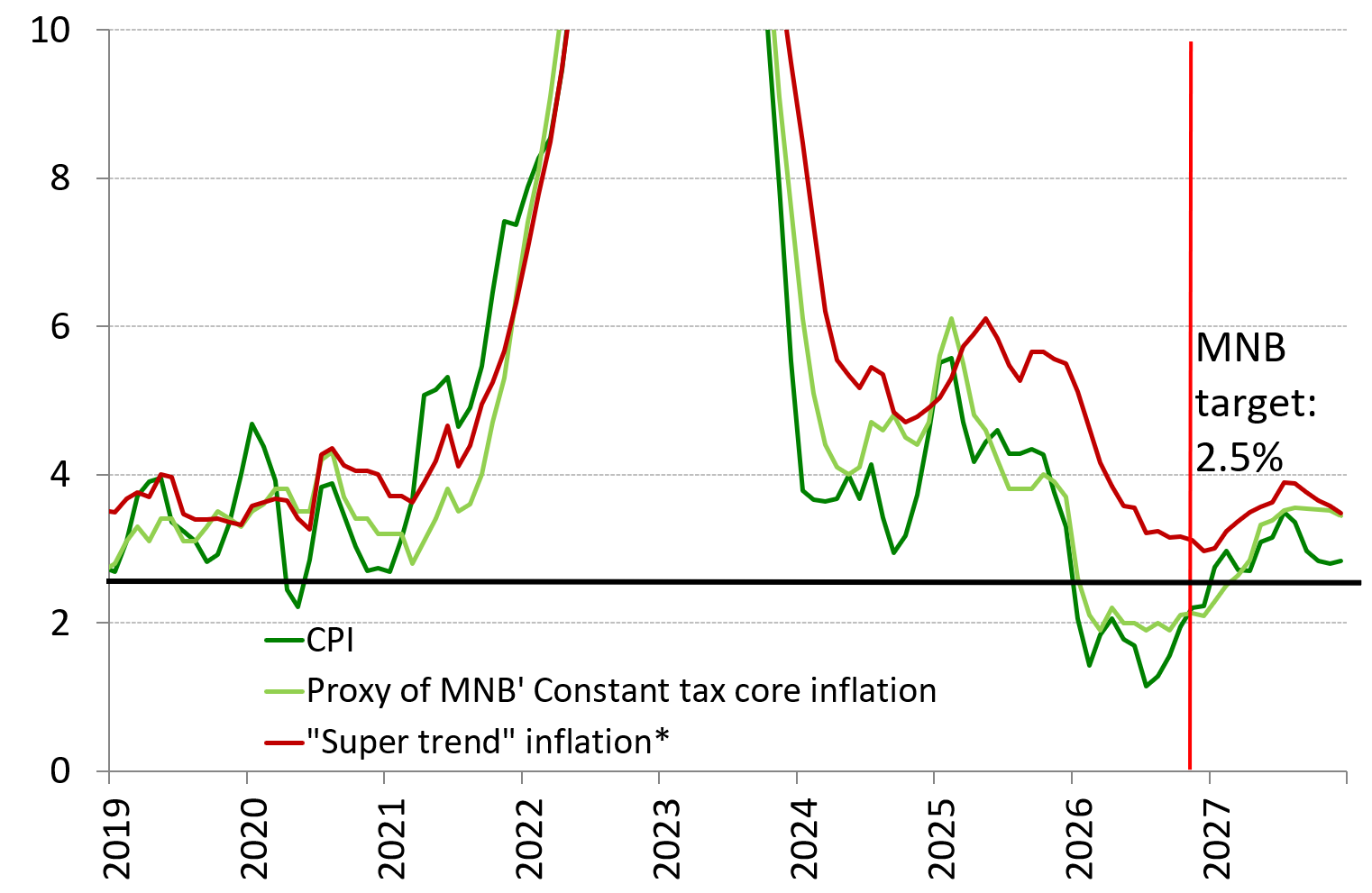
While headline inflation increased, our core inflation proxy remained unchanged, as expected, suggesting that the recent increase in fuel prices has not generated broader inflationary pressures. The MNB’s constant-tax core inflation increased from 1.9% to 2.1% YoY, the core inflation indicator excluding processed foods increased from 3.3% to 3.4% YoY, while sticky-price inflation stagnated at 3.9% YoY. Our “supertrend” inflation indicator (Chart 9), which is similar to the aforementioned MNB indicators but does not contain the mainly backward-looking pricing of telecommunication and financial services and is filtered for the effects of the margin cap (therefore it is not affected by any administrative measures), essentially stagnated at 4.5% on an annualized MoM basis, as lower non-durable goods inflation compared to the previous month was offset by accelerating durable goods inflation following the muted dynamic in September. Meanwhile, our filtered service inflation indicator increased to 8.2% from the 7.2% average of the previous three months on an annualized MoM basis. For both the “supertrend” inflation indicator and filtered services inflation, the last time we saw similarly elevated readings was in December of last year.
The big picture is that, following the exceptionally subdued repricing observed at the beginning of the year, when our closely watched "supertrend" indicator fell to roughly half of its Q4 2025 level, the indicator accelerated again in both Q2 and Q3 compared with the previous quarter. While in July the strong exchange rate appeared to trigger a more pronounced decline in goods prices, the August and September data failed to confirm these positive developments, and the October reading that has just come in also showed no improvement. The 4.5% readings recorded over the past two months do not support further disinflation and, particularly in light of the expected increase in food prices next year, are not consistent with achieving the inflation target. This strengthens our view that an EUR/HUF exchange rate of around 360 (or rather below) is necessary to meet the new 2.5% inflation target.
As a result of higher-than-previously-expected energy prices, we marginally increased our 2026 inflation forecast from 1.7% to 1.8%, and our 2027 inflation forecast from 2.9% to 3.0%. The 2027 budget is likely to add to inflationary pressures next year, due to significant income transfers to more consumption-oriented lower-income households are coupled with higher corporate taxes and excise tax increases. As a result of this, and given the recent deterioration in underlying inflation trends, and as the October medium-term fiscal and macroeconomic outlook failed to surpass already elevated market expectations or provide further support for the euro adoption narrative, coupled with uncertainty over energy prices and next year's minimum wage increase, we consider now a December rate cut as increasingly unlikely. In our view, the MNB should refrain from further easing until there is greater clarity regarding next year's wage dynamics, the repricing period at the beginning of the year, developments in energy markets, and the trajectory of the fiscal deficit.
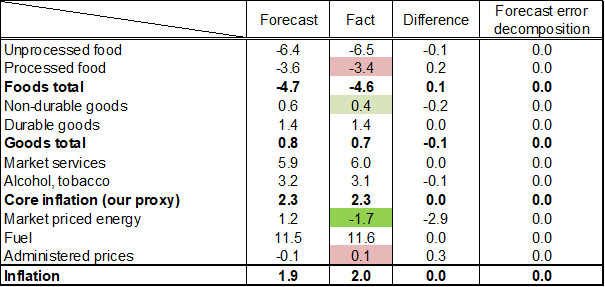
Inflation forecast (annual changes, %)
Get more out of your investments!
Global Markets Services
OTP Global Markets offers a broad range of services in the field of local and international money and capital markets.
Read morePrivate Banking Services
Personal care and expertise with OTP Private Banking, along with the knowledge, security, and innovations of a multinational banking group.
Read more