
Political tensions in France could ease
Related content
US bank shares fell
The third-quarter earnings season in the US has picked up pace following the release of the latest figures from US banks. Based on preliminary expectations, the third quarter is likely to have closed with strong earnings growth for S&P 500 companies, led by the energy and technology sectors. The major US banks have still achieved solid growth on an annual basis, indicating that their operations remain strong, but the pace has clearly slowed in many cases, which has tended to result in negative share price reactions.
Commodities - Technical Analysis
Gold and silver continued their downward trend, bouncing off key levels. Until their downward trends are broken, they will not be able to produce a significant rise. The fall in oil prices reversed from the $87.5 level and began a slight upward movement. Natural gas remained in an uptrend; a significant rise could even occur if it breaks out upwards. The price of copper has become stuck in a wider range, so the oversold and overbought zones may offer more favourable trading opportunities. The falling prices of wheat and corn have reached key support levels; a buying reaction from these levels could present favourable long opportunities with limited risk.
It seems that the wrangling over this year's French budget may finally be coming to an end. Although contrary to the prime minister's earlier promise, the 2026 budget may still be pushed through parliament without a vote, with the help of a constitutional mechanism. However, thanks to concessions made by Sebastien Lecornou and the government, the no-confidence motions following the passage of the budget in parliament were successfully defeated. The entire budget is expected to be approved in mid-February. All this may reduce the domestic political headwinds surrounding the budget, and the French-German ten-year bond yield spread has fallen to levels not seen since June 2024, so market participants may already have priced this in. Attention will then turn to the French municipal elections due in the spring, where hopefully there will be no further negative political surprises. It is also worth noting that the French stock market climbed to a new high in mid-January, although the technical picture has become somewhat gloomier in recent days.
The French budget may be approved
The adoption of the 2026 budget has been a winding road: although this year's social security budget was approved in December, politicians have been unable to reach an agreement on the 2026 state budget. Therefore, a special law was applied to prevent the government from shutting down, which, among other things, allowed taxes to be collected until the budget for this year was approved.
In mid-January, the French prime minister presented a draft budget that included several concessions to various political groups. However, the far left and far right were still unwilling to cooperate, so the prime minister halted the budget voting process in parliament. Although Sébastien Lecornu had previously ruled out passing this year's annual budget through parliament without a vote, he ultimately had no choice but to go back on his earlier promise and use the mechanism provided for in the constitution to pass the 2026 budget without a vote.
Theoretically, the prime minister had several options to choose from. On the one hand, he could have used Article 49.3 of the Constitution to pass the budget without a vote, but this would have exposed him to no-confidence motions, which, if successful, could have forced him to resign in addition to rejecting the budget. An alternative solution was to invoke Article 47 of the Constitution, which could also have led to motions of no confidence, but the measures introduced by the decree (in this case, the budget) would remain in force even if the government fell.
Since the prime minister first pushed the income side of the budget through parliament and then the expenditure side, this opened up the possibility for opposition parties to table a motion of no confidence. Although the two French prime ministers preceding the current one also fell victim to wrangling over budgets, Lecornu had a good chance of winning the no-confidence votes due to the concessions he had made. The concessions made to the Socialists (discounted meals for students, financial support for low-income earners) entail higher costs compared to the previous version of the budget. Among other things, limiting the tax burden on households will increase costs by at least €8 billion, which will be offset by €9 billion in taxes levied on companies.
In many cases, reaching a budget compromise entails an increase in public spending, which is why several ministries will see spending cuts (with the exception of the Ministry of Defense, among others). In addition, large companies will also pay more tax than in the preliminary draft budget, as the supplementary tax on large companies, which was originally intended to remain in force for only one year, will ultimately be extended (although this year it will affect the ~300 largest companies, while last year the tax applied to around 450 companies). The government will also not reduce the taxes levied on the added value generated by companies in France.
Domestic political tensions may ease
As expected in light of previous events, the French government did indeed survive the votes of no confidence at the end of January (since the income and expenditure sections of the budget were pushed through parliament separately, both were followed by votes of no confidence, which were successfully overcome by the prime minister and the government). The entire budget for this year will then go first to the upper house and then back to the lower house, after which the prime minister will be able to push the entire budget through parliament without a vote, which will likely be followed by another no-confidence motion, which the prime minister will probably be able to survive again. The budget is expected to be approved by the first half of February, which means that the protracted budget wrangling will finally come to an end and domestic political tensions may ease. Barring any unexpected events, attention in French domestic politics is likely to turn to the local elections in March and then to the presidential election due in the second quarter of 2027.
Following steps toward the successful adoption of the budget, the yield spread between French and German ten-year government bonds fell to levels not seen since June 2024 (when President Macron announced snap elections). Even so, not everyone seemed satisfied: according to the French central bank governor, the government and parliament could have done more to reduce the deficit. The revised budget forecasts a deficit of 5% of GDP for this year (compared to the previous deficit target of 4.7%).
According to some market participants, since the revised budget relies more heavily on taxation and only reduces spending to a limited extent, the final version is unlikely to significantly curb economic activity. The government expects GDP growth of 1% this year, while the market consensus currently also forecasts 1% growth for 2026. Even so, it seems that the wrangling over the budget may have left its mark on activity at the beginning of the year, as the preliminary PMI for service sector fell back below the 50-point level separating growth from contraction in January.
Meanwhile, the French stock market climbed to new highs in mid-January, but following a correction, the index has been stagnating in recent days. Overall, the reduction in domestic political risk is good news, but the question is whether France will be able to meet its target of a 5% GDP deficit this year. Although some expectations did not rule out the possibility that France could end the year with a slightly higher deficit, which would likely further increase concerns about achieving the medium-term consolidation path.
In the case of the CAC40, 12-month forward EPS expectations have been rising again since October last year, while the consensus expects double-digit percentage profit growth in each of the financial years between 2026 and 2028 from the index's two largest market capitalization components, while for the third largest component, analysts expect single-digit profit growth for the same period. In terms of valuation, the CAC40's 12-month forward P/E ratio of 15.4 is only slightly lower than that of the Stoxx600 (15.5), although it is lower than the MSCI ACWI index's forward P/E ratio of 19.2. The budget debate may soon come to an end, which market participants seem to have already priced in.
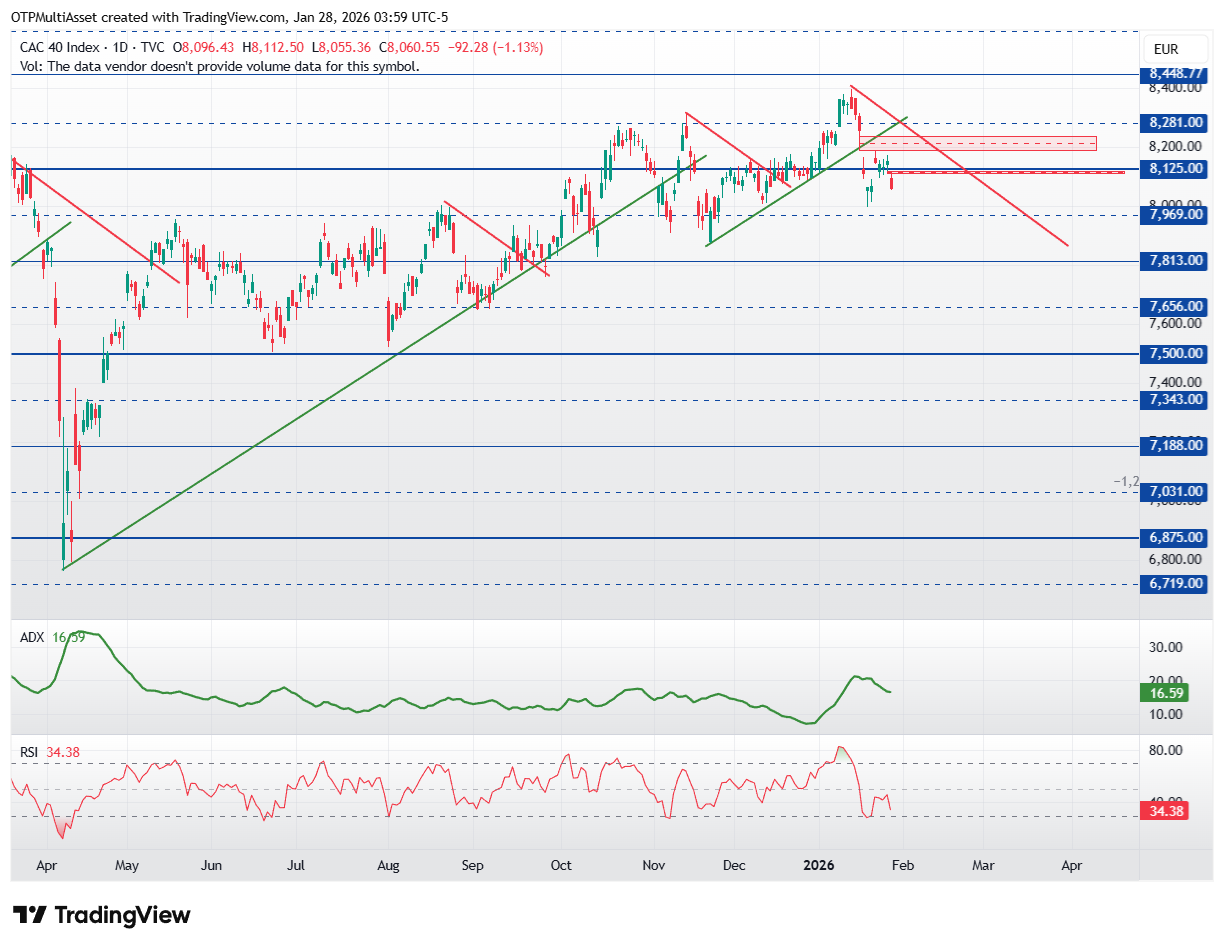
CAC40 technical picture
The gap that occurred nearly two weeks ago may have sealed the upward trend, and based on the current pattern, this chart looks bad. Yesterday, it left a downward gap, so until it exceeds the 8281 level, there is a greater chance of further decline. The first stronger support level can be expected around 7813. The thick red line represents the ideal downward trend, and until it breaks, there will be no strong upward trend.
Get more out of your investments!
Global Markets Services
OTP Global Markets offers a broad range of services in the field of local and international money and capital markets.
Read morePrivate Banking Services
Personal care and expertise with OTP Private Banking, along with the knowledge, security, and innovations of a multinational banking group.
Read more