
Orsted: Project Developments Remain on Track
Related content
Glencore: clouds are gathering over the metals market
Glencore, the commodities giant, has achieved excellent financial results so far in 2026, but in our view, the outlook has taken an unfavorable turn, especially in the metals and mining sector, where both copper and zinc prices have been trending downward in recent weeks. Among other factors, weaker Chinese economic data and deteriorating AI sentiment may have played a role here, as data centers use significant amounts of copper. At the same time, although coal prices have improved significantly this year, we would have expected even higher prices given the tight conditions in the energy market. Accordingly, we are removing Glencore from our Equity Top Pick List. The stock has provided a return of about 26% including dividends since we added it to our list last December despite the decline in recent weeks.
FX - Technical Analysis
Following the correction seen over the past month, the U.S. dollar has regained strength against its major currency counterparts. The EUR/USD exchange rate has broken below the 1.1108 level, confirming the continuation of the downward trend. The dollar is also in a favorable position against the British pound, with the exchange rate potentially extending its move after breaking below the lower boundary of a broader trading range.In the case of EUR/HUF, the recent narrowing price action may soon come to an end, potentially leading to an upside breakout from the triangle pattern. The Hungarian forint had already been showing signs of depreciation against the U.S. dollar earlier, and this trend may continue with the formation of new swing highs. USD/JPY broke out to the upside from a narrowing range two weeks ago; however, the breakout has not yet been accompanied by particularly strong momentum. As for EUR/CHF, following a recent modest correction, the downward direction may once again come into focus.
The Danish renewable energy giant Orsted recently released its third-quarter results, which were mixed. At first glance, net profit appears weak, but this was largely due to impairment charges rather than operational issues. The company continues to make solid progress in executing its extensive project portfolio, which could support a gradual improvement in profitability next year and beyond, while its liquidity position appears adequate. We continue to keep the stock on our Equity Top Pick List, with our target price unchanged.
Quarterly earnings
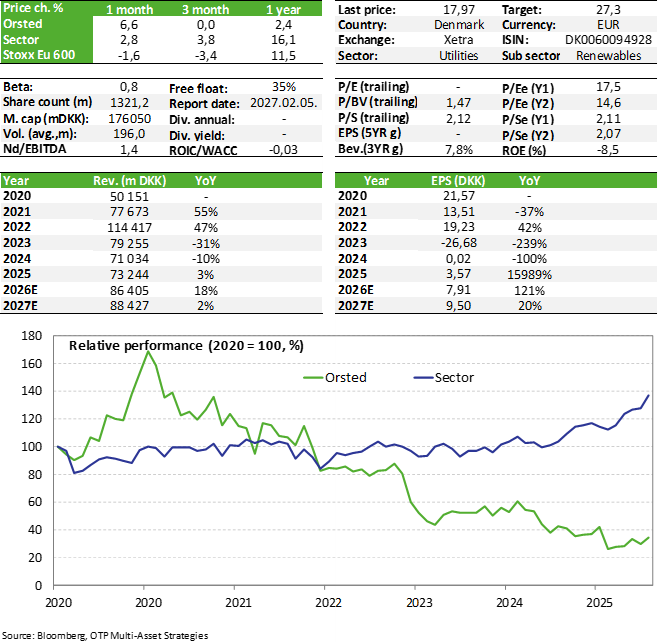
In the third quarter, Orsted generated revenue of DKK 21.2 billion (approximately USD 3.2 billion), up 73% year-over-year and 25% above analysts’ expectations. EBITDA came in at DKK 5.26 billion, representing a 72% increase from a year earlier and broadly in line with the consensus estimate of DKK 5.28 billion. However, the adjusted loss per share of DKK 0.55 fell well short of the consensus expectation of a DKK 1.78 profit per share.
The weaker net result was once again due to larger impairment charges, which were largely related to the company’s two U.S. wind projects (Sunrise and Revolution) and to the increase in long-term U.S. interest rates (higher WACC). Similar write-downs were also recorded in the first two quarters for the same reasons. From this perspective, it is positive news that long-term U.S. interest rates have already eased somewhat in recent weeks.
The company nevertheless made solid progress with project developments during the quarter. Among the U.S. offshore wind projects that had previously faced difficulties, construction of Revolution Wind has been completed and the project is now in commercial operation, while Sunrise Wind reached a completion rate of 60%. At the same time, Orsted’s European and Asian projects are also progressing well. Among others, Borkum Riffgrund 3 in Germany entered commercial operation already in August, while Taiwan’s Changhua project is also approaching this milestone (Q4 2026).
Management maintained its guidance that 2026 EBITDA could exceed DKK 28 billion in light of the third-quarter results. However, capital expenditures may come in slightly lower, in the DKK 45-50 billion range instead of the previously expected DKK 50-55 billion. This is only a timing effect, however, as the expected cost of projects currently under construction has not changed. At the end of the quarter, the company held approximately DKK 76 billion in cash and liquid assets (DKK 13 billion in cash and DKK 63 billion in securities). During the first nine months of the year, operating cash flow amounted to around DKK 8 billion, while capital expenditures totaled DKK 29 billion.
From a liquidity perspective, there are therefore no issues with financing investments, although free cash flow may naturally remain negative for some time (negative DKK 12.5 billion in the first nine months). In addition, the company still has access to more than DKK 30 billion in undrawn credit facilities, bringing total available liquidity to nearly DKK 108 billion.
Orsted's total debt stood at DKK 114 billion at the end of September, while net debt amounted to DKK 38 billion (implying a current net debt-to-EBITDA ratio of 1.4x). Due to the company's still elevated investment requirements, leverage metrics are expected to rise further for some time. However, as certain projects are completed, cash generation is expected to improve in parallel, providing a partial offset. In addition, 93% of the debt portfolio carries fixed interest rates, while the debt maturity profile can generally be considered favorable.
Another positive factor for renewable energy producers is that the Democrats secured majorities in both the House of Representatives and the Senate in the U.S. midterm elections, and they have traditionally been strong supporters of the sector. This could be particularly important for Orsted, as the Trump administration had previously hindered the development of both of the company's offshore wind projects in the United States, while Sunrise Wind is still under construction (with completion expected in H2 2027). At the same time, the outlook for the renewable energy sector remains more complex in practice due to the President’s veto powers and the possibility of governing through executive orders. In addition, any slowdown in data center-related investments as a result of Democratic pressure could also have negative implications for the U.S. energy sector through weaker demand.
Valuation
Orsted's valuation trades at 17.5x P/E based on expected 2026 EPS, while it falls to 14.6x based on 2027 earnings expectations, with further declines possible as project developments are gradually completed. The EV/EBITDA multiple stands at 8.6x based on expected 2026 EBITDA, declining to 8.0x based on 2027 EBITDA.
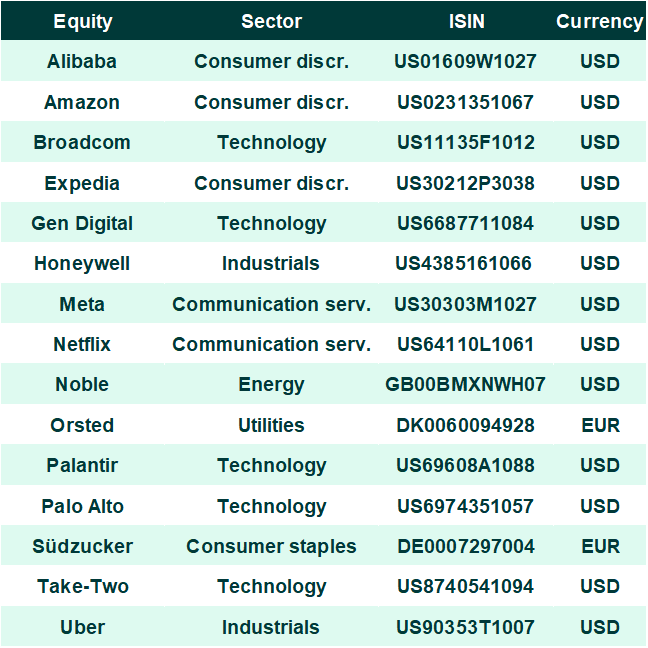
Overall, Orsted continues to perform as expected, project developments are proceeding smoothly, and there are no signs of liquidity issues. Taking all of this into account, we are keeping the company’s stock on our Equity Top Pick List.
Equity Top Pick List (updated)
Get more out of your investments!
Global Markets Services
OTP Global Markets offers a broad range of services in the field of local and international money and capital markets.
Read morePrivate Banking Services
Personal care and expertise with OTP Private Banking, along with the knowledge, security, and innovations of a multinational banking group.
Read more