
Orsted may pay dividend again after several years
Related content
US bank shares fell
The third-quarter earnings season in the US has picked up pace following the release of the latest figures from US banks. Based on preliminary expectations, the third quarter is likely to have closed with strong earnings growth for S&P 500 companies, led by the energy and technology sectors. The major US banks have still achieved solid growth on an annual basis, indicating that their operations remain strong, but the pace has clearly slowed in many cases, which has tended to result in negative share price reactions.
Commodities - Technical Analysis
Gold and silver continued their downward trend, bouncing off key levels. Until their downward trends are broken, they will not be able to produce a significant rise. The fall in oil prices reversed from the $87.5 level and began a slight upward movement. Natural gas remained in an uptrend; a significant rise could even occur if it breaks out upwards. The price of copper has become stuck in a wider range, so the oversold and overbought zones may offer more favourable trading opportunities. The falling prices of wheat and corn have reached key support levels; a buying reaction from these levels could present favourable long opportunities with limited risk.
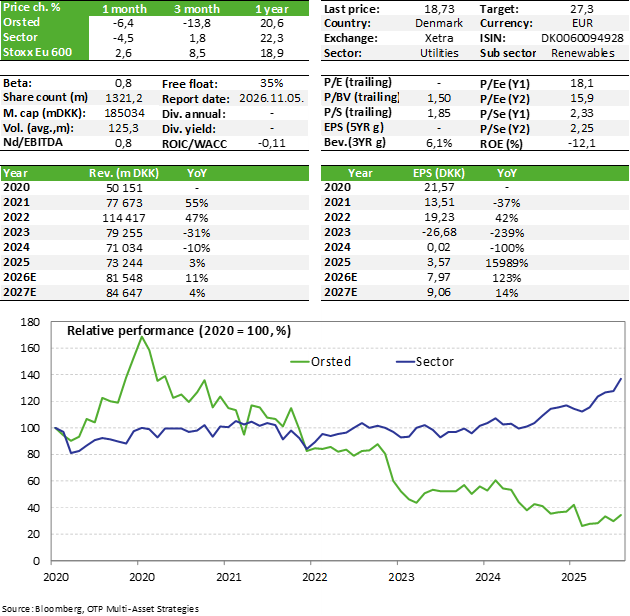
Orsted, the Danish renewable energy utility, recently published its Q2 earnings report, which showed mixed results. The company exceeded analysts’ expectations in terms of both revenue and EBITDA, but fell short of net income estimates. Nonetheless, project developments are on track, and the company’s liquidity position remains adequate. In light of the results, management maintains its 2026 guidance, and announced dividend payment plans for 2027. Overall, Orsted keeps making good progress, so we are keeping the stock on our Equity Top Pick List.
Quarterly earnings
In the second quarter, Orsted reported revenue of 20.6 billion Danish kroner (~3.1 billion USD), which was 21% higher YoY and 18% above analysts’ expectations. EBITDA was 5.4 billion DKK, which, although 18% lower YoY (the base period was stronger due to one-off items), exceeded the expected 5.2 billion DKK. However, adjusted earnings per share of 0.52 DKK fell short of the consensus estimate of 0.95 DKK. The weaker net income is largely attributable to a significant impairment charge, which is primarily related to the company’s two U.S. wind energy projects (Sunrise and Revolution) and is linked to the rise in long-term U.S. interest rates (higher WACC). We note, that the company recognized a similar impairment charge in Q1 as well.
Nonetheless, the company continued to make successful progress on its project developments during the second quarter. As for the two U.S. projects that had previously encountered difficulties: most of the wind turbines at Revolution Wind are now generating electricity (95% completion), while work is also progressing at Sunrise Wind (50% completion). At the same time, Orsted’s projects in Europe (United Kingdom, Germany, and Poland) and Asia (Taiwan) are also progressing with no delays relative to planned timelines provided over the last quarter. This means that, overall, more than 30% of the total 8.1 GW project portfolio could be completed this year, while the remaining 70% is expected to be completed by Q1 2028 (bringing total capacity to over 24 GW in 2028).
In light of the Q2 results, management maintains its 2026 guidance. Accordingly, Orsted’s full-year EBITDA is still expected to exceed 28 billion DKK, while capital expenditures are projected to range between 50-55 billion DKK. At the end of the quarter, cash equivalents totaled more than 80 billion DKK (20 billion DKK in cash and 60 billion DKK in securities). In addition, operating cash flow exceeded 9.1 billion DKK in the first half of the year, while capital expenditures totaled 18.2 billion DKK. The company expects EBITDA to exceed 32 billion DKK in 2027.
Taking these factors into account, there does not appear to be a problem with financing investments, although, of course, free cash flow may remain negative for some time yet (in the first half of the year, it was slightly positive, but this was due to asset sales; ~9.5 billion DKK). In addition, more than 30 billion DKK in undrawn credit lines is still available (for a total liquidity of 116.8 billion DKK).
Orsted’s gross debt stood at 107 billion DKK at the end of June, while its net debt was only 22 billion DKK (net debt / EBITDA ratio is below 1x based on the EBITDA expected for 2026). Of course, given the continued high investment needs, the debt ratio is expected to rise. Approximately 93% of the total debt is fixed-rate, and the maturity profile is favorable (only ~10 billion DKK is due over the next two years).
Another good news is that management plans to pay dividends again as early as 2027. However, the exact amount has not yet been announced (it will depend on the progress of project developments and associated costs).
Valuation
Orsted’s valuation is not high as based on the expected 2026 EPS the P/E ratio is 18.1x, while based on the 2027 EPS it is 15.9x. The EV/EBITDA ratio is 7.8x based on 2026 EBITDA and 7.4x based on 2027 EBITDA. We also note that many project developments may be completed in 2027 or by early 2028, so there is still plenty of room for growth.
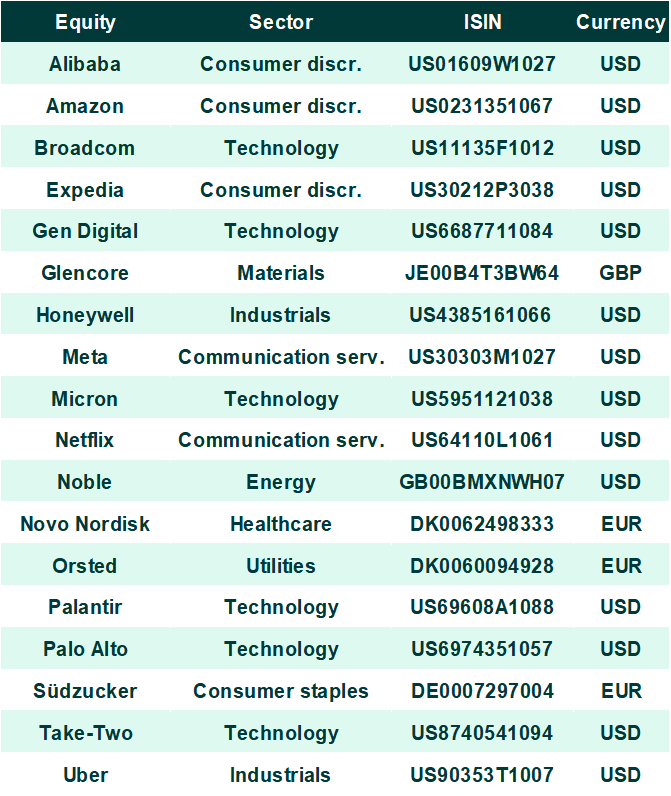
Overall, Orsted continues to perform as expected; project developments are proceeding smoothly, and there are no signs of liquidity issues. Taking all of this into account, we are keeping the company’s stock on our Equity Top Pick List.
Equity Top Pick List (updated)
Get more out of your investments!
Global Markets Services
OTP Global Markets offers a broad range of services in the field of local and international money and capital markets.
Read morePrivate Banking Services
Personal care and expertise with OTP Private Banking, along with the knowledge, security, and innovations of a multinational banking group.
Read more