
One Step Closer to a New World: Brazil
Related content
Südzucker: little sweet, little sour earnings
Südzucker, which is one of the world’s largest sugar producers and a leading player in European biofuel production, released its latest interim report, which contained both pleasant and slightly negative surprises. On the one hand, there has been a significant improvement in financial performance on an annual basis, three out of five business segments posted excellent results, and losses in the sugar production division also narrowed thanks to cost-efficiency measures. On the other hand, management raised its annual forecasts only moderately despite strong business performance, which may have disappointed some investors. However, in our view, the outlook for the sugar market remains favorable, so the sugar production segment’s profitability may improve in the coming period. Overall, we are keeping the stock on our Equity Top Pick List.
Vistra: A Potential Winner of the AI Energy Demand Surge
Major U.S. indices are trading near their all-time highs, but have not yet broken out toward new peaks. Meanwhile, it is rare to find stocks that are breaking out and rising after periods of consolidation or correction. This week, Vistra from the utilities sector stood out. The company is one of the largest electricity producers in the U.S., with significant nuclear capacity, and is benefiting from the growing electricity demand of AI data centers.
Elections were held in Brazil in early October, during which Flávio Bolsonaro, the challenger to incumbent President Lula, performed better. The second round of the presidential election will follow in late October, when it will be decided which of the two will become Brazil’s next president. Currently, Flávio Bolsonaro appears to be the favorite to win, and based on market reactions, investors may already started pricing in this scenario. If Flávio Bolsonaro is elected president, it could pave the way for the fiscal turnaround anticipated by market participants, and relations between Brazil and the United States could also improve, which over time could even lead to lower Brazilian tariffs.
Flávio Bolsonaro could be Brazil's next president
The Brazilian presidential election in October was preceded by tense anticipation, as opinion polls showed only a minimal difference between President Lula—who is running for his fourth term—and his main challenger, Flávio Bolsonaro, the son of the former president.
Although some polls suggested that Lula was the favorite in the first round, Flávio Bolsonaro ultimately won 47% of the vote, while Lula received 45%. Since neither candidate was able to secure more than 50 percent of the vote, a runoff election on October 25 will determine whether Lula or Bolsonaro will be Brazil’s next president. Flávio received 3.8% more votes than his father, Jair Bolsonaro, did in the first round of the 2022 presidential election.
However, the stakes of the referendum were not limited to who would be Brazil’s next head of state; on October 4, Brazilians also voted to fill all seats in the lower house of Congress and two-thirds of the Senate. The right wing performed very well: the Liberal Party (PL) increased its representation in the Senate from 15 to 28 seats and also increased its number of seats in the lower house (to 121 from the current 98). According to preliminary projections, Bolsonaro’s agenda, together with that of other right-wing parties, is likely to have sufficient support in the next Brazilian Congress.
Looking at Brazilian presidential elections since the 1990s, whenever a runoff has been held, the candidate who won the first round has, without exception, gone on to win the runoff as well. Given the strong showing by the right, it looks like it will be very difficult for Lula to turn things around from here. It likely hurt Lula’s campaign that he did not emphasize his commitment to fiscal responsibility, for example, and, according to those familiar with his campaign, the president rejected requests from his staff that he should have focused primarily on a forward-looking plan rather than emphasizing his personal story. According to some commentators, the result reflected not only Bolsonaro’s victory but rather Lula’s defeat.
The Brazilian stock market hit a new high
Bolsonaro’s better-than-expected performance and the strong showing of the right wing may have come as a surprise to investors, and although the presidential election has not yet been officially decided, the majority of votes not cast for Lula or Bolsonaro went to other right-wing candidates, so these voters are more likely to cast their ballots for Flávio Bolsonaro in the second round. Bolsonaro’s chances therefore appear to have improved, a trend that was also evident in the initial market reactions following the election. The yield on 10-year Brazilian government bonds fell sharply on October 5, dropping below 13%, the real strengthened to below the 5.0 level against the dollar, and the Brazilian stock market index, the Bovespa, soared 7.7% to a new high after foreign investors purchased approximately $2 billion worth of Brazilian stocks on the day following the election—a new record—and the index continued to rise thereafter.
Market participants have not only begun to price in Bolsonaro’s victory, but also the possibility that, if he becomes Brazil’s next president, he will be more likely to implement the necessary fiscal adjustments, which could pave the way for further central bank interest rate cuts. The 8 percent budget deficit and public debt exceeding 80 percent of GDP also limit the central bank’s room to maneuver.
In the campaign, Bolsonaro appeared holding a pair of scissors while promising to cut Brazilian public spending, alluding to Argentine President Javier Milei’s chainsaw. Many details regarding the potential direction Bolsonaro intends to take still need to be clarified, but according to press reports, a fiscal adjustment equivalent to ~1.5–2% of GDP may follow. Initially, costs would be cut within the public sector (reports indicate that pension reform or cuts to social benefits would be avoided at first), and the focus would be on administrative reform, which could include reducing the number of ministries and reviewing public sector salaries, among other measures. A constitutional amendment could also be required for the fiscal package, and it could be submitted to Congress between the second round of the presidential election and the presidential inauguration.
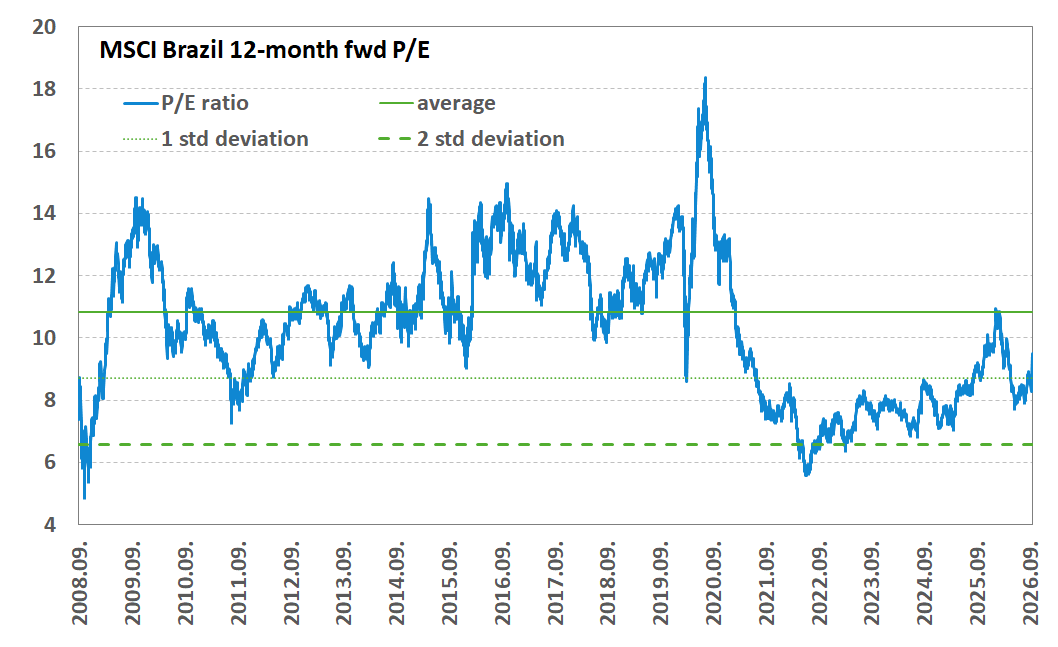
Reports of an impending fiscal adjustment may reinforce market participants’ optimistic expectations regarding Flávio Bolsonaro; however, for the rally in Brazilian assets to continue after the election, not only would a Bolsonaro victory be necessary, but also a credible and fully implemented fiscal turnaround—which, as it now appears, market participants appear to have already partially priced in. Following the stock market surge after the first round of the Brazilian election, the valuation gap between Brazilian and emerging markets has narrowed; with the MSCI Brazil Index’s forward P/E ratio of 9.3 currently only marginally lower than that of the MSCI Emerging Markets Index (though it has not yet come close to the Brazilian index’s long-term average valuation of 10.81). A Bolsonaro presidency could also lead to improved relations with the United States and, as a result, potentially lower tariffs on Brazilian imports.
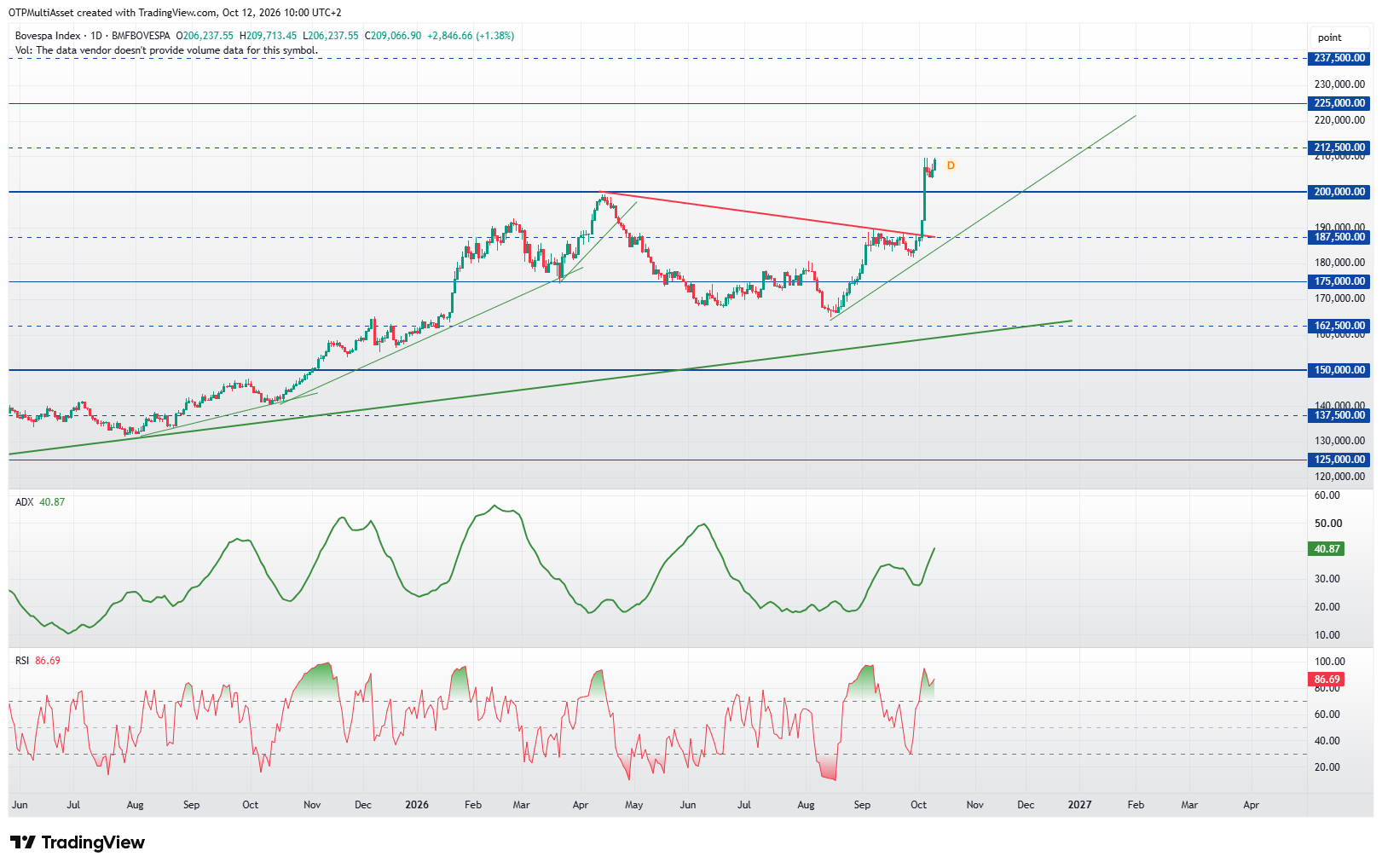
Bovespa index technical picture
A week ago, it broke out of a consolidation phase that had lasted a few weeks, which served as another signal to go long. Even before that, we could see a trend-reinforcing pattern, which pointed to a new high. There is still potential for further gains; the zone between 225,000 and 237,500 is expected to act as stronger resistance. A break below the thin green trendline could reverse the upward trend.
Get more out of your investments!
Global Markets Services
OTP Global Markets offers a broad range of services in the field of local and international money and capital markets.
Read morePrivate Banking Services
Personal care and expertise with OTP Private Banking, along with the knowledge, security, and innovations of a multinational banking group.
Read more