
Novo Nordisk: Investors Wanted More
Related content
German Healthcare Giant Shows Signs of a Comeback.
European markets seemed to be struggling in recent weeks, but following the declines, patterns suggesting a correction have emerged on the indices, with an increasing number of stocks signaling a possible turnaround. However, the technical charts of the companies on the list still do not reflect clear trading opportunities. For this reason, this week we are analyzing one stock from the momentum list: Siemens Healthineers. The company is part of the Siemens Group and is one of the world’s leading manufacturers of medical devices.
Hungarian Equities - Technical Analysis
The BUX index broke out of its uptrend last week and underwent a sharp correction, which may be followed by some retesting. MOL’s share price found minor support but is still in a correction. Richter stalled at the 12,180 level, but a bullish day signaling a reversal has not yet occurred. Magyar Telekom’s share price remains narrow, a day with a strong move could provide short-term direction. Opus is still in a downtrend; a reversal is still pending. Rába continued to trade within a narrow range; another upward wave could follow later if conditions are right.
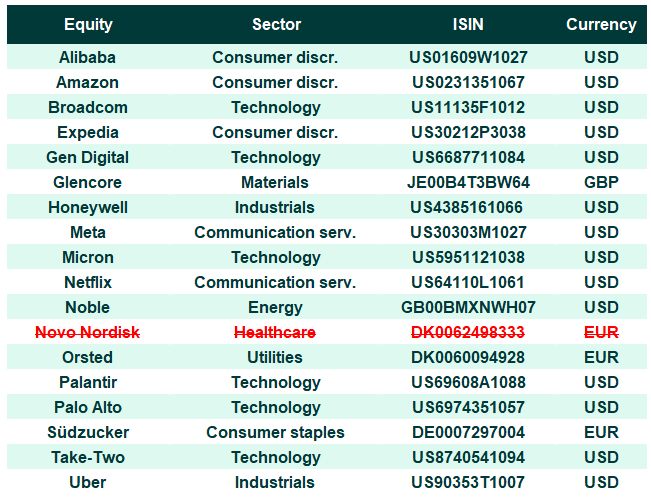
Novo Nordisk shares fell more than 7% on Monday after the company presented its strategy for the coming years at its Capital Markets Day. Management promised the launch of several new medicines and a significantly broader product portfolio. However, this was not enough for investors, who had expected a firmer and more quantifiable plan. We also view the strategy presented as disappointing and are therefore removing the stock from our Equity Top Pick List.
We initiated our positive view on Novo Nordisk at the beginning of the year, believing that the sharp sell-off had left the risk-reward skewed to the upside, with a significant amount of bad news already discounted. That view proved premature, as the February earnings release materially weakened the investment case. We allowed management a further six months to set out a credible path forward, but the September Capital Markets Day fell short of that requirement.
Novo expects revenue growth between 2026 and 2030 to be broadly in line with the average of its industry peers, while maintaining its operating margin at approximately the current level. This would imply mid-single-digit annual growth, which looks relatively weak, particularly compared with Eli Lilly. Moreover, this level of growth is likely already priced in, meaning Novo would need to outperform these expectations to deliver meaningful share-price appreciation.
To achieve this, the company plans to launch more than five medicines with multibillion-dollar annual revenue potential by 2030. According to management’s plans, risk-adjusted revenue from products currently under development could exceed DKK150 billion by 2035. This is an ambitious target, but it relates to a long time horizon and includes several medicines that are still in clinical development, resulting in a high degree of execution uncertainty.
Management expects the company to have a significantly more diversified product portfolio by 2035. In addition to obesity and diabetes, medicines developed to treat cardiovascular, liver and haematological diseases could play a larger role. Larger acquisitions could also be considered, although management did not identify any specific targets or transaction plans..
Patent Expiries Are Approaching
It remains unclear how the company will manage the slowdown in the growth of Ozempic and Wegovy. The US patents for the two medicines will begin to expire from 2032, while semaglutide will start losing exclusivity in several major markets from this year. The United States is the company’s most important market, accounting for more than half of revenue, and the arrival of generic medicines will also create significant pricing pressure there. This is particularly important given that US prices already had to be reduced in 2025.
Management believes that higher volumes can offset lower prices. However, the market is sceptical that this can be sustained while maintaining adequate profitability. The oral version of Wegovy could become an important growth driver, and its sales have started well this year. However, lower prices and the potential cannibalisation of the injectable market may not ultimately benefit the company’s profitability.
Competition in obesity treatment is already intense. According to IQVIA data, Lilly held a 60.9% share of the US diabetes and obesity drug market in the second quarter, compared with Novo’s 38.8%. In addition, several other companies could launch competing products in the coming years.
Lilly’s two medicines, Zepbound and Mounjaro, have strong clinical profiles. The company is also growing its US sales more quickly, while the market has a more favourable view of its pipeline. Meanwhile, several Novo development programmes have disappointed. CagriSema’s clinical results did not reach the previously expected level, while the Phase III trial of ziltivekimab did not deliver a meaningful reduction in major cardiovascular events.
Novo Nordisk remains one of the leading companies in the treatment of obesity and diabetes, with strong brands and considerable experience. However, tangible results will be required to restore investor confidence. The strategy presented at the Capital Markets Day fell short in this respect, and we are therefore removing the stock from our Equity Top Pick List.
Get more out of your investments!
Global Markets Services
OTP Global Markets offers a broad range of services in the field of local and international money and capital markets.
Read morePrivate Banking Services
Personal care and expertise with OTP Private Banking, along with the knowledge, security, and innovations of a multinational banking group.
Read more