
Netflix: Cracks Are Emerging in the Growth Story
Related content
Meta: Burning Cash on the AI Promise
Overall, Meta’s quarterly performance continues to paint a positive picture in terms of the underlying fundamentals, while the company has also achieved significant milestones on the AI model development front. However, elevated spending is taking a substantial bite out of cash generation, with free cash flow now turning negative, which may increasingly require funding through capital market financing. Following the stock’s rally in recent weeks, valuation levels have also moved higher. In the near term, these factors may continue to put pressure on the stock, although the longer-term outlook remains constructive. Naturally, much will depend on the company’s ability to effectively monetize its investment program over time.
The government plans a 4.9% deficit for next year
The government plans a 4.9% deficit for next year and will gradually reach 2.8% by 2030, under the Maastricht criteria
The negative investor narrative surrounding Netflix remains unchanged. Although the headline results were solid, the slowdown in the growth rate is currently overshadowing everything else in the equity market. Questions are increasingly being raised about US engagement and the performance of the content slate. A tangible catalyst would be needed for a sustained rerating of the shares, but none is currently in sight.
Earnings report
Netflix released its quarterly results against a difficult backdrop, and given the stock’s year-to-date performance, the subsequent 5 to 6 percent decline in the share price was hardly surprising. Nevertheless, the headline figures offered little cause for complaint. Revenue came in line with expectations, earnings per share exceeded estimates, and the operating margin improved. Management did note, however, that the margin outperformance was partly attributable to the timing of certain expenses, meaning that some of the quarterly improvement is unlikely to be sustainable.
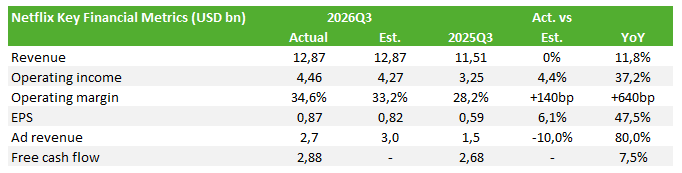
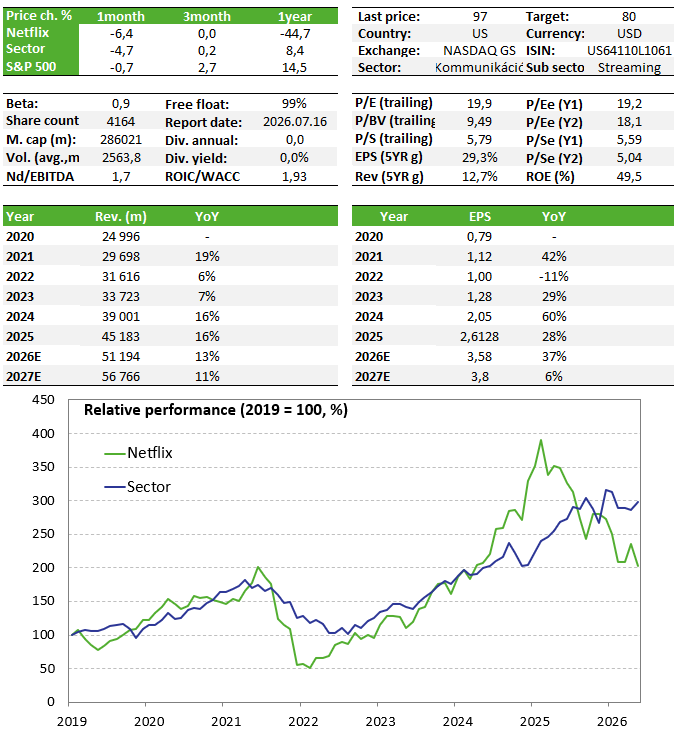
The market reaction nevertheless shows that investors’ perception of Netflix has changed, with many now questioning the credibility of the company’s growth trajectory. Revenue growth has slowed for four consecutive quarters, and the latest growth rate was the weakest since 2023. Some moderation is, of course, inevitable for a global company reaching more than 300 million households. In the current market environment, however, slower growth makes it difficult to sustain the premium valuation multiples previously assigned to the stock.
Moreover, Netflix expects revenue to grow by “only” 11 percent in the current quarter, slightly below market expectations, while both EPS and margins could remain under pressure. Full-year 2026 revenue is now likely to come in closer to the lower end of the company’s previous guidance range, while the operating margin is expected to remain in line with the level previously indicated. Investors are looking for a tangible catalyst capable of reigniting growth, but no such driver is currently visible.
The biggest disappointment in the earnings release was the reduction in the advertising revenue target. Instead of its previous expectation of approximately USD 3 billion, Netflix now forecasts advertising revenue of USD 2.7 billion for 2026. The ad-supported plan is designed to target price-sensitive households while also enabling the company to monetize existing viewing activity more effectively. Total revenue per subscriber on the ad-supported tier, including both subscription and advertising revenue, remains below that of the standard ad-free plan, although the objective is to close this gap over time.
Intense Competition for Screen Time
The primary reason behind the negative sentiment surrounding Netflix is that total time spent on the platform increased by only 2 percent in the first half of 2026, while viewing time per subscriber declined. Performance in the US market is a particularly sensitive issue. Although management described engagement as stable, it acknowledged that the US content slate had lacked breakout titles capable of achieving major global success. This represents a long-term challenge that Netflix will need to address, as the company is now competing for total digital screen time. YouTube, TikTok, Instagram, and even video games have become direct competitors. This is a considerably more intense competitive environment than the one in which Netflix primarily measured itself against Disney, HBO, and other film studios.
YouTube is the company’s most significant rival, and its business model presents a formidable challenge. Its content library is effectively unlimited, while creators bear most of the production costs. It also benefits from a highly developed recommendation engine and a mature advertising business. By contrast, Netflix’s film and television content requires substantially greater expenditure and longer development lead times. The quarter was also accompanied by significant organizational changes. Netflix announced 1,000 job cuts, representing approximately 6 percent of its workforce. The company’s chief content officer also departed and was replaced by Peter Rice, who previously worked at Disney. Film chief Dan Lin and several other senior executives also left the company.
Peter Rice has considerable experience in the sports media market and is also regarded as having an extensive network of relationships in Hollywood. He may bring additional executives to the company. Live events and sports could increase time spent on the platform and strengthen engagement, while also providing Netflix with premium advertising inventory.
There are, of course, still areas where growth remains strong. The international business continues to perform well. In India, viewing hours increased by 24 percent, accompanied by revenue growth of nearly 20 percent on a constant-currency basis. Non-English-language content now accounts for approximately one-third of total viewing activity. By contrast, the US content slate produced fewer titles capable of becoming major successes both domestically and internationally. The company also continued its share repurchases during the quarter, although these failed to provide meaningful support for the stock price.
For the time being, we are keeping the stock on our Equity Top Pick List, as the share price has fallen to levels where buyers could begin to return. We do not dispute that Netflix faces significant challenges. Nevertheless, it remains the world’s largest streaming service and continues to generate substantial cash flow. Much will depend on whether the company can produce content that keeps subscribers engaged and discourages churn. It also remains unclear how costly a broader expansion into sports would ultimately prove. If no tangible catalyst emerges over the coming months, however, we may need to remove the stock from our list.
Investment case
- Netflix remains the leading player in the global streaming market, supported by strong pricing power and industry-leading customer retention.
- Advertising revenue could nearly double this year, although it is not yet large enough to become the company’s primary growth engine on its own. The latest quarter brought a setback in this area, as the company now expects lower full-year advertising revenue than previously forecast.
- Despite accounting for a relatively limited share of total viewing hours, live events have proved to be effective tools for subscriber acquisition and advertising monetization. The key question is whether these offerings can generate attractive returns, given that sports broadcasting rights are typically very expensive.
- An operating margin above 30% and substantial share repurchases continue to support the company’s long-term investment case.
- Risks: Netflix is no longer competing only with traditional streaming platforms. It must also compete with YouTube and social media platforms for users’ screen time. This has raised questions about the level of organic growth the company can still achieve.
Get more out of your investments!
Global Markets Services
OTP Global Markets offers a broad range of services in the field of local and international money and capital markets.
Read morePrivate Banking Services
Personal care and expertise with OTP Private Banking, along with the knowledge, security, and innovations of a multinational banking group.
Read more