
Netflix: Profit-Taking Does Not Undermine the Investment Case
Related content
US bank shares fell
The third-quarter earnings season in the US has picked up pace following the release of the latest figures from US banks. Based on preliminary expectations, the third quarter is likely to have closed with strong earnings growth for S&P 500 companies, led by the energy and technology sectors. The major US banks have still achieved solid growth on an annual basis, indicating that their operations remain strong, but the pace has clearly slowed in many cases, which has tended to result in negative share price reactions.
Commodities - Technical Analysis
Gold and silver continued their downward trend, bouncing off key levels. Until their downward trends are broken, they will not be able to produce a significant rise. The fall in oil prices reversed from the $87.5 level and began a slight upward movement. Natural gas remained in an uptrend; a significant rise could even occur if it breaks out upwards. The price of copper has become stuck in a wider range, so the oversold and overbought zones may offer more favourable trading opportunities. The falling prices of wheat and corn have reached key support levels; a buying reaction from these levels could present favourable long opportunities with limited risk.
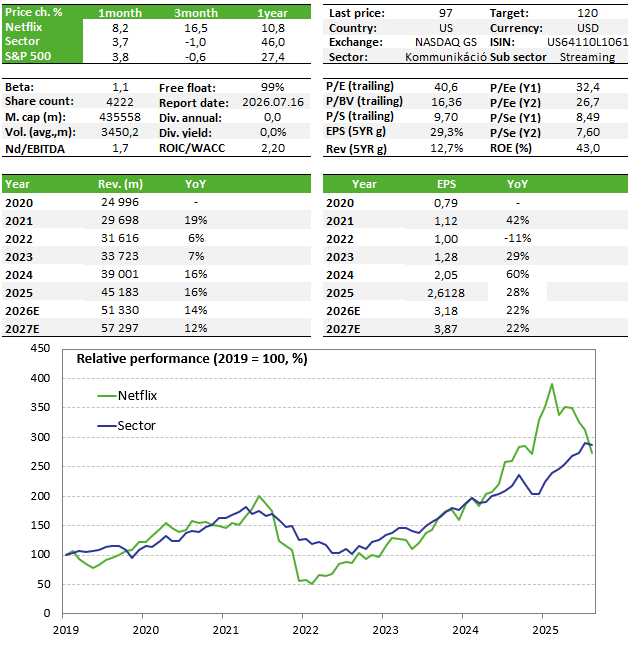
Netflix shares may open sharply lower on Friday following the earnings release, as investors appear to be taking profits after the stock’s strong rally. However, in our view, the current correction does not weaken the underlying investment case. The weaker-than-expected second-quarter profit outlook is primarily driven by timing effects, while management reaffirmed its full-year growth expectations and the advertising business continues to expand rapidly. As such, after the strong rally seen since the February lows, we view the pullback more as a healthy correction than a trend reversal.
Earnings report
Netflix shares are set to begin Friday’s trading session with a significant decline, after the quarterly earnings report triggered profit-taking among investors. This comes after the share price had already risen by 40% from its February lows. We added Netflix to our Equity Top Pick List list earlier this week, and we continue to believe that the company remains a fundamentally attractive investment opportunity, particularly in light of the current correction.
The sharp share price decline was triggered by the company guiding for lower-than-expected net income in the second quarter. The main reason is that Netflix’s content spending will peak in Q2 due to the timing of content releases. At the same time, spending is expected to decline in the second half of the year.
Apart from this, first-quarter revenue came in ahead of expectations, as did profit. However, the latter is more difficult to compare due to the one-off USD 2.8 billion payment received from Paramount after Netflix walked away from the Warner acquisition. Management reaffirmed its full-year guidance for revenue growth of 12–14% and an operating margin of 31.5%. At the group level, the ad-supported tier continues to expand significantly, and management reiterated that advertising revenue could reach USD 3 billion this year, which would imply a doubling on an annual basis.
Selling pressure may also have been intensified by the announcement that founder Reed Hastings will not renew his board membership when it expires in June. Hastings has not served as CEO since 2023 and no longer has an active operational role at the company, but the market nevertheless reacted negatively to the news. Regarding the decision to walk away from the Warner transaction, management commented that the deal would only have created value for Netflix if the company could have been acquired at the right price, which ultimately did not materialize.
The Asia region delivered a strong performance, supported by the streaming of the World Baseball Classic Japan. The event was streamed by more than 31 million viewers globally and generated the largest single-day subscriber additions in Japan. According to press reports, Netflix is also in talks with the NFL over potentially broadcasting not only Christmas games, but a broader slate of matches as well.
Investment case
- The most important positive development is that Netflix did not proceed with the Warner acquisition. As a result, the company avoided taking on significant additional debt, higher interest expenses, and the integration and synergy risks that have historically often destroyed shareholder value in the media sector. Consequently, Netflix’s balance sheet has remained cleaner, while management’s focus has shifted back to the core business.
- Netflix remains the leading player in the global streaming market, with 325 million subscribers, giving it a clear advantage over its competitors. At the same time, real competition is no longer limited to traditional streaming players such as Disney, HBO/Paramount, but increasingly includes YouTube as well, as the battle is now also for screen time. Meanwhile, the remaining room for subscriber growth is increasingly concentrated in emerging markets.
- The centre of gravity of the growth story has shifted from subscriber growth toward monetization, which is particularly supportive for profitability. The crackdown on password sharing, the launch of the ad-supported tier, and price increases all serve to drive revenue growth. This is further supported by content diversification — including live sports events and a move into podcasts — which could create new sources of viewership and revenue.
Get more out of your investments!
Global Markets Services
OTP Global Markets offers a broad range of services in the field of local and international money and capital markets.
Read morePrivate Banking Services
Personal care and expertise with OTP Private Banking, along with the knowledge, security, and innovations of a multinational banking group.
Read more