
Netflix Goes to the Movies
Related content
French Stocks Show Promising Technical Setup
The European markets continue to be characterized by choppy price action, with two days of gains often followed by two days of declines, reflecting the prevailing uncertainty among investors. Some sector rotation can be observed away from the previously market-leading technology sector and into other areas of the market. While attractive stock opportunities can still be found, we remain sceptical that a sustained momentum-driven move can develop in the current environment. As a result, strong directional trends appear unlikely for the time being. In such conditions, pullbacks and retests are likely to provide more favourable entry opportunities. This week, we highlight two French stocks from our screen.
Hungarian Equities - Technical Analysis
The BUX index may currently be in a corrective phase following its recent decline, with a retest of the latest swing low appearing more likely. MOL remains in a downtrend and could move lower if it breaks below its most recent swing low. Richter, however, has broken above its downtrend line, suggesting that a new upward wave may have started with the all-time high as a potential target. Magyar Telekom also broke higher two weeks ago, and the uptrend remains intact. Opus is still trading in a downtrend, with no convincing signs of a reversal yet. Rába continued to move within its narrowing range, and under the right conditions, another upward wave could emerge later on.
Netflix has repeatedly demonstrated its ability to adapt to structural changes across the media industry. Its latest initiative represents another potentially important shift, with the company preparing to test substantially longer theatrical release windows for selected films. While the initiative is unlikely to have a material near-term earnings impact, it could support the development of an additional revenue stream, improve content monetisation and help Netflix build blockbuster franchises that have so far remained largely absent from its portfolio.
Netflix shares have regained some ground following the company’s July quarterly results, although performance remains well below the levels seen during earlier periods of stronger momentum. Several factors may explain this relative weakness. Most importantly, investors have begun to question whether Netflix can sustain user engagement over the longer term as competition for consumers’ screen time continues to intensify. The company also needs to maintain significant content investment, while the scope for repeated subscription price increases is unlikely to be unlimited.
These concerns have not yet become visible in Netflix’s financial performance. The company remains the leading global streaming platform, while management has repeatedly shown that it is willing to reassess long-standing strategic assumptions when market conditions change. Netflix initially resisted advertising before introducing an ad-supported subscription tier to broaden its addressable market. It subsequently tightened restrictions on password sharing and expanded beyond traditional films and scripted series into live sports and other programming categories. The company’s latest push into theatrical distribution should be viewed as another step in this broader evolution.
Netflix chart
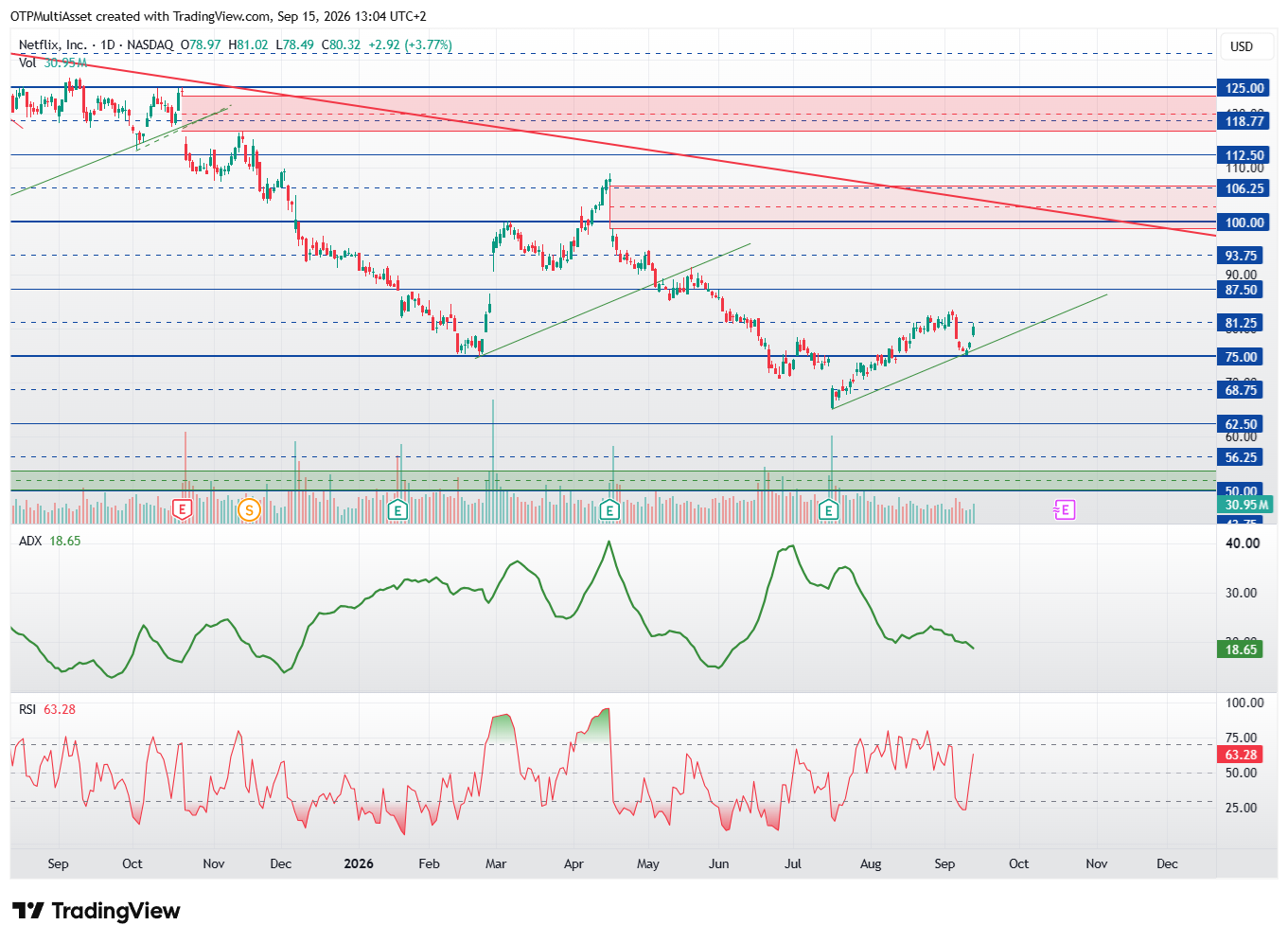
Netflix heads to the cinema
Netflix plans to give six upcoming films an exclusive 45-day theatrical window before making them available on its streaming platform. The company has previously released selected titles in cinemas, including The Irishman and All Quiet on the Western Front. However, these releases were generally limited in scale and duration and were primarily designed to satisfy eligibility requirements for major film awards. Box-office figures were typically not disclosed, and theatrical screenings largely served as part of the marketing campaign ahead of the films’ streaming launches.
The new approach appears more substantial. Netflix increasingly recognises that 2026 has marked a revival in theatrical cinema, with selected releases achieving not only strong box-office results but also a broader cultural impact. The company has little incentive to remain entirely outside this ecosystem if theatrical exposure can increase the commercial and strategic value of its content.
An exclusive window of approximately 45 days is sufficiently long to qualify as a meaningful theatrical release. Under these terms, cinema operators may be more willing to allocate additional screenings, more attractive time slots and stronger marketing support to Netflix films. At the same time, Netflix would still be able to bring titles to its own platform significantly faster than under the traditional 75- or 90-day theatrical windows historically used by the industry.
Building an additional revenue stream
Netflix spends heavily on original films, but the financial return on an individual production is difficult to measure when the title is released exclusively on the streaming platform. It is rarely possible to determine precisely how many new subscribers a film attracts or how many existing subscribers it prevents from cancelling their memberships.
Theatrical box-office revenue, by contrast, can be attributed directly to a specific title. Even a moderately successful theatrical run for a large-budget production could generate tens of millions of dollars and reduce the net economic cost of the content. A theatrical release can also extend the commercial life of a film. On streaming platforms, new titles often lose visibility quickly amid a continuous flow of new content. A cinema release creates several distinct marketing opportunities, allowing Netflix to build awareness ahead of the theatrical premiere and subsequently position the streaming launch as a second event.
This two-stage release model could therefore generate greater consumer awareness and potentially improve the return on marketing expenditure. A successful theatrical campaign may increase the number of users who watch the film once it reaches Netflix, supporting subscriber engagement and, in the case of the ad-supported tier, advertising inventory and revenue.?
The theatrical strategy may also strengthen Netflix’s position when competing for leading directors, actors and producers. Many prominent filmmakers continue to regard a cinema release as important for artistic, reputational and financial reasons. For directors, theatrical distribution can provide access to film festivals, critical recognition and industry awards.
Netflix has historically compensated creative talent through relatively high upfront payments in exchange for the absence of traditional theatrical revenue participation. This has increased the cost of securing the most sought-after filmmakers and performers. In some cases, even substantial guaranteed payments have not been sufficient to persuade leading talent to produce films without a meaningful cinema release. A more flexible theatrical strategy could consequently reduce Netflix’s reliance on elevated upfront compensation while expanding the pool of filmmakers willing to work with the company.
Successful franchises needed
Netflix has created several globally successful television franchises, including Stranger Things, Squid Game and Wednesday. Its record in feature films has been less convincing. Despite significant investment and numerous widely viewed releases, Netflix has yet to establish a film franchise with the cultural durability and commercial potential of the leading intellectual properties owned by traditional Hollywood studios.
Netflix’s new Narnia film, currently planned for release in 2027, represents a potential test case. The production is expected to feature Meryl Streep and Daniel Craig, with Barbie director Greta Gerwig attached to direct. IMAX screenings are also planned, indicating that Netflix views the film as a genuine large-scale theatrical proposition rather than a limited awards-qualification release. The project could become an important strategic milestone.
A successful theatrical and streaming performance would increase the probability of further instalments and support a broader rollout of the new distribution model. Conversely, a disappointing result could reduce management’s willingness to pursue an extensive theatrical strategy. Before Narnia, Netflix plans to test the 45-day window with several smaller-scale productions. These include The Further Adventures of Cliff Booth, written by Quentin Tarantino and directed by David Fincher, with Brad Pitt in the lead role.
Over time, the most likely outcome is a hybrid distribution model. The length and scale of theatrical exposure would depend on the audience potential, production budget and genre of each individual title. Netflix will initially apply its longer theatrical release window to only six films. The programme is therefore unlikely to have a meaningful impact on consolidated revenue, earnings or free cash flow in the near term. However, the strategic rationale is credible. If the selected films generate profitable theatrical runs and subsequently achieve strong viewing figures on Netflix, the company would be able to monetise the same content across two consecutive distribution stages.
Box-office revenue would offset part of the production cost, while theatrical marketing could increase awareness ahead of the streaming release. Once the film arrives on Netflix, it could support subscriber acquisition, retention, engagement and advertising revenue. The next 12 months should provide initial evidence on whether Netflix can use theatrical releases without weakening the value proposition of its streaming platform.
If the company demonstrates that a film can perform successfully in cinemas and subsequently generate strong engagement on Netflix, the model could become a meaningful extension of its content strategy.
Get more out of your investments!
Global Markets Services
OTP Global Markets offers a broad range of services in the field of local and international money and capital markets.
Read morePrivate Banking Services
Personal care and expertise with OTP Private Banking, along with the knowledge, security, and innovations of a multinational banking group.
Read more