
Hungary: After 17 months, the base rate was cut by 25bps, to 6.25%; we expect another move in March; post-election policy may shape the path thereafter
Related content
US bank shares fell
The third-quarter earnings season in the US has picked up pace following the release of the latest figures from US banks. Based on preliminary expectations, the third quarter is likely to have closed with strong earnings growth for S&P 500 companies, led by the energy and technology sectors. The major US banks have still achieved solid growth on an annual basis, indicating that their operations remain strong, but the pace has clearly slowed in many cases, which has tended to result in negative share price reactions.
Commodities - Technical Analysis
Gold and silver continued their downward trend, bouncing off key levels. Until their downward trends are broken, they will not be able to produce a significant rise. The fall in oil prices reversed from the $87.5 level and began a slight upward movement. Natural gas remained in an uptrend; a significant rise could even occur if it breaks out upwards. The price of copper has become stuck in a wider range, so the oversold and overbought zones may offer more favourable trading opportunities. The falling prices of wheat and corn have reached key support levels; a buying reaction from these levels could present favourable long opportunities with limited risk.
At its February meeting, the MNB’s Monetary Council cut the base rate by 25 basis points, to 6.25%, as expected. Despite the rate cut, the MNB’s forward guidance remained hawkish: the Governor emphasized that this is not the start of an interest-rate-cutting cycle and the data-driven approach will be kept.
The MNB's key messages:
· Incoming inflation data evolved in line with the central bank’s December forecast, which signalled improving underlying inflation trends and stable financial markets. This has allowed for a cautious reduction in interest rates: the base rate (+6.25%) as well as the lower (+5.25%) and upper (+7.25%) bands of the interest rate target were reduced by 25 basis points, which was the one and only option discussed by the Monetary Council on the rate-setting meeting in February.
· The Council has not started an interest rate cutting cycle; it continuously evaluates incoming data and the impact of its decisions on a meeting-by-meeting basis, and has not committed to any specific interest rate path. Given the risks surrounding the inflation outlook, a cautious and patient monetary policy stance remains warranted.
· Domestic economic growth continued to be subdued, the labour market remained resilient. Household lending is expanding dynamically, while corporate lending is gradually picking up.
· The pace of price increases is expected to remain in the lower half of the tolerance band in the coming months, before temporarily rising into its upper range.
· Repricing in January 2026 was moderate across market services, food and industrial goods. However, caution is warranted in the case of durable goods, as their prices increased more strongly than in January last year.
· The forint has outperformed regional currencies against the euro. Maintaining foreign exchange market stability is crucial to anchoring inflation expectations.
· The Monetary Council makes decisions on the base rate in a careful and data-driven manner, evaluating the impact of each decision on a meeting-by-meeting basis.
· The MNB does not see inflationary risks arising from the temporary shutdown of the Druzhba (Friendship) oil pipeline.
Market reactions:
· The decision was in line with expectations, so market reaction was barely noticeable. In the afternoon, regional currencies slightly appreciated, but the HUF gained a bit more against the EUR than the PLN or the CZK did. Yields barely changed, FRAs, swap and bonds yields have not changed substantially. The market still prices three 25-bp cuts for this year – one for each remaining quarter – and another one is likely in 2027.
Before the decision: 25 bps cut was foreseen
· It seemed that the time had come: the MNB’s Monetary Council was expected to cut its key interest rate, which had been flat since September 2024, by 25 basis points in February. Having left the base rate on hold for a long while, the central bank’s new leadership announced in December, simultaneously with the publication of the new Inflation Report, that it would switch to data-driven mode, thus opening the door to interest rate cuts. Although December's reading of inflation still caused a negative surprise, in January both headline and core inflation slowed stronger than expected and, more importantly, services inflation has also eased, suggesting that this year's average inflation may fall below 3%. The fact that the forint had remained strong —the EUR/HUF was trading below 380— also pointed to an interest rate reduction. Market prices imply that the base rate may sink as low as to 5.5% this year, and bond yields have fallen to their one-year low.
Our assessment: We expect another 25-basis-point rate cut in March, while the economic policy after the parliamentary elections will determine the MNB’s room for manoeuvre over the remainder of the year
· Considering that currently the forint is stronger (EUR/HUF: ~380) than we had previously anticipated, price adjustments at the beginning of the year were smaller than anticipated, and food prices may develop even more favourably than we had previously thought, we cut our forecast of average inflation for this year to 2.9%. Inflation could remain below the 3% inflation target at the beginning of 2026 and could rise to around 3.5% in H2 and in 2027. That increase will be the result of expected rises in fuel and food inflation and declining trend inflation.
· Despite the rate cut, the MNB maintained a hawkish tone and emphasized the importance of preserving foreign exchange market stability. Previously, we expected two interest rate cuts this year, one in Q1 and one in Q3. However, inflation in January delivered a downside surprise to us, suggesting that repricing activity could remain subdued also in February, so we expect another 25-basis-point rate cut in March. We expect inflation to remain in the upper part of the tolerance band in H2 2026 and in 2027, the base rate could remain at 6% afterwards. However, the base rate trajectory and the elbowroom of the MNB thereafter could be strongly influenced by the market reaction on election results and the economic policy announced after the parliamentary elections. In case of positive market reaction, we see further room for additional rate cuts.
Expectations for the base rate (%)
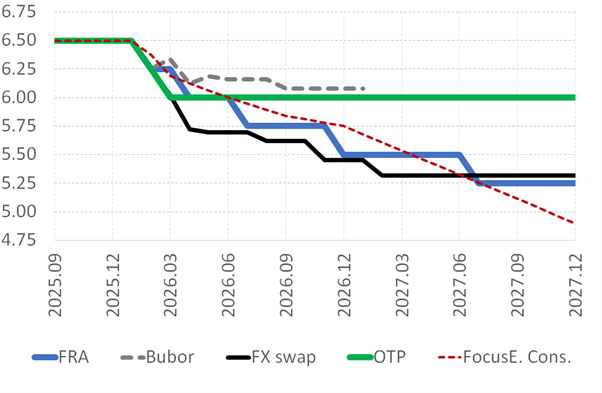
Sources: Bloomberg, OTP Research, Focus Economics, MNB
Get more out of your investments!
Global Markets Services
OTP Global Markets offers a broad range of services in the field of local and international money and capital markets.
Read morePrivate Banking Services
Personal care and expertise with OTP Private Banking, along with the knowledge, security, and innovations of a multinational banking group.
Read more