
Hungary: MNB kept its policy rate at 5.5% and announced the lowering of its inflation target from 3.0% to 2.5% effective from 2028
Related content
One Step Closer to a New World: Brazil
Elections were held in Brazil in early October, during which Flávio Bolsonaro, the challenger to incumbent President Lula, performed better. The second round of the presidential election will follow in late October, when it will be decided which of the two will become Brazil’s next president. Currently, Flávio Bolsonaro appears to be the favorite to win, and based on market reactions, investors may already started pricing in this scenario. If Flávio Bolsonaro is elected president, it could pave the way for the fiscal turnaround anticipated by market participants, and relations between Brazil and the United States could also improve, which over time could even lead to lower Brazilian tariffs.
Südzucker: little sweet, little sour earnings
Südzucker, which is one of the world’s largest sugar producers and a leading player in European biofuel production, released its latest interim report, which contained both pleasant and slightly negative surprises. On the one hand, there has been a significant improvement in financial performance on an annual basis, three out of five business segments posted excellent results, and losses in the sugar production division also narrowed thanks to cost-efficiency measures. On the other hand, management raised its annual forecasts only moderately despite strong business performance, which may have disappointed some investors. However, in our view, the outlook for the sugar market remains favorable, so the sugar production segment’s profitability may improve in the coming period. Overall, we are keeping the stock on our Equity Top Pick List.
At its September meeting, the MNB’s Monetary Council put on hold its recent rate-cut cycle started in June and left the base rate unchanged at 5.50%. This clearly cautious step was underlined by the announcement of decreasing the central bank’s inflation target from the current 3.0% to 2.5% effective from January 1, 2028.
The MNB's key messages:
· Inflation is and will remain low until the end of 2026 (lower than in MNB’s previous assessment in June). This is reflected by the sentiment of households, too.
· There are serious upside risks due to re-emerging and high energy prices, though.
· Increase of long yields in advanced economies reduces general risk-taking that should always be taken cautiously in emerging market. Also, advanced central banks (ECB, Fed, BoJ) raised their policy rates, and hikes of the Czech and Polish central banks have been priced already (+25 bps by the end of the year).
· The EURHUF exchange rate is stable, but volatility seems to increase (with sometimes sudden weakenings of the rate as experienced in early September).
· Compared to its June-baseline, MNB decreased its forecast on inflation for Q3 2026, but revised the rest of the trajectory upwards: from Q1 2027 seeing changes in price levels above 3% (its recent target) until the end of 2027. This is led mostly by energy prices, but also by the recently announced increase of excise tax on tobacco products. Then, by the end of 2027, inflation shall come back below 3%, and then by 2028 below the new 2.5%-target, but under the assumption of the normalization of the energy prices.
· The MNB justified the decrease of its target on inflation by the fact that the new target is more in line with Hungary’s level of economic development and its ambition to access the eurozone. Hungary will benefit from the lower target by lower inflation and nominal interest rates, lower financing costs and mitigated vulnerability.
Market reactions:
· Market reactions were very moderate as the MNB acted basically in line with rumors that were aired and then internalised by the market earlier this month. FRAs barely changed, fluctuations in the EURHUF exchange rate remained below the 0.5%-range.
Before the decision: over September, the market priced in the stop of the rate-cut cycle
· After MNB’s last cut in August, market expectations foresaw another one coming in September. But earlier this month, there have been rumors spread by Bloomberg referring to “a person familiar with the matter” that MNB would not continue its interest rate cut cycle despite headline inflation being far below the 3% target (August: 1.3% YoY). In fact, hints were already made to the decrease of the inflation target to 2.5% or 2.0% (but without referring to timing) – a step, which might have provided an additional argument for not cutting interest rates further (as compared to the lower target, actual low inflation is not that low, anymore). While MNB rejected to confirm or even comment these rumors as usual, the market took at least the keep of the base rate at 5.5% as granted. It seemed that the only question remained whether the Monetary Council will indeed alter its inflation target. This was a material change in sentiment compared to August, when an additional interest rate cut in September was assessed as highly probable.
Our assessment: despite market pricing suggesting different, we still cannot rule out another cut in interest rates until the end of the year. The outlook remains dependent on geopolitical developments on the one hand, but also on the government’s medium-term fiscal trajectory and the details of its euro adoption strategy, on the other.
· During the press conference, answering a question, MNB-President Varga did not rule out either keeping the rates unchanged or deciding on a further cut until the end of the year, and emphasised the MNB’s data-driven approach. The central bank’s own forecast sees inflation to moderate even further from its recent subdued level (August: 1.3% YoY) on the ultra short term (until Q3 2026). As the decrease of the inflation target will be effective only from 2028, it will not constrain MNB’s discretionary latitude very recently. Thus, for the cases of energy prices normalising and geopolitical tensions easing, an additional decrease in interest rates is not completely off of the table.
· Although the MNB raised its 2027 headline inflation forecast, the direction of change in the closely watched constant tax core inflation measure, and which will be published in the Inflation Report on Thursday, remains uncertain. Indeed, it is quite possible that this indicator will decline from the 2.6% projected in June. Such an outcome would imply that the central bank could reach its new 2.5% inflation target for this key anchor of inflation developments even before the end of its 6-8 quarter monetary policy horizon.
· Key for further easing monetary conditions for Hungary are the continued credibility of the euro-accession story. The next milestones in that will be the 2027-budget, the medium-term fiscal plan and the underlying macroeconomic trajectory that will be provided by the Ministry of Finance over the mid of October. It has already become clear that, following the review, the Ministry of Finance is projecting a budget deficit of 7.5% of GDP for this year, but next year’s budget and the related macroeconomic trajectory are still unknown are in the center of investors’ interest.
· As for the decrease of the inflation target, it can be considered also as a symbolical step made by the MNB to support the euro-accession story. At the same time, it has its economic foundations as outlined by the 10-page long excerpts of a study published by the MNB alongside with the announcement. While the Penn-effect (more developed countries have higher price levels) would justify more tolerance for excess inflation for emerging economies like Hungary, the MNB refers to satisfactory price convergence of the country to the average of the eurozone that has occurred already and that enables allowing less room for prices to further catch up in the future. Also, Hungary’s 3% target stood out in the region (Czech Republic: 2.0%, Romania and Poland: 2.5%), so it was time that the MNB made a move. Even if the +/-1% tolerance band around the target will remain in place, the decrease of the target itself can be considered as a commitment to a more hawkish approach on inflation on the long run.
· Current energy prices and the rapidly rising global yield environment appear to be limiting the central bank’s short-term room for manoeuvre, even if the market reception of the October fiscal documents turns out to be positive. As a result, it now seems more likely that the central bank will have scope for only one additional rate cut this year.
Expectations for the base rate (%)
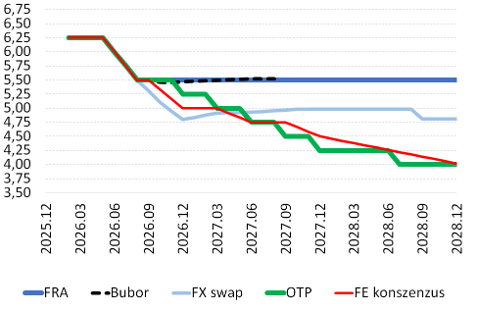
Sources: Bloomberg, OTP Research, MNB
Get more out of your investments!
Global Markets Services
OTP Global Markets offers a broad range of services in the field of local and international money and capital markets.
Read morePrivate Banking Services
Personal care and expertise with OTP Private Banking, along with the knowledge, security, and innovations of a multinational banking group.
Read more