
Hungary: MNB kept its policy rate at 5.5% while the government’s new budget stole the show
Related content
A Former Renewable Energy Sector Star Could Be Staging a Comeback
European stock markets continue to trade near their highs. The sharp correction that hit technology stocks in the United States in recent days has had virtually no impact on European markets, which continue to show remarkable stability. In the wake of the U.S. midterm elections, stocks in the renewable energy sector have also begun to rally. As a result, the Danish energy company Oersted, one of the world’s leading renewable energy producers—particularly in the field of offshore wind power—has made it onto our weekly list. A longer-term turnaround in the stock’s price may be taking shape, while the technical picture suggests an upside opportunity with a particularly favorable risk-reward ratio. If this potential trend reversal is successfully confirmed, significant upside potential could open up in the coming period.
Hungarian Equities - Technical Analysis
The BUX index has rebounded to a level where, if the right conditions are met, a favorable shorting opportunity could arise again. MOL’s share price continues to follow a downward trend, and until this trend is broken, a sustained, trend-following rally is unlikely. Richter is moving within an ascending triangle pattern and is currently near its lower leg. If it forms a higher low, this could support the possibility of building additional long positions. Magyar Telekom has been in an uptrend for a month now, and there are no clear signs of a top yet. Opus continues to trade in a downtrend; no technical signals indicating a reversal have emerged yet. Rába continued its narrowing range and is getting closer and closer to the point where it is expected to break out of the pattern.
At its October meeting, the MNB’s Monetary Council kept its base rate unchanged at 5.50%. Although information on the FY27 budget and the mid-term deficit trajectory up to 2030 – key factors in Hungary’s recent euro-accession story – has been gradually released by the government since Monday, those could not be considered by MNB due to the short notice.
The MNB's key messages:
· Although there has been some recovery in the supply of fossil fuels despite ongoing tensions on the Middle East and no supply disruptions are threatening, energy prices – especially those of natural gas - are still high and so is inflationary pressure. The ECB and Fed will face above-target inflations throughout 2027.
· Hungary’s headline inflation (September: 1.6%) remains below target, but only because of the strong appreciation of the HUF that occurred during the spring. But even this will not be sufficient to stop inflation to accelerate again from its recent below-target levels by the end of the year.
· Yields in the advanced economies are still on the rise fuelled by large deficits and crowding-out effect of the AI-related investments.
· Regional central banks – such as the Czech and the Polish – might be about to start or continue their most recent hike cycle.
· At the same time, Hungarian real economy shows decent signs of activity with industrial production (August, YoY: +8.7%) and retail sales (August, YoY: 2.4%) increasing.
· MNB has not received the government’s new budget plans released earlier this week, therefore the Monetary Council could not consider them in its recent decision.
· All in all, MNB saw justified to remain on the cautious side and thus have not changed its base rate. The Monetary Council expects inflation to be below its recently (in September) lowered inflation target of 2.5% by the end of its forecast horizon, i.e. by 2028, when the new target will enter into force.
· MNB Governor Varga urged Hungary to speed up negotiations about joining the ERM II system. He pointed out that – while ERM II membership is a precondition of the eurozone-accession – the accession to the ERM II per se does not mean a commitment to any concrete target date of introducing the euro; it signals a general commitment to joining the eurozone at same point, though.
Market reactions:
· Markets have been pretty much distracted by new information released by the government on the budget deficit. On Monday, Prime Minister Magyar announced the FY27 deficit to be 4.9% and on Tuesday, just hours before the Monetary Council’s decision, further information were aired by the Ministry of Finance on the deficit trajectory up to 2030. According to the latter, Hungary’s deficit would further decrease to 3.4% in 2029 and 2.8% in 2030. The HUF reacted with a 0.5% weakening vis-á-vis the euro to this piece of news.
· But later, in the afternoon, HUF exchange rates showed unaffected by the interest rate decision of the Monetary Council. FRAs did not flinch, either, showing still very anchored expectations on short-term HUF-yields at the recent 5.5%-level.
· Now the market is still processing news on the budget deficit. While it is definitely a plus that FY27 will see a material correction to below 5% (4.9%) compared to the 7.5% deficit expected for this year, but the fact that the government promises to cut the deficit below 3%, the Maastricht-criteria for the euro-accession only by 2030, an election year, might be considered as a disappointment. Maybe not in an unrelated way, long yields (5Y and above) of Hungarian government bonds surged by 12-13 bps on Tuesday, while nothing similar could be observed in bonds of other European countries (DE: -6 bps, CZ: 0; PL: +3 bps).
Before the decision: caution – thus non-action – was expected anyway
· After MNB’s last cut in August, market expectations changed in September quickly with ever growing energy prices, increases of long-term yields and even the Fed joining the rate hiking club. When the MNB kept its policy rate at 5.5% in September, indeed, no one was surprised anymore and consensus has not seen any movements in the rate for October, either. While Hungarian inflation is still under the central bank’s target with real economy – though showing signs of awakening – being far from overheated, pure theoretical textbook decision could have been a slash. But Hungary is a very open economy with the recently strong HUF to be credited for low inflation, therefore it was straightforward that the Monetary Council could not disregard the deteriorating external environment and will remain on the safe side.
Our assessment: this time, not the decision of the Monetary Council, but the new budget deficit plans of the government might be a game-changer, but there is more time needed to evaluate them
· The recently favourable inflation data can be attributed mostly to the strong HUF, which, at the end of the day, can be attributed to the euro-accession plans of the government. While the plan is still considered as credible by the market, the key factor of it is whether Hungary can comply with the Maastricht-criteria, of which the 3% deficit limit seems to be hardest nut to crack.
· The government exposed an ambitious plan to decrease the deficit to 4.9% for next year from the recent 7.5%. While this overall figure looks good, the devil is always in the details – so the government’s plan will become under scrutiny the next days. Also, a further announcement on Tuesday shed lights on the governments mid-term deficit plans according to which Hungary’s deficit would decrease below the Maastricht-limit of 3% only by 2030. Taken into account that it is an election year, there are several risks about this timing.
· Thus, until the dust around the deficit plans settles, we do not see an additional base rate cut from MNB probable this year taken into account the recent circumstances of high energy prices, yields and base rates in the external environment. New information pointing to additional material improvements in the Hungarian fiscal positions or in the global economy would be needed to facilitate new rate slashes.
Expectations for the base rate (%)
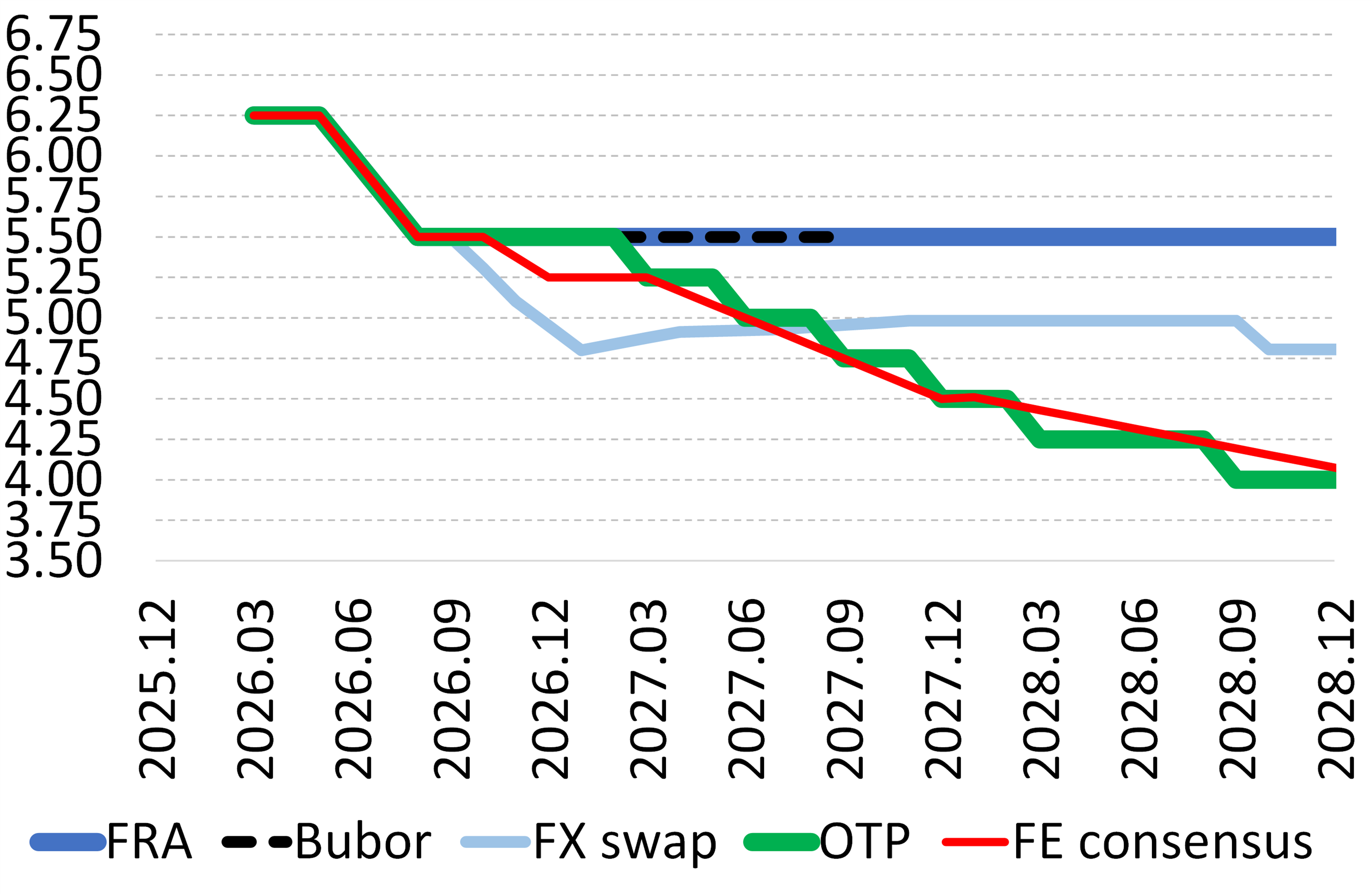
Sources: Bloomberg, OTP Research, Focus Economics, MNB
Get more out of your investments!
Global Markets Services
OTP Global Markets offers a broad range of services in the field of local and international money and capital markets.
Read morePrivate Banking Services
Personal care and expertise with OTP Private Banking, along with the knowledge, security, and innovations of a multinational banking group.
Read more