
Hungary: MNB decided to keep its policy rate at 5.5%, but some Monetary Council members voted for a cut
Related content
European Markets at Risky Levels
European stock markets have also started to pull back from levels near their all-time highs. While our screening lists continue to generate a handful of candidates, the quality of these opportunities does not yet justify a buy recommendation. In fact, a momentum-based approach is increasingly favoring short positions, making it more challenging in the coming weeks to identify long ideas that offer both outstanding upside potential and an attractive risk-reward profile. Given these unfavorable trends, we are not issuing a buy recommendation this week. It may be more prudent to remain patient and wait for a more meaningful correction, at which point attractive entry opportunities could emerge again in selected stocks.
Hungarian Equities - Technical Analysis
The BUX index has rebounded to a level where it could form a lower high. However, this would require a trading session in the coming days that reflects strong selling pressure. MOL’s share price continues to move within a downtrend, and until it breaks through the key trendline, a sustained, trend-following rally is unlikely. Richter has broken out upward from an ascending triangle pattern, so this trend-confirming formation may continue to provide room for the rally to continue. Magyar Telekom has already begun its third upward wave, which could even signal the end and peak of the current uptrend. Opus continues to move within a downtrend, while no technical signals indicating a reversal have emerged yet. Rába also continued its range-bound movement but has still not managed to break out significantly from the established consolidation range.
At its November meeting, the MNB’s Monetary Council kept its base rate unchanged at 5.50%. According to the central bank’s assessment, leeway of the monetary policy (in terms of monetary easing) has improved as a consequence of the good market perception of the government’s recent budget plans and mitigating energy prices after the US midterms, some members of the Monetary Council even voted for a rate cut, but were outnumbered this time.
The MNB's key messages:
· Risk assessment of Hungary is still favourable as markets deemed the government’s budget plans (both the one for 2027 and the midterm projections until 2030) to be in line with its ambitions to introduce the euro.
· While energy prices remained high and volatile, markets are pricing the easing of underlying geopolitical tensions based on the results of the US midterm elections. Gas prices decreased, too, but remained still much higher than before March.
· The favourable risk assessment of Hungary and the potential of easing geopolitical tensions together increase the leeway of the central bank’s monetary policy. A more thorough assessment of the situation can be expected in MNB’s Report on Inflation published in December.
· But caution is needed as the ECB and Fed faces above-target inflation throughout 2027 and are expected to further hike their interests. Also long-term interest rates – while easing somewhat in the recent weeks – are still high.
· Hungary’s headline inflation (October: 2.0%, up from 1.6% in September) reached the lower bound of MNB’s tolerance range (2.0-4.0%). The favourable inflationary developments are due to the appreciation of the HUF since the spring, though.
· GDP grew YoY by 1.5% in Q3 2026 that was mostly led by the industry, but also services performed well, while agriculture was a material drag. Unemployment is low in international comparison, and nominal wages increase dynamically, although with a decelerating pace.
· Answering a question, Governor Varga admitted that the Monetary Council’s decision was not unanimous and some members voted for a rate cut. He emphasised that the MNB will keep following its cautious and data driven approach to assess the situation. He hinted to the upcoming revisions Hungary’s sovereign rating by Moody’s, S&P and Fitch by the next decision of the Monetary Council as an important factor.
Market reactions:
· It seems that markets were surprised – not by the decision to keep the rate at 5.5% – but by Governor Varga’ comment about some Council Members voting for a cut: the HUF weakened 0.3% vis-a-vis the euro in the aftermath of the decision. There was some drops in the FRA-pricings, too: 2x5 FRA dropped from 5.48% to 5.44%, meaning that the market sees now a higher probability of a rate cut of 25 bps in December, longer FRAs decreased even more, by 10-15 bps . However, the long-term outlook did not change materially: even longer FRAs indicate the MNB’s key policy rate to be above 5.25 by the end of 2027.
Before the decision: no change in base rate was expected
· Market expectations have been steady since the end of September: pricings did not indicate any change in the recent 5.50% policy rate until the end of 2027. Consensus of experts saw some chances for rate cuts, but not for now, much more later in 2027.
Our assessment: while this time the MNB showed somewhat dowish, upside risks in inflation might steel the December-cut expected by some market participants
· The MNB’s tone was surprisingly dowish this time: not just the fact that some Council members preferred a hike over keeping, but also Governor Varga’s emphasise on stable risk assessment of Hungary, his hint to the upcoming supervision of the country’s sovereign rating and on the potentially moderating energy prices due to potential changes in the geopolitical situation.
· But at the same time, Governor Varga reiterated MNB’s data-driven approach and also referred to the publication of the December Report on Inflation that might sheed light on the underlying economic developments.
· Acknowledging that positive scenarios – with radically lowering energy prices that may have a positive impact not only the domestic inflation outlook, but the rate hikes expectations in the developed countries alongside an improvement in Hungary’s credit rating – do exist and they would facilitate a December-cut, we still see upside risks in inflation looming that could hold back MNB to hurry too much with its lowering cycle. While headline inflation of 2.0% as of October is indeed favourable, it is facilitated by the appreciation of the HUF since April and the food deflation – but this impact will run off in 5-6 months. In addition the closely watched core inflation excluding processed food inflation indicator climbed from 3% YoY in May to 3.4% YoY by October. We should also note that consumption targeting measures together with indirect and corporate tax hikes in next year may increase the probability that firms pass-through the larger share of cost-side inflation pressures stemming from elevated energy prices and an expected minimum wage hike of around 7% to the consumer prices.
· Thus, while we still see monetary policy rates in Hungary to be lower than the recent ones on the long-run in line with the euro-convergence story, but we are more cautios and we think the National Bank will continue it’s easing cycle just after the repricing at the start of the year offers a cleaner read on underlying inflation trends.
Expectations for the base rate (%)
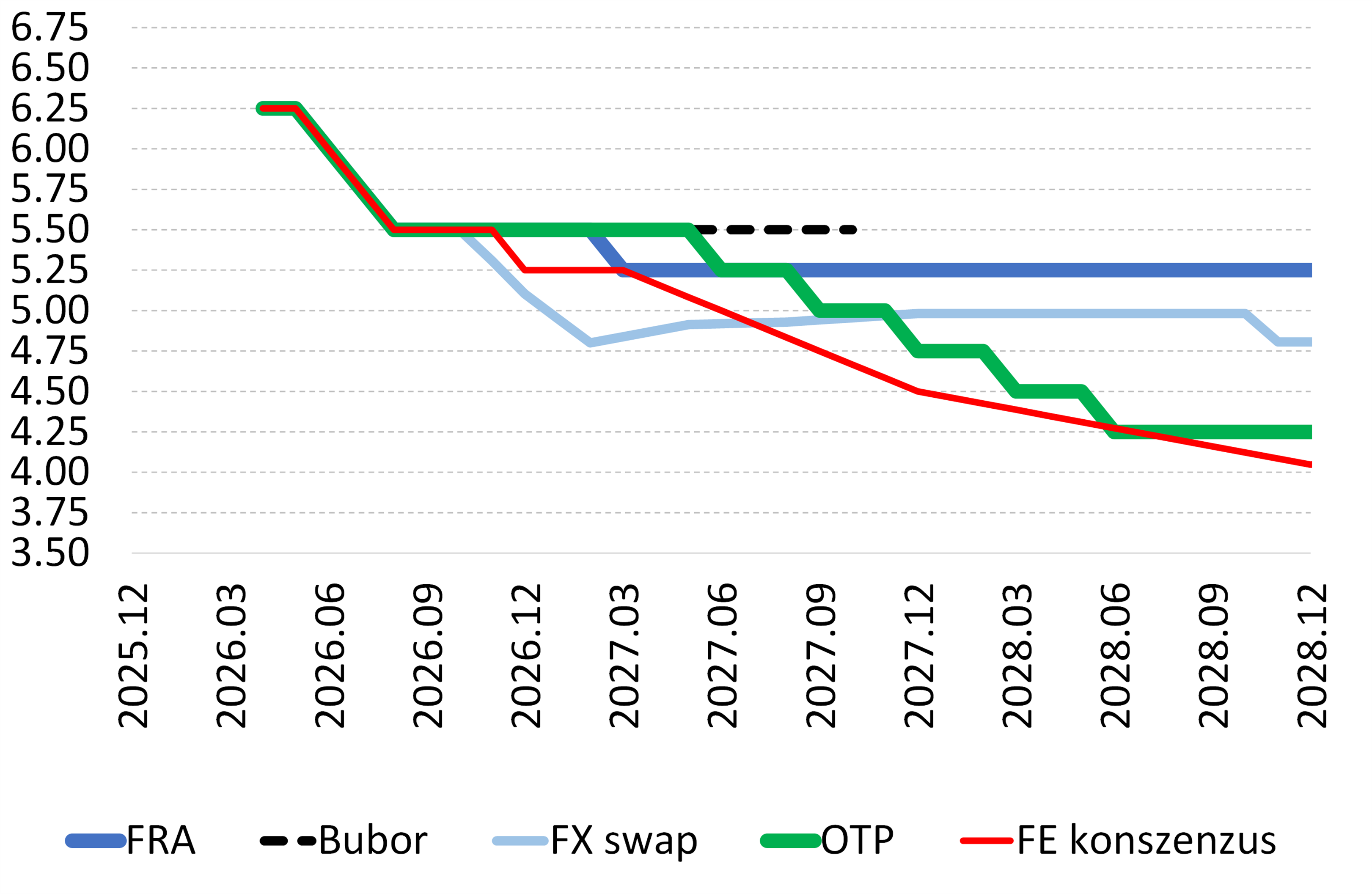
Sources: Bloomberg, OTP Research, Focus Economics, MNB
Get more out of your investments!
Global Markets Services
OTP Global Markets offers a broad range of services in the field of local and international money and capital markets.
Read morePrivate Banking Services
Personal care and expertise with OTP Private Banking, along with the knowledge, security, and innovations of a multinational banking group.
Read more