
Hungary: As expected, the MNB continued its rate-cut cycle in July; the tone remained dovish; the base rate could fall by another 75 basis points to 5.0% by the end of the year
Related content
One Step Closer to a New World: Brazil
Elections were held in Brazil in early October, during which Flávio Bolsonaro, the challenger to incumbent President Lula, performed better. The second round of the presidential election will follow in late October, when it will be decided which of the two will become Brazil’s next president. Currently, Flávio Bolsonaro appears to be the favorite to win, and based on market reactions, investors may already started pricing in this scenario. If Flávio Bolsonaro is elected president, it could pave the way for the fiscal turnaround anticipated by market participants, and relations between Brazil and the United States could also improve, which over time could even lead to lower Brazilian tariffs.
Südzucker: little sweet, little sour earnings
Südzucker, which is one of the world’s largest sugar producers and a leading player in European biofuel production, released its latest interim report, which contained both pleasant and slightly negative surprises. On the one hand, there has been a significant improvement in financial performance on an annual basis, three out of five business segments posted excellent results, and losses in the sugar production division also narrowed thanks to cost-efficiency measures. On the other hand, management raised its annual forecasts only moderately despite strong business performance, which may have disappointed some investors. However, in our view, the outlook for the sugar market remains favorable, so the sugar production segment’s profitability may improve in the coming period. Overall, we are keeping the stock on our Equity Top Pick List.
At its July meeting, as expected, the MNB’s Monetary Council cut the base rate by 25 basis points to 5.75%. There was no change in the tone of the communication compared to the previous meeting, it remains dovish.
The MNB's key messages:
· The domestic risk assessment remained favorable, and inflation was lower than expected, thus maintaining the room for maneuver in monetary policy.
· The interest rate cut cycle can continue throughout the summer, alongside the maintaining of positive real interest rates. The Monetary Council will decide the future of the interest rate path based on the September Inflation Report.
· Looking ahead, the domestic risk assessment will be shaped by the fiscal path and the adoption of the euro, as well as the developments in the conflict in the Middle East.
· Household inflation expectations have moderated since the beginning of the year, and the MNB will continue to anchor expectations by maintaining a positive real interest rate.
· A stable, predictable HUF is the interest of all members of the market.
· Decision by the Monetary Council was unanimous; no other options were discussed.
Market reactions:
· The decision was in line with expectations, so following the announcement, there was no significant movement in either the forint exchange rate or interest rate expectations. During the press conference, FRA curve shifted down by around 5 basis points and the EURHUF jumped above the 363 level, but this is partly due to unfavorable developments in the Middle East conflict. The FRAs now price the end-2026 base rate at around 5.2%, down 4 bps from its pre-decision level, suggesting that the market assessed the decision and the subsequent press conference as rather dovish. In the broader picture, interest rate cut expectations have weakened since tensions in the Strait of Hormuz escalated again, as FRA pricing seven days ago implied a 5.0% policy rate by year-end.
Before the decision: the cut was widely expected
· The MNB restarted its rate-cutting cycle in June, and in its post-decision statement, it strongly signaled that further cuts would follow in July and August. Since then, favorable inflation data has been released, coming in below both the market’s 1.8% forecast and the central bank’s short-term projection of 2%, which in itself reinforced the likelihood of additional rate cuts. In the meantime, tensions have escalated in the Strait of Hormuz, energy prices have risen significantly, and the forint has weakened.
· Since market pricing continues to reflect two rate cuts in summer, we thought that, given the favorable inflation trends, the central bank will not halt its rate-cutting cycle simply because of a few percentage points of exchange rate depreciation.
Our assessment: We still expect that the interest rate cut cycle will continue in August and the base rate could fall to 5.0% by the end of the year. The outlook for rates next year remains more uncertain and will largely depend on the government’s medium-term fiscal trajectory and the details of its euro adoption strategy.
· The statement and the press conference after the meeting confirmed our expectation that the interest rate cut cycle will continue in August and, if favourable trends persist, further cuts could follow in the autumn, so the base rate could fall to 5.0% by the end of the year and to 4.25% by the end of 2027. But the outlook for next year can change depending on the situation of the fiscal trajectory and the progress for joining ERM II.
· Before the meeting, the forint weakened due to the escalation of the conflict in the Middle East, and the unresolved conflict could lead to further depreciation of the currency. However, we believe that, in the short term, the MNB will not suspend the interest rate cut cycle in response to the forint’s depreciation, since if it were to react to even a minor depreciation by immediately halting the rate cut cycle, the market could easily interpret this as a “weak-side” pain threshold, which would not be desirable.
· The longer-term outlook has become more uncertain. In the longer term, monetary policy will be driven by the credibility of euro convergence; in this regard, the market may receive further reinforcement in the autumn with the release of the medium-term fiscal and macroeconomic outlook, as well as a potential reduction of the inflation target by the MNB. However, a renewed rise in energy prices and possibly further interest rate hikes by the ECB could slow the pace of interest rate cuts and interest rate convergence.
Expectations for the base rate (%)
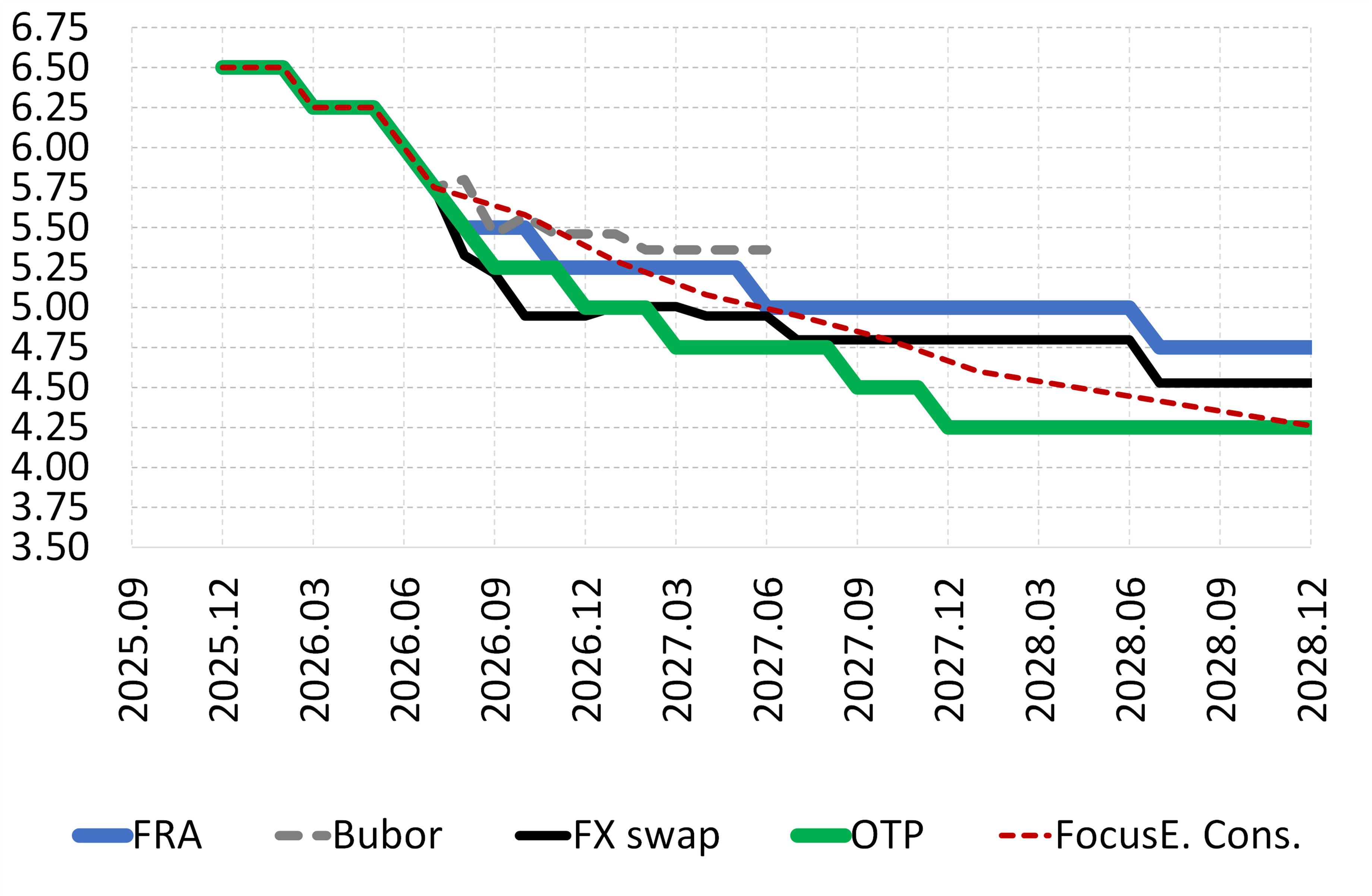
Sources: Bloomberg, OTP Research, Focus Economics, MNB
Get more out of your investments!
Global Markets Services
OTP Global Markets offers a broad range of services in the field of local and international money and capital markets.
Read morePrivate Banking Services
Personal care and expertise with OTP Private Banking, along with the knowledge, security, and innovations of a multinational banking group.
Read more