
Hungary: As expected, the MNB continued its rate-cut cycle in August; uncertainty surrounding the short- and medium-term outlook strengthened
Related content
Meta: Burning Cash on the AI Promise
Overall, Meta’s quarterly performance continues to paint a positive picture in terms of the underlying fundamentals, while the company has also achieved significant milestones on the AI model development front. However, elevated spending is taking a substantial bite out of cash generation, with free cash flow now turning negative, which may increasingly require funding through capital market financing. Following the stock’s rally in recent weeks, valuation levels have also moved higher. In the near term, these factors may continue to put pressure on the stock, although the longer-term outlook remains constructive. Naturally, much will depend on the company’s ability to effectively monetize its investment program over time.
The government plans a 4.9% deficit for next year
The government plans a 4.9% deficit for next year and will gradually reach 2.8% by 2030, under the Maastricht criteria
At its August meeting, as expected, the MNB’s Monetary Council cut the base rate by 25 basis points to 5.50%. The tone of the communication at the press conference was rather hawkish, as external risks were emphasized.
The MNB's key messages:
· Inflation was lower than projected in the baseline scenario released in June, while the risk premium on domestic assets remained stable.
· The pace of price increases may remain below the central bank’s 3% target for the rest of this year and next year.
· Domestic risk perceptions are influenced by expectations regarding the fiscal path and the introduction of the euro, as well as the external market environment.
· International and domestic factors affecting the inflation outlook will continue to be monitored with great attention.
· The high yield levels in developed markets and rising interest rate paths carry the risk of capital outflows from emerging markets.
· The risk premium on domestic assets has stabilized at a lower level.
· A decision on the future path of the base rate will be made based on the September Inflation Report.
· The MNB began reviewing its inflation target this spring and is expected to report on the results this fall.
Market reactions:
· Based on the FRA curve, interest rate cut expectations had strengthened even before the meeting during August, and before the press conference, the market was pricing in another 25-basis-point cut by the end of the year, in addition to the current one. After the press conference the FRA curve didn't change significantly; it shifted down slightly. The forint strengthened, and the EURHUF rate fell from around 363 to below 361 on the back of the rather hawkish statement.
Before the decision: the cut was widely expected
· Following its June meeting, the MNB basically announced the interest rate cuts for July and August. Although the international environment has deteriorated since then and the forint is weaker than it was at that time, the latest surprisingly low inflation figure (July: 1.2% YoY) gives strong support to further interest rate cuts in August. The question was rather just how the MNB would move forward after August.
Our assessment: We still expect that the interest rate cut cycle will continue in November and the base rate could fall to 5.0% by the end of the year. The outlook for rates next year remains more uncertain and will largely depend on the government’s medium-term fiscal trajectory and the details of its euro adoption strategy.
· The statement and press conference following the meeting gave no clear indication regarding the September interest rate decision. As expected, the MNB will decide on the future path of interest rates in light of the September Inflation Report. Compared to previous meetings, external risks were emphasized more than before. Regarding the inflation outlook, the MNB is more optimistic than earlier.
· Due to the significant downside surprise in July, when headline inflation decreased to 1.2% YoY from 1.7% in June, we lowered our CPI forecast for 2026 from 2.0% to 1.7%. We also lowered our CPI forecast for 2027 from 2.9% to 2.6%. The main question is how long the current very favourable food inflation will last. Damage from the severe drought and the shortage of fertilizers may take their toll on next year’s agrocommodity prices.
· Several factors can influence the future of the interest rate cut cycle over the rest of the year: (1) it appears that the period when the forint was able to break away from the trends seen in regional currencies has come to an end, so the question is what the fall will bring for the forint market considering the current high oil price of around 90 USD per barrel and the gas price of over 60 EUR per MWh; (2) it has already become clear that, following the review, the Ministry of Finance is projecting a budget deficit of 7.5% of GDP for this year, but next year’s budget and the related macroeconomic trajectory are still unknown, furthermore, the medium-term fiscal plan is set to be released this fall, which will outline the path necessary for the introduction of the euro; (3) it would mark a significant milestone on the path to joining the eurozone if the MNB were to announce a revision of its inflation target following this year's review.
· Overall, we continue to expect the base rate will be cut by further 50 basis points this year, with 25-basis-point cuts in November and December, following the publication of the medium-term budget outlook, assuming that the conflict in the Middle East doesn't escalate further and the market assesses the medium-term macroeconomic and budgetary outlook as credible enough to meet the euro adoption criteria by 2030. This could open the door to three additional rate cuts in 2027.
Expectations for the base rate (%)
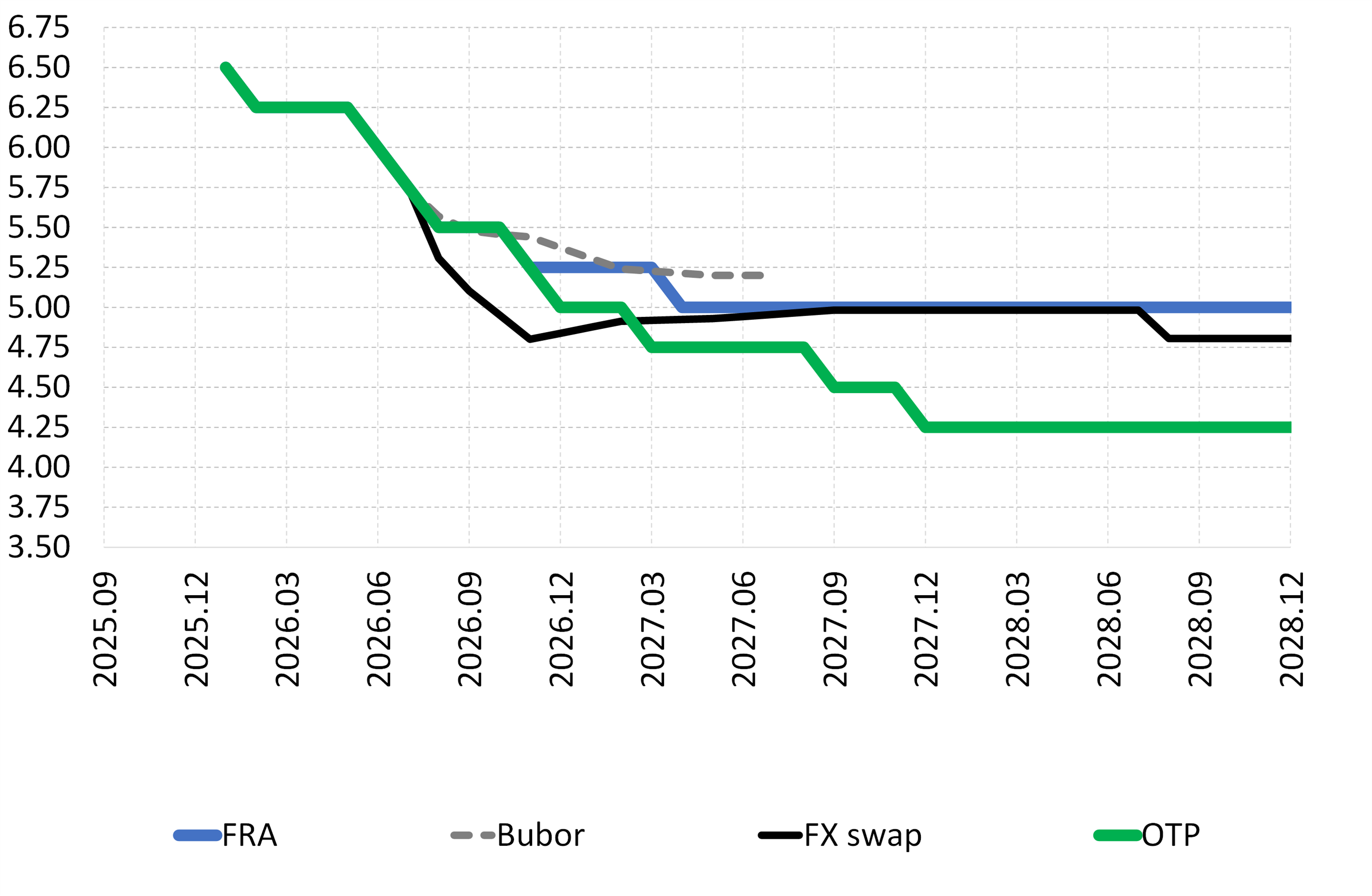
Sources: Bloomberg, OTP Research, Focus Economics, MNB
Get more out of your investments!
Global Markets Services
OTP Global Markets offers a broad range of services in the field of local and international money and capital markets.
Read morePrivate Banking Services
Personal care and expertise with OTP Private Banking, along with the knowledge, security, and innovations of a multinational banking group.
Read more