
Micron: profits soared at an incredible pace
Related content
FX - Technical Analysis
The dollar entered a corrective phase, but the euro also showed weakness during the week, meaning that the EUR/USD exchange rate has so far managed only to consolidate sideways. The dollar has entered a correction phase, but the euro has also shown weakness this week, so the EUR/USD exchange rate has so far only been able to correct within a sideways range. However, the pound has strengthened against the dollar, which means there may still be room for an uptrend within the broad range. The forint remained strong against its major counterparts. Against the euro, it may trade within a narrower range. Against the dollar, however, it reached its first target level, below which it began to consolidate. The USD/JPY exchange rate closed above its downtrend line, but still shows no signs of strength. The EUR/CHF, in a strong retest, broke below the key support level—which is not a good sign, as it should have bounced off that key level.
Hungary: MNB kept its policy rate at 5.5% while the government’s new budget stole the show
At its October meeting, the MNB’s Monetary Council kept its base rate unchanged at 5.50%. Although information on the FY27 budget and the mid-term deficit trajectory up to 2030 – key factors in Hungary’s recent euro-accession story – has been gradually released by the government since Monday, those could not be considered by MNB due to the short notice.
The earnings report from the largest U.S. memory chip manufacturer was met with heightened expectations after industry players became the biggest beneficiaries of the expansion of AI infrastructure. However, the results published after the market closed yesterday still exceeded expectations and were accompanied by a similarly strong forecast. In addition, management outlined a favorable long-term outlook, based on which it is not yet clear when the balance between supply and demand in the industry might be restored. In light of this, we continue to view the company’s fundamental outlook as strong and are maintaining it on our Equity Top Pick list.
We continue to maintain Micron on our Equity Top Pick List
Quarterly earnings report
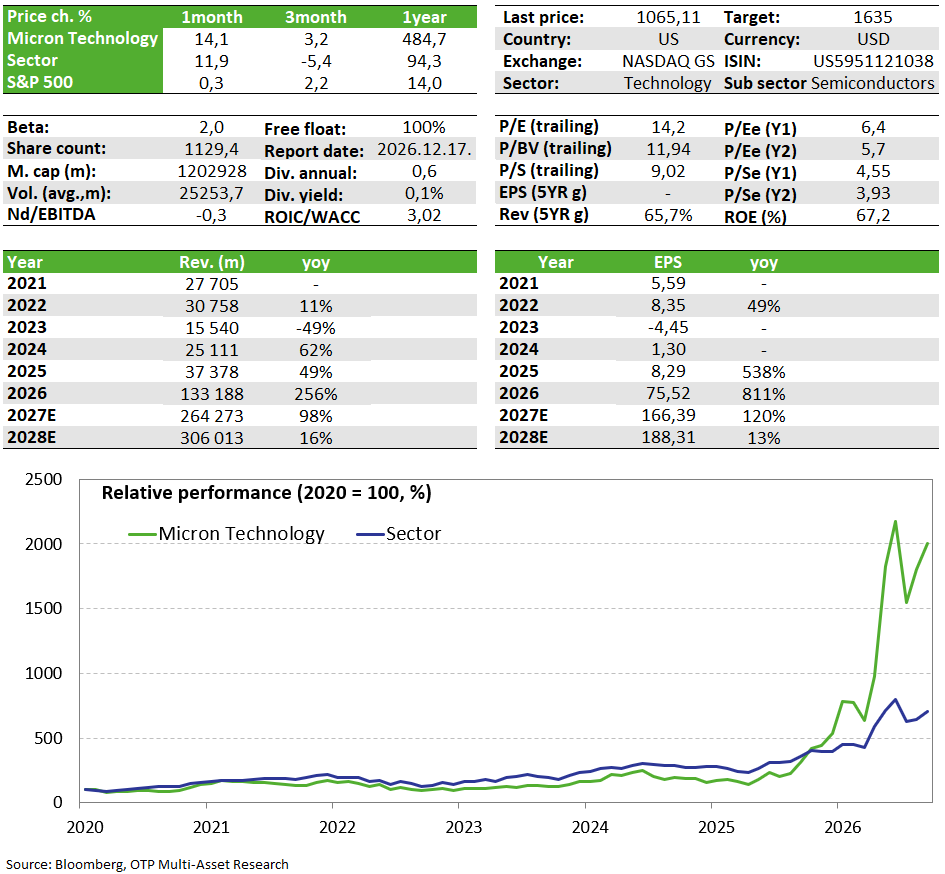
One of the best-performing stocks on the U.S. stock market this year has been Micron Technology, which has been one of the biggest beneficiaries of rising memory prices driven by strong AI-fueled demand and tight supply. In light of the company’s earnings report, investors are likely most curious about how long memory will remain one of the most significant bottlenecks in AI infrastructure and when supply might catch up with demand.
The company's revenue reached $54.2 billion in the quarter just ended, representing a 379% increase year-over-year and exceeding analysts' expectations of $51.5 billion. The primary driver of revenue growth continued to be the data center market, particularly sales related to high-bandwidth memory (HBM) chips. The rise in memory prices was primarily reflected in a significant expansion of the gross margin, which rose to 87% from 45.7% a year earlier. However, management expects a slight contraction in the current quarter (86.3% gross margin), primarily due to rising personnel expenses and higher employee incentive payments.
The company’s earnings per share rose by more than 1,000% year-over-year, exceeding the $33.4 mark and surpassing analysts’ expectations of $31.8. In the past, industry players have experienced significant declines in profitability following periods of strong profit growth, a result of the memory industry’s highly cyclical nature. To mitigate this, Micron is increasingly entering into five-year supply agreements with its customers.
The number of these agreements rose from 16 at the end of the previous quarter to 26, and management estimates that they could account for more than 35% of the company’s revenue through 2030. These strategic contracts reflect the key role of memory in AI infrastructure and other endmarkets, while providing significantly greater revenue visibility for the coming years compared to previous cycles.
In the longer term, the company’s management expects growth to continue on a quarter-over-quarter basis through 2027. In addition, strong demand driven by the widespread adoption of AI and AI agents may exceed the capacity expansions expected by 2028, meaning that the memory shortage could persist longer than previously anticipated. According to management, by the end of the decade, physical AI — primarily autonomus vehicles, followed later by humanoid robots — could be the next major driver of memory demand growth.
As for shareholder distributions, the company may reach its target cash balance by the end of the current quarter, so it is expected to increase the capital returned to shareholders after December 9, primarily in the form of share buybacks. Under the current capital allocation policy, 100% of excess cash would be returned to shareholders, which could enable the repurchase of more than 10% of the outstanding shares in 2027, thereby providing an additional catalyst for the stock..
Valuation
By comparison, the company’s shares are trading at a forward 12-month P/E ratio of just 6.3, which is lower than the typical end-of-cycle valuation range of 9 to 10 in the industry. This appears particularly favorable in light of the fact that AI-driven investments and memory chip orders point to a more enduring structural trend in demand. Although current revenue and profit dynamics — with revenue growth of 98% and earnings growth of 118% projected through 2027 — are unlikely to be sustainable in the longer term, we still consider the company’s valuation attractive, even assuming a more moderate growth trajectory, relative to both its peers and historical averages. Accordingly, we continue to see potential in the stock, so we are maintaining it on our Favored Stocks list.
Investment story
- The wave of AI infrastructure development could provide Micron with a favorable structural tailwind. The company is an indirect but increasingly important supplier to the AI ecosystem, as it supplies high-bandwidth memory (HBM) chips for the high-end server platforms of Nvidia and AMD, among others. These products are considered the company’s primary growth catalysts, but rising prices for memory chips used in simpler PCs and smartphones—driven by supply shortages—could also support growth throughout 2026.
- Beyond growth, it is strategically significant that the share of AI-related revenue is gradually increasing, which could mitigate the cyclicality typical of the memory chip industry in the company’s core fundamentals, such as revenue and gross margin. This improvement in the product mix and the resulting potential reduction in volatility across key earnings metrics could justify a valuation premium for the stock in the longer term.
- In addition, Micron is an active player in the field of data center and cloud infrastructure storage solutions, which gives it a further stake in the AI story. Furthermore, in the longer term, the company stands to benefit from the growth of numerous segments that require high computing capacity or significant data storage needs. These include, among others, self-driving vehicles, 5G smartphones, robotics, and in the future, even quantum computing – essentially any disruptive technology that relies heavily on memory-intensive infrastructure. The company is already present in some of these markets: it supplies memory solutions for automotive applications and 5G devices, and recently unveiled a new memory product – a pioneer in the industry – that is also suitable for use in space technology.
- Micron Technology places a strong emphasis on continuous innovation, which enables it to maintain its technological leadership in the memory industry, giving it a competitive advantage. In the highly concentrated DRAM market in the United States, Micron is effectively the only major player, while its main competitors are based in South Korea (SK Hynix, Samsung). This geographic positioning could be an advantage for the company, as Korean manufacturers may be more sensitive to current tariff and trade uncertainties.
Risks
For Micron, the primary risk stems from volatile fundamentals. The company exhibits strong cyclicality in both revenue and gross margin, which is also reflected in its valuation levels (a significant discount even relative to the broader market). If the current favorable supply-demand conditions were to shift toward equilibrium, it would significantly impair the company’s profitability and put pressure on its shares.
Get more out of your investments!
Global Markets Services
OTP Global Markets offers a broad range of services in the field of local and international money and capital markets.
Read morePrivate Banking Services
Personal care and expertise with OTP Private Banking, along with the knowledge, security, and innovations of a multinational banking group.
Read more